Fisher, Vories
This page presents a biography of Franklin Vories Fisher, always known as Vories Fisher.
It is part of the site Classical 'Society' Records by Nick Morgan.
From the early 1920s, Fisher worked as a stock broker in Chicago. He also collected records, and wrote about them for British and US magazines.
In 1926, Fisher and his first wife, Dorothy B. Fisher, founded a group which became the Chicago Gramophone Society. Together with fellow-member Robert Pollak, Fisher was responsible for commissioning the U.S.A.'s first known subscription records, issued by the Society in 1927.
In 1928 Fisher ceased writing about records. The Chicago Gramophone Society also disappeared from public view.
In the 1930s, Fisher changed career and worked as a professional photographer until his retirement.
For dates of creation and latest update, please see 'Page information' in left sidebar.
Life
Born 23 May 1901, Chicago, Illinois, USA[1]
Married 28 October 1924, Dorothy Button, Chicago
Divorced date unknown
Married 13 April 1943, Florence Gertrude Armstrong, Chicago
Children 12 September 1943, daughter (still living). 17 December 1944, daughter (still living). Both born Chicago
Died 31 December 1969, Chicago
Studies
Fisher was the only child of George Franklin Fisher Jr. (1876-1942), manager of a laundry, later President of the Hyde Park Laundry Company and an officer of the Illinois Laundry Owners' Association;[2] and Grace Elizabeth Vories (1877-1959), born into an affluent family prominent in the baking industry.[3] The Fishers were reportedly conservative and not artistic; Vories' personality, artistic, altruistic and progressive, was in noted contrast to theirs.[4]
Vories attended Hyde Park High School in Chicago, and then the University of Chicago, 1918-1922, graduating as a PhB (Bachelor of Philosophy).[5] At university, Fisher was very active in student drama: he was a member and officer of the Dramatic Club, acting in many of its productions and directing some, and finally becoming its President.[6] As well as acting in plays put on by other groups, in May 1922 Fisher played a reporter in Bartlett Cormack's highly successful Anybody's Girl, mounted by the Blackfriars, the student musical comedy society.[7] His appearance in the role was captured in a contemporary photograph: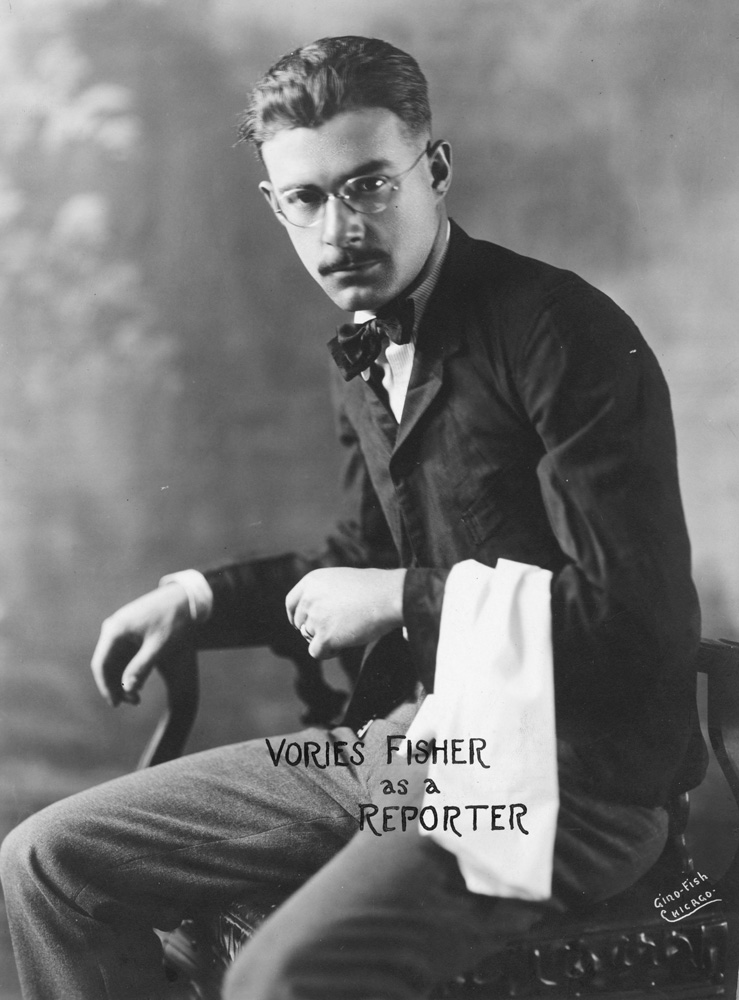
(University of Chicago Photographic Archive, apf4-03050, Special Collections Research Center, University of Chicago Library)
It was possibly through the Blackfriars that Fisher met Robert Pollak, who was closely involved in its 1923 and 1924 productions (although Fisher is not known to have joined the society). Later, they would be fellow-members of the Chicago Gramophone Society and co-sponsors of its two recorded issues. In 1924, after graduating, Fisher acted in the University's annual Christmas 'Revels', put on by the faculty Quadrangle Club;[8] Pollak also contributed to the Revels for several years, although his early involvement is not documented. But Fisher also belonged to an unofficial student society, the 'Green Chalybeate', whose 'Supreme Calyb' was Fisher's friend John Gunther, and some of whose antics Pollak witnessed and later chronicled.[9] Finally, Fisher was also a member of the Score Club, a sophomore honour society.[10]
Fisher did not study music academically or privately, did not learn or play an instrument, and, according to his daughter, 'could not carry a tune'. But he had attended orchestral concerts in Chicago as a child, and became a life-long lover of classical music and opera.
Early employment
After completing his studies in the summer of 1922, Fisher sailed for Europe on a cattle boat with friends, including John Gunther, later author of the celebrated Inside— books. Together they visited several European countries. On his return, Fisher found employment in Chicago's financial sector. He reportedly did not enjoy this work, and had to rein in his bohemian tendencies. Years later, he told the Chicago Sunday Tribune that
'he shaved the beard he had grown while traveling to Europe with John Gunther [...] "In the financial world then one just didn't wear a beard!"'[11]
It is not known which firm or firms Fisher initially worked for. Possibly he went into business on his own account (see below). He apparently enjoyed a reasonable income: he was able to afford to buy many relatively expensive records, some imported from abroad, and to travel again to Europe with his wife.
The Gramophone
The earliest known evidence of Fisher's interest in recorded music comes from The Gramophone. In 1925 and 1926, Fisher had three contributions published in the British magazine, to which he was probably an early subscriber:
- 'Polydor Records' (letter), The Gramophone, Vol.III No.1, June 1925, p.40
- (with Dr. Kenneth E. Britzius) 'List of Recorded Music of Richard Strauss', The Gramophone, Vol.III No.4, September 1925, p.183
- (with Dr. Kenneth E. Britzius) 'Recorded Music of Debussy', The Gramophone, Vol.III No.12, May 1926, p.563
Fisher's letter was written in response to a request by the Editor of The Gramophone for readers' opinions of orchestral works issued on Polydor,[12] the export label of Germany's Grammophon company, which had only recently become available in Britain. Fisher had to import Polydor records to the USA, presumably at considerable expense; still, he did not let this affect his judgement, but offered perceptive, honest and trenchant evaluations of them.
Fisher's other two contributions are remarkable as early efforts at discography, compiled jointly with a fellow-collector from Minneapolis. Fisher was an admirer of Richard Strauss's music, and probably owned many of the large number of records listed, which again included many imports.[13] (Fisher later credited the Tulsa architect Bruce Goff with having compiled a discography of Debussy;[14] this may have formed the basis of the list submitted to The Gramophone by Fisher and Britzius.) These contributions confirm Fisher's later statement, made in a letter to a US magazine, that he had been collecting records for some time, possibly since 1922 or so.[15]
The Gramophone published no further contributions by Fisher. But it almost certainly suggested to him the ideas both of forming a gramophone society, and of financing and selling records by subscription. The magazine's very first number had included an article on 'How To Start A Gramophone Society', and two pages of reports of the activities of existing societies in London, Glasgow and on Tyneside.[16] From then on it carried these reports in almost every issue for several years. Meanwhile, its Editor, Compton Mackenzie, had mooted and successfully launched a subscription record label, the National Gramophonic Society (N.G.S.).[17] This innovative venture also quickly attracted subscribers in the US, some of whom were named in the Society's frequent reports and notices in The Gramophone, its mouthpiece.[18] As it happens, Fisher was not among those named, and clear evidence for his membership is lacking, but the N.G.S. was certainly Fisher's model for the Chicago Gramophone Society.
In 1927, as the first issue was being distributed to members, Fisher and his wife visited the magazine's editorial office in London, and spent the best part of a day with its London Editor, Christopher Stone, who was also the N.G.S. Secretary. Back in the US, Fisher published an account of his visit, noting with obvious excitement that 'in the not too distant future the N.G.S. records will be made available in this country.'[19] He also sent a copy of the Chicago Gramophone Society's first issue to The Gramophone; it was acknowledged in the magazine but not reviewed.[20]
The Phonograph Monthly Review
In the autumn of 1926, a publisher in Boston, Massachusetts, launched a new magazine. Clearly and closely modelled on The Gramophone, The Phonograph Monthly Review aimed to emulate the British magazine's successful role as an independent intermediary between US consumers and producers of recorded music. Just as the The Gramophone had, the new magazine tapped into enthusiastic (if small and disparate) fraternities of record-buyers and collectors. It also acted as a forum for and advocate of a US gramophone society movement.
The Phonograph Monthly Review was a natural home for Fisher. From the first issue until mid-1928, his writings appeared regularly in its pages. Fisher's contributions were of six types, of which he was probably paid for the first three:
- 'Is Your Favorite Work Recorded?', a series of discussions and reports of the work of the magazine's Contest Committee
- 'Recorded Remnants', a regular column of personal observations and musings
- Record reviews
- Miscellaneous, free-standing editorial articles, including contributions to the magazine's 'forum'
- Phonograph society reports
- Letters
These are considered in more detail below.
Contests
The first issue of The Phonograph Monthly Review introduced Fisher to readers in glowing terms:
'Mr. Fisher [...] is a phonograph and musical connoisseur of long standing all over the country. One of the leading phonograph enthusiasts and delightful personalities in the Middle West, we are proud to have him for our Chicago representative and for the Chairman of our Contest Committee. No better man could be selected to conduct this significant and important contest.'[21]
The contest in question was designed to canvas readers' nominations for the works they most wished to own in recorded form, and to put these nominations to the readers' vote. The magazine claimed that 'the leading recording companies in this country have shown themselves more than willing to co-operate', and were 'ready to record any work for which there is shown a demand.' (This contest was clearly inspired by those run by The Gramophone, from early in 1924.[22]) A second contest was also planned, to determine the best playback equipment, again by vote.
Neither of these contests came to fruition. The second was never mentioned again. The first was introduced by Fisher in November 1926, in an article which set out the contest's aims and basic rules. Fisher displayed a businessman's pragmatism, and showed awareness of the sometimes fraught relations between specialist collectors and record companies. Possibly he himself had been on the receiving end of such reactions, and he surely heard reports of them from fellow-collectors:
'The demands and suggestions of the few enthusiasts who do write into the companies' Repertory Managers have usually been so extreme and impractical in nature that the companies are prone to view all suggestions with disfavor. [...] The support and co-operation which the major companies have given us have been unstinted. [...] We must be exceedingly careful not to take undue advantage of such an offer. We must not kill the goose that lays the golden eggs.'[23]
Fisher was apparently swamped by letters containing long lists of suggestions: his next four 'contest' articles were devoted almost entirely to these, sometimes quoting them at length. Only in March 1927 were detailed rules for the contest and a voting form promised, but neither materialized.[24] In April or May 1927, Fisher and Mrs. Fisher left Chicago for a tour of Europe. In Fisher's absence, management of the contest was delegated to the Contest Committee's Assistant Chairman, George S. Maynard of the Boston Public Library (the only other Committee member ever named or alluded to in the magazine).[25] Two months later, a new contest was launched, titled 'The Sacrifices I Have Made To Obtain Good Records'.[26]
Once home from Europe, Fisher resumed duty as Contest Committee chairman, but from now on he wrote mainly, and very briefly, about the new 'Sacrifices' contest. By the end of 1927, he was probably unable to devote enough time to administering and adjudicating the contests; November saw the last article on the original contest, not signed by Fisher, although possibly written partly by him.[27] In the same month, an interim report on the 'Sacrifices' contest stated that it would be judged by record company officials, although Fisher remained 'the court of final decision'. This was the last mention of Fisher in this capacity.[28] In December 1927 the Editor announced that the original 'Favorites' contest would be dropped:
'after counting up the recent releases of major works, it begins to look as if there was hardly anything left to "contest" about any longer!'[29]
The 'Sacrifices' contest remained open, but adjudication was considerably delayed,[30] and the winner was only announced many months later, in May 1928.[31]
If the contests were, in the final analysis, unsuccessful, they may have played a part in shaping the Chicago Gramophone Society's recording programme, by confronting Fisher with some problems of planning by plebiscite - the difficulty of pleasing everyone, and the indecision brought on by excessive choice. It was perhaps no coincidence that, for the Society's first issue, Fisher and Robert Pollak adopted a diametrically opposite policy: one artist, one work, no choice.
'Recorded Remnants'
This column was Fisher's most extensive contribution to the Phonograph Monthly Review: from February 1927 onwards, eleven instalments were published. At the start, Fisher made it clear that these were his personal musings and reactions to news, trends, gossip and rumours in the music world and recording business.[32] They add up to a valuable self-portrait of an early gramophile, voraciously curious, a little obsessive (by his own admission), opinionated but open-minded and observant. The series ended in May 1928, with what would prove to be Fisher's last words in the Phonograph Monthly Review.[33]
Reviews
The Phonograph Monthly Review published just one review by Fisher, of the US issue of Beethoven's Symphony No.9 in d Op.125, conducted by Felix Weingartner and recorded in London by Columbia.[34] Fisher's capabilities were many and varied, but reviewing records, a specialised task which entails considerable drudgery, seems not to have been congenial to him. His effort was probably judged not to have been a success, and rightly so; the magazine had a better reviewer on its roster, Robert Donaldson Darrell (1903-1988), who would become one of the USA's most respected record critics.
Miscellaneous articles
The Phonograph Monthly Review published a submission by Fisher to its planned 'Open Forum' for 'Suggestions to the Manufacturer and Dealer'.[35] It stimulated a lively, at times acrimonious debate, and is considered with Fisher's letters, below. The Review also planned to publish an article by Fisher on the life and music of Modest Musorgsky. This did not materialize, probably because Fisher used it as the basis for a talk to the Chicago Gramophone Society which was printed in the magazine, seemingly in its entirety, although the planned article would probably also have included a discography.[36]
Phonograph society reports
The Phonograph Monthly Review's first issue included a preliminary report by Fisher on what would become the Chicago Gramophone Society;[37] thereafter, the duty of writing the Society's reports fell to the Secretary, L.J. Harris. One report was left unsigned.[38] Another contained a substantial piece of writing by Fisher: a talk of nearly 4,000 words on the life and music of Modest Musorgsky, illustrated with recordings of excerpts from the opera Boris Godunov. It was given at a meeting of the Chicago Gramophone Society on 18 January 1927, and was reportedly based on an article originally intended for the Phonograph Monthly Review.[39]
Letters
Fisher's passion for his hobby could land him in hot water. The second number of The Phonograph Monthly Review included a submission by Fisher to its 'Open Forum' for 'Suggestions to the Manufacturer and Dealer'. Comparing record shops and their sales personnel with booksellers, highly unfavourably, Fisher claimed that when he could not find something in a bookshop, 'where the emphasis is laid on the more worthwhile literature of all nations [...] the intelligent salesman' would know of it, would order it for him, and might recommend something else in the meantime. Whereas:
'The shop handling recorded music seems to have no interest in any records aside from those on their shelves. No interest? Let me say no knowledge. The person who waits on you may know a particular catalogue, but only as such; he will never know it as to the Debussy records contained, as to the Brahms that is available. [...] I should be able to go into a shop and ask, for example, "What has been recorded from Boris?" "What Beethoven Quartets are made?" and I should get at once a complete answer. The record collector is not interested in only the Victor records from Boris but rather all those available.'[40]
Fisher was clearly unaware of the very different distribution models prevalent in the book and record trades. Towards the back of the same issue was a measured but heartfelt open letter from 'A Dealer', to whom Fisher's tirade must have been shown before publication:
'Dear Enthusiast: [...] There is one thing that you are prone to forget, – that is, that I am in business to make a living. Records are not simply things to enjoy for me (although I do get enjoyment from them as well as you) but they are my stock in trade. If I don't sell them, I don't eat, to put the matter in its crudest light. Yet you and others, through thoughtlessness alone, I am sure, often hurt me financially.'[41]
Three issues later, the magazine printed a more combative response from 'S.K.', a retailer in New York:
'As usual, it seems to be we dealers who come in for all the blame. I have been in the game for many years and [...] always the dealers were at fault for everything wrong in the eyes of the so-called enthusiasts. It sounds fine to talk about keeping all these wonderful things in stock [...] but it doesn't make any money. [...] the few of my customers who really like the classical stuff certainly do keep coming back for more. But [...] the "jazz-hounds" are the ones that keep me alive. They may throw their records away after a week or two but that's none of my business. There are enough of them to keep me busy.'[42]
Perhaps unwisely, 'S.K.' added a jibe at those who claimed to like 'Strangle-insky', and drew a passionate rejoinder from Fisher, the following month.[43] Others joined the fray and the correspondence dragged on, somewhat inconclusively, with Fisher making one further, conciliatory contribution, months later.[44]
In Britain, The Gramophone had headed its correspondence column with the Latin tag 'De Gustibus Non Est Disputandum' as early as its sixth issue.[45] This did not prevent spats between readers, which the Editors often had to put a stop to. (The parallel with modern internet 'flame wars' is striking.) As it happened, Fisher would be proved right. Effectively, his original 'Open Forum' submission and subsequent letters argued for more specialization and segmentation in retail, for more and better information for both sellers and buyers, and for better-trained salespeople. In The Gramophone, British record-buyers clamoured for exactly the same things; and the trade responded positively, on both sides of the Atlantic.
Again, as with the The Phonograph Monthly Review contest, this episode may have helped to convince Fisher that it was not possible, or at least very time-consuming, to achieve consensus in the intensely personal world of musical taste.
The Phonograph Monthly Review published one other letter from Fisher, providing a fellow-reader with information about recordings made by the German pianist Walter Gieseking for Germany's Homocord label.[46]
Chicago Gramophone Society
Fisher's involvement with the Chicago Gramophone Society lasted from 1926, when the group was formed by his wife and him, until its sudden disappearance in mid-1928. It is examined in detail on the relevant page of this site.
Later employment
By 1928, Fisher had his own securities and investment firm in Chicago, Vories Fisher & Co.[47] His workload may have contributed to the lessening of his interest in and time for record-collecting.
Fisher's firm survived apparently survived the 1929 Crash.[48] By 1932 it had taken on a new partner, to become Vories Fisher, Marr & Co.;[49] but it seems to have been dissolved soon afterwards.[50]
In January 1937, a new firm, Fisher, Schmick & Watts, Inc., 'an investment banking business', was formed, with Vories Fisher as Secretary.[51] Within a year, the firm was effectively absorbed by another, and presumably ceased to trade.[52]
At an unknown date, Fisher became a professional photographer. He perhaps pursued his new career in parallel with the old, building up expertise and contacts. Ultimately, he quit the financial world completely.
In 1940, according to a later reminiscence, he
'spent months photographing old southern plantations in Louisiana. He crept thru the bayous from New Orleans to St. Francisville snapping more than 35 ante-bellum mansions to be used in travel folders of the Illinois Central railroad. [...] "I felt strong about that plantation business," he said recently. "Those homes are representative of a way of life that was unique in this country."'[53]
It was through photography that Fisher met his second wife, Florence, who was also a photographer, specializing in portraits. They were married in 1943. She later gave up her work to be a full-time housewife and mother.
From 1943, Fisher's work was regularly published in Life magazine.[54] In 1946, the Chicago Sunday Tribune reported that Fisher and three other photographers had remodelled a 'fine old mansion' on La Salle Street as 'a modern plant for their work'.[55] As well as working for corporate clients,[56] Fisher undertook assignments for the University of Chicago, photographing faculty members and scenes of teaching and student life; his images can be seen in the University's online photographic archive. Fisher's work was also published in newspapers such as the The Cincinnati Enquirer,[57] and magazines such as The Farm.[58]
By 1949, Fisher was official photographer to the Chicago Museum of Science and Industry, a position he still held in 1960.[59] That year, the Chicago Daily Tribune reported plans for a public exhibition of his 1940 photographs of Louisiana's ante-bellum mansions, many of which had been destroyed in the two intervening decades.[60]
In the 1950s, Fisher gave lectures on photographic practice and technique at the Museum, the University of Chicago, the YMCA and other venues.[61]
At an unknown date, Fisher became official photographer to Chicago's Goodman Theater, a position he reportedly held for 17 years.[62] In 1961, Fisher's photographs of ante-bellum mansions were again exhibited, at his place of work, the Museum of Science and Industry.[63] Later during that decade, Fisher left the Museum to became head of the photography department of Presbyterian-St. Luke's Hospital in Chicago.[64]
In the mid-1960s, Fisher very occasionally broadcast on Chicago's AM station WBBM.[65]
Charitable and other activities
Fisher was for many years actively involved with the Parent-Teacher Association of his alma mater, Hyde Park High School.[66]
From at least 1960, possibly earlier, Fisher was a volunteer officer of Child and Family Services, a welfare organization in Chicago; he was later its president.[67]
Hobbies
In the 1930s, Fisher and his first wife maintained a second home near Nashville, Brown County, Indiana. Fisher took up hunting to hounds and was Master of Hounds of the Hunting and Kennel Club of Gnaw Bone, Indiana.[68] One one occasion in 1934, he had 'charge of the [shooting] traps at which Kurt Vonnegut won the cup given by the M.F.H. [Master of Hounds]'; the winner was the father of the writer Kurt Vonnegut Jr.[69] Fisher also reportedly managed Nashville's baseball team for a time.[70]
It was on holiday in Indiana that Fisher was introduced to his greatest avocation in later life, when he was fascinated by a loom used to make rag carpeting.[71] In a letter to the Chicago Daily Tribune, published in 1955, he wrote
'I have been a hand weaver for over 20 years. I have woven on all types of looms from the old Colonial clunker [...] to the most modern of Swedish and American foot power looms. I have woven all kinds of materials from simple rag rugs on two harnesses to complicated 16 harness damask and double faced twill. [...] Several years ago I was forced to give up weaving for the simple reason that I did not have the room to house the big floor looms [...] A couple of years ago I heard about this new tubular aluminum loom. I was frankly skeptical. [...] I have now used this modern tubular aluminum loom for some two years, and I can say without equivocation that I would have no other!'[72]
After some years, Fisher decided to weave only woollen cloth and tweed for clothing, using hand-dyed yarn which he obtained from Uist in Scotland's Western Isles.[73] He dressed his wife and daughters in his cloth, and he supplied his tweed to Chicago outfitters, who made it up into men's suits.[74]
Fisher retained his love of classical music all his life. His daughters remember him conducting the broadcast performances which he listened to via Chicago's WFMT station. He did not remain a record collector; there were records in the Fisher household, but far fewer than at the height of his collecting craze in the early 1920s.
After his death, Fisher was described in a tribute as
'a "rugged individualist", a "Renaissance man." [...] who could wear a corduroy suit, red flannel shirt and bow tie to an exclusive restaurant for lunch.'[75]
Images
Vories Fisher, 1945 (Getty Images)
(This photograph may have been taken by Fisher's second wife Florence, a portrait photographer)

References
- ↑ Biographical data for Fisher and family retrieved from birth, death, census, travel and other documents, accessed via ancestry.co.uk, except where noted; additional details of Fisher's early life, education and personality kindly supplied by Fisher's daughter, whose generous and patient help are very gratefully acknowledged (personal communications, June 2017)
- ↑ 'Sober Is Head Of Laundry Owners', The Decatur Herald [Decatur, Illinois, Saturday 24 March 1928, p.24; 'George Fisher Pays $250,000 For Laundry', Chicago Sunday Tribune, Sunday 19 May 1929, Part 3, p.2; 'Death Notices', Chicago Daily Tribune, Wednesday 18 November 1942, Section Two, p.28
- ↑ 'Week Of Weddings', The Sunday Inter Ocean [Chicago, Illinois], 12 June 1898, p.17; 'Harry F. Vories Funeral Rites To Be Tomorrow', Chicago Sunday Tribune, 16 August 1931, Part 1, p.16; 'Death Notices', Chicago Daily Tribune, Wednesday 22 April 1959, Part 3, p.[12]
- ↑ Information kindly supplied by Fisher's daughter (personal communications, June 2017)
- ↑ 'Alumni News', University of Chicago Magazine, Vol.LXII No.4, January 1970, pp.36-44
- ↑ 'Dramatic Club Elects Seven Candidates To Associate Membership', The Daily Maroon [University of Chicago], Vol.XVII No.23, 8 November 1918, pp.[1]-2; 'Dramatic Club', Cap & Gown (University of Chicago Junior Class yearbook), Vol.27, 1922, pp.210-13
- ↑ Bird, Harry Jr. 'News Of The Quadrangles', University of Chicago Magazine, Vol.XIV No.7, May 1922, p.256; see also 'Large Audience Applauds Plays by Chicago Authors', Chicago Daily Tribune, Tuesday 2 May 1922, Section One, p.25 (Fisher is not named in this report)
- ↑ 'Alumni Affairs', University of Chicago Magazine, Vol.XVI No.3, January 1924, pp.87-90
- ↑ Pollak, Robert 'Continental Footnotes', University of Chicago Magazine, Vol.31 No.3, December 1938, pp.8-9, 20; id 'Those Were the Days', ibid., Vol.60 No.1, October 1967, pp.4-7
- ↑ 'Score Club', The Daily Maroon [University of Chicago], Vol.17 No.108, 14 May 1919, p.[1]
- ↑ Page, Eleanor 'Does a Beard Add to Manly Charm?', Chicago Sunday Tribune, Vol.CXIII No.39, 20 July 1958, Part 7, p.4
- ↑ 'The Polydor Catalogue', The Gramophone, Vol.II No.10, March 1925, pp.373-74
- ↑ [Fisher,] Vories 'Recorded Remnants', The Phonograph Monthly Review, Vol.1 No.6, March 1927, p.274
- ↑ [Fisher,] Vories 'Recorded Remnants', The Phonograph Monthly Review, Vol.1 No.5, February 1927, p.215
- ↑ Fisher, Vories untitled letter, The [Music Lovers'] Phonograph Monthly Review, Vol.1 No.12, September 1927, pp.511-12
NB from Vol.1 No.10, July 1927, to Vol.2 No.1, October 1927 (inclusive), the Review carried the new, long title on its cover but not on its mast-head; from Vol.2 No.2, November 1927 (inclusive) onwards, it carried the long title on the cover and mast-head - ↑ Rogers, Wm. J. 'How To Start A Gramophone Society', The Gramophone, Vol.I No.1, April 1923, pp.10-11; (various authors) 'Gramophone Societies' Reports', ibid., pp.11-13
- ↑ On the background, launch and early months of the N.G.S., see Morgan, Nick The National Gramophonic Society, Sheffield: CRQ Editions, 2016, §2.4, pp.51-60
- ↑ '[...] records are already being sent to America, China, Australia, South Africa, Egypt, and even Turkey.': 'National Gramophonic Society Notes', The Gramophone, Vol.II No.8, January 1925, p.294; among early US members of the N.G.S. was Fisher's fellow-discographer, Dr. Kenneth Britzius of Minneapolis, see e.g. 'National Gramophonic Society Notes', The Gramophone, Vol.III No.2, July 1925, p.80
- ↑ [Fisher,] Vories 'Recorded Remnants', The [Music Lovers'] Phonograph Monthly Review, Vol.1 No.11, August 1927, pp.462-63
- ↑ 'Trade Winds and Idle Zephyrs', The Gramophone, Vol.5 No.4, September 1927, pp.171-72
- ↑ 'Is Your Favorite Work Recorded Coming Contests Conducted by Vories Fisher', The Phonograph Monthly Review, Vol.1 No.1, October 1926, p.23
- ↑ e.g. Mackenzie, Compton 'Editorial', The Gramophone, Vol.I No.8, January 1924, p.[146], and Mackenzie, Faith [as 'F. Sharp'] and Mackenzie, Compton 'The Symphony Competition', The Gramophone, Vol.I No.10, March 1924, pp.202-03
- ↑ Fisher, Vories 'Is Your Favorite Work Recorded', The Phonograph Monthly Review, Vol.1 No.2, November 1926, pp.28-29
- ↑ Fisher, Vories 'Is Your Favorite Work Recorded?', The Phonograph Monthly Review, Vol.1 No.3, December 1926, pp.119, 122; 'Is Your Favorite Work Recorded?', ibid., Vol.1 No.4, January 1927, pp.177-78; 'Is Your Favorite Work Recorded?', ibid., Vol.1 No.5, February 1927, p.218; 'Is Your Favorite Work Recorded?', ibid., Vol.1 No.6, March 1927, p.252
- ↑ 'Is Your Favorite Work Recorded?', The Phonograph Monthly Review, Vol.1 No.7, April 1927, p.299
- ↑ 'As announced in the April issue...' (untitled notice), The Phonograph Monthly Review, Vol.1 No.9, June 1927, p.396
- ↑ 'Is Your Favorite Work Recorded?', Music Lovers' Phonograph Monthly Review, Vol.2 No.2, November 1927, pp.56-58
- ↑ 'Prize Contest', Music Lovers’ Phonograph Monthly Review, Vol.2 No.2, November 1927, pp.65-66
- ↑ Johnson, Axel B. 'General Review', Music Lovers' Phonograph Monthly Review, Vol.2 No.3, December 1927, pp.[81]-84
- ↑ 'Prize Sacrifice Contest', Music Lovers' Phonograph Monthly Review, Vol.2 No.6, March 1928, p.204
- ↑ 'Prize Contest Awards', Music Lovers' Phonograph Monthly Review, Vol.2 No.8, March 1928, p.292
- ↑ [Fisher,] Vories 'Recorded Remnants', The Phonograph Monthly Review, Vol.1 No.5, February 1927, p.215
- ↑ [Fisher,] Vories 'Recorded Remnants', Music Lovers' Phonograph Monthly Review, Vol.II No.8, May 1928, p.298
- ↑ Fisher, Vories 'Beethoven's Ninth Symphony... (review), in 'Analytical Notes and Reviews', The Phonograph Monthly Review, Vol.1 No.1, October 1926, pp.34-47
- ↑ 'Suggestions to the Manufacturer and Dealer', The Phonograph Monthly Review, Vol.1 No.1, October 1926, p.23; V[ories].F[isher]. 'Suggestions to the Dealer', ibid., Vol.1 No.2, November 1926, p.27
- ↑ Harris, L.F. [sic, recte L.J.] 'Chicago Gramophone Society', in 'Phonograph Society Reports', The Phonograph Monthly Review, Vol.1 No.6, March 1927, pp.269-74
- ↑ Fisher, Vories 'Chicago Phonograph Society', in 'Phonograph Society Reports', The Phonograph Monthly Review, Vol.1 No.1, October 1926, pp.32-34 (the title of this report was probably an error)
- ↑ 'Chicago Gramophone Society', in 'Phonograph Society Reports', The Phonograph Monthly Review, Vol.1 No.5, February 1927, pp.224-27
- ↑ Harris, L.F. [sic, recte L.J.] 'Chicago Gramophone Society', in 'Phonograph Society Reports', The Phonograph Monthly Review, Vol.1 No.6, March 1927, pp.269-74
- ↑ 'Suggestions to the Dealer', The Phonograph Monthly Review, Vol.1 No.2, November 1926, p.27
- ↑ 'A Dealer' 'An Open Letter to a Phonograph Enthusiast', The Phonograph Monthly Review, Vol.1 No.2, November 1926, p.46
- ↑ 'S.K.' 'Open Forum', The Phonograph Monthly Review, Vol.1 No.5, February 1927, p.213
- ↑ Fisher, Vories 'Having only looked over...' (letter), The Phonograph Monthly Review, Vol.1 No.6, March 1927, p.258
- ↑ Fisher, Vories 'S.K., my silence has not been...' (letter), The [Music Lovers'] Phonograph Monthly Review, Vol.1 No.12, September 1927, pp.511-12
- ↑ 'Correspondence', The Gramophone, Vol.I No.5, October 1923, pp.117-19
- ↑ Fisher, Vories 'I am glad to be able to help...' (letter), The Phonograph Monthly Review, Vol.1 No.8, May 1927, p.353
- ↑ 'We are pleased to announce...' (notice), Chicago Daily Tribune, Monday 17 September 1928, Section Two, p.32
- ↑ 'Business Personals', Chicago Daily Tribune, Friday 14 March 1930, Part Two, p.25, and Thursday 4 February 1932, Section Two, p.26
- ↑ 'Hartley Rogers Investor House Extending Field', The Los Angeles Times, Thursday 22 December 1932, Part I, p.11
- ↑ 'Vories Fisher, who was formerly head of the Vories Fisher & Company, one of the well known Chicago trading houses...': 'Opens Chicago Trading Office', The Los Angeles Times, Sunday 30 June 1935, Part V, p.[1]
- ↑ 'Business Bits', Chicago Daily Tribune, Wednesday 20 January 1937, Section Two, p.29
- ↑ 'We are pleased to announce...' (notice), Chicago Daily Tribune, Monday 3 January 1938, Finance Commerce section, p.24
- ↑ Bach, Erwin 'Photographer Tells His Secret', Chicago Daily Tribune, Thursday 27 October 1960, Part 5, p.11
- ↑ Fisher's earliest known credit is for one photograph in 'Farming For War', Life, Vol.14 No.4, 25 January 1943, pp.81-89, on p.82, bottom left (picture credit on p.17); his latest known credit is for one photograph in 'A Vivid Moment in Time by Degas', Life, Vol.39 No.19, 7 November 1955, p.119 (picture credit on p.2)
- ↑ Clark, Herma 'When Chicago Was Young', Chicago Sunday Tribune, Sunday 7 April 1946, Part 7, p.10
- ↑ 'Vories Fisher Rites Are Set For Monday', Chicago Tribune, Friday 2 January 1970, Section 1, p.16
- ↑ Whole-page photograph captioned, 'Snooze Test. [...] Scene is the famous Sleep Laboratory', credited to Vories Fisher, in Lader, Lawrence 'Why Can't You Sleep?', The Cincinnati Enquirer, Sunday 15 June 1947, This Week magazine section, pp.4-5, 22
- ↑ 'Brown County Featured In New Magazine', Brown County Democrat [Nashville, Indiana], Thursday 18 April 1946, p.[1]
- ↑ Jones, Billie 'Early Fire Fighting Equipment Goes on Display at Science Museum Today', Chicago Sunday Tribune, Sunday 9 October 1949, Part 3 (Metropolitan Section), pp.[1]-2
- ↑ Bach, Erwin 'Photographer Tells His Secret', Chicago Daily Tribune, Thursday 27 October 1960, Part 5, p.11
- ↑ e.g. 'Photography to Be Subject of Two Museum Lectures', The Chicago Heights Star, Friday 4 September 1953, Part 2, p.14; 'Tell Programs Of U. Of C. Adult School In Loop', Chicago Daily Tribune, Thursday 13 March 1952, Part 3, p.2 S; 'Y Will Hold Talent Night In Hyde Park', Chicago Sunday Tribune, 13 June 1954, Part 3, p.3
- ↑ 'Vories Fisher Rites Are Set For Monday', Chicago Tribune, Friday 2 January 1970, Section 1, p.16
- ↑ 'Close-Up of Camera Clubs', Chicago Daily Tribune, Thursday 16 February 1961, Part 5, p.11
- ↑ 'Memorial Service Held For V. Fisher', news rounds, Vol.8 No.1, February 1970, pp.5-6
- ↑ e.g. 'Tie Line. Vories Fisher discusses cameras': 'Monday AM Choices', Chicago Tribune, Monday 12 July 1965, Section 2, p.14
- ↑ Earliest known mention: Avery, Suzanne 'School Board Hears Groups' 'Space' Pleas', Chicago Daily Tribune, Thursday 24 December 1959, Part 2, p.2 S F; Fisher named as 1st Vice President, Hyde Park High School PTA: Quinn, Helen & Fisher, Vories 'School Board Appointments' [letter], Chicago Sunday Tribune, 9 April 1961, Part 1, p.24
- ↑ Earliest known mention: 'Agency Marks Anniversary; Elects Heads', Chicago Sunday Tribune, 29 January 1961, Part 8, p.12; Presidency: 'Memorial Service Held For V. Fisher', news rounds, Vol.8 No.1, February 1970, pp.5-6
- ↑ 'Locals', Brown County Democrat [Nashville, Indiana], Friday 14 October 1932, p.[4]
- ↑ 'The Stroller' 'What Have We Here?', The Indianapolis Star, Saturday 17 November 1934, p.5
- ↑ 'Fun Finding Fisher Fails; 6 Men, 6 Hounds, 1 Rabbit', Brown County Democrat [Nashville, Indiana], Friday 16 November 1934, p.[1]
- ↑ Rannells, Elizabeth 'Have You Heard?', Chicago Sunday Tribune, 26 September 1954, Part 7, p.4
- ↑ Fisher, Vories 'Weaver's Challenge' [letter], Chicago Daily Tribune, Thursday 13 October 1955, Part 1, p.14 H*
- ↑ 'Photographer Weaves a Hobby', Buffalo Courier-Express, 20 November 1955, pictorial section(?), pp.32-33
- ↑ Rannells, Elizabeth 'Have You Heard?', Chicago Sunday Tribune, 26 September 1954, Part 7, p.4
- ↑ 'Memorial Service Held For V. Fisher', news rounds, Vol.8 No.1, February 1970, pp.5-6

