Difference between revisions of "Bernard Roux"
m |
m (→Ultima) |
||
| (12 intermediate revisions by the same user not shown) | |||
| Line 27: | Line 27: | ||
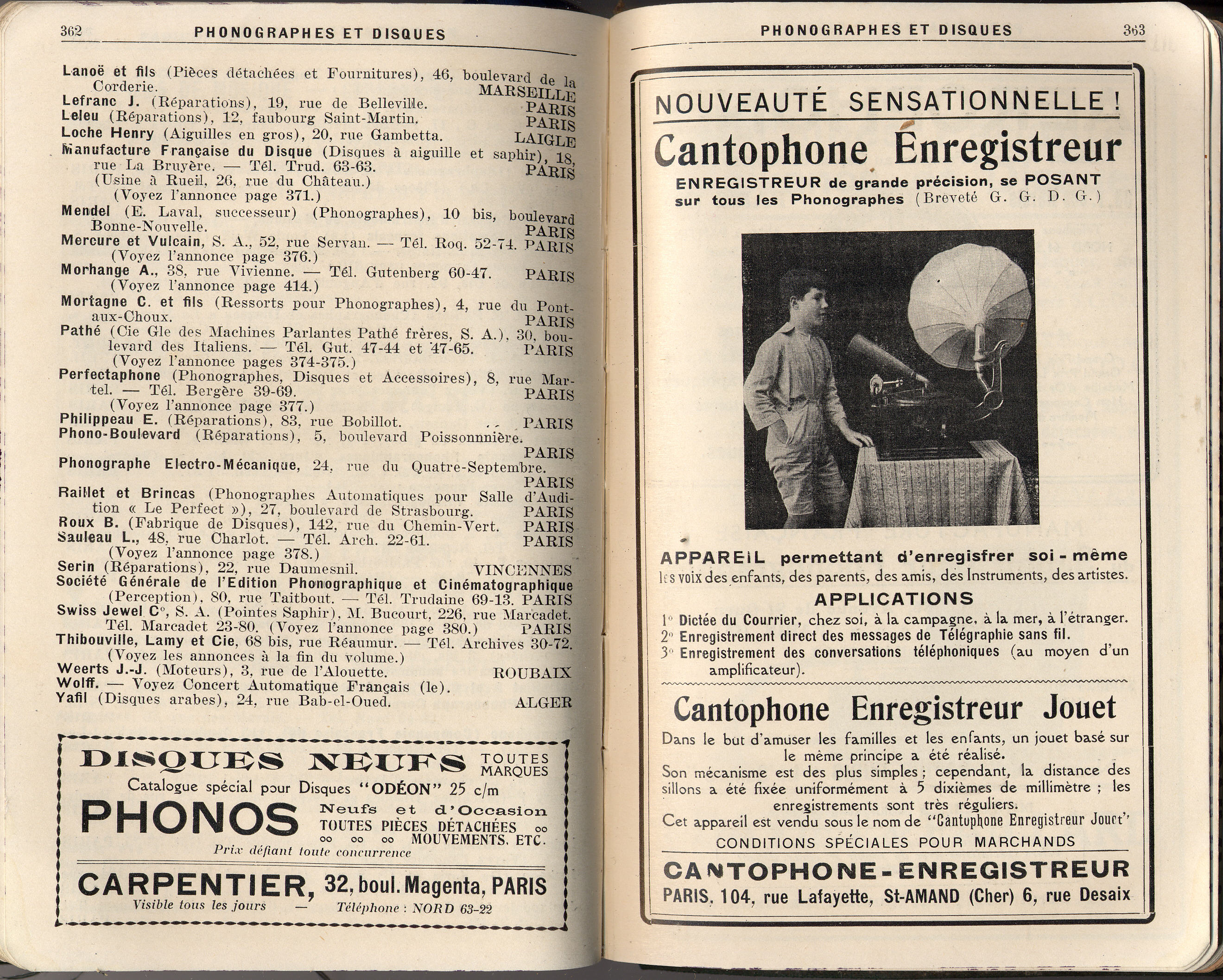
The labels on most known Roux test pressings give away little or nothing about their contents or intended clients. Fortunately, other sources have proved rich in information about Roux's businesses and achievements. Richest by far are the historical newspapers, periodicals, directories, official bulletins and other publications (mostly in French) which have been digitized and made freely accessible, in full text, via institutional websites, notably the BnF’s Gallica, its commercial partner <span class="plainlinks">[https://www.retronews.fr/ RetroNews]</span><ref>Although RetroNews is a commercial service, a subscription is necessary only for detailed searches and some other facilities</ref> and the Internet Archive. That said, a vexing and perplexing omission (to date) from the BnF’s print digitization programme is France's important heritage of historical audio and record magazines (''Musique et radio'', ''Machines parlantes et radio'', ''Phono-radio-musique'', ''L’édition musicale vivante'', ''Le Guide Bleu des Nouveaux Disques'' etc.); I very much hope we will be able to read these before it's too late. Another invaluable source is the national and international online patent databases from which historical patents applied for by Bernard Roux and others can be freely retrieved. Genealogical information about Roux himself, his family and other French citizens mentioned below is also freely accessible in France's online municipal archives, although to find it one needs to know where and when an individual was born, which often means subscribing to a commercial genealogical website such as <span class="plainlinks">[https://www.ancestry.co.uk/ Ancestry]</span> or <span class="plainlinks">[https://geneanet.org/ Geneanet]</span>. | The labels on most known Roux test pressings give away little or nothing about their contents or intended clients. Fortunately, other sources have proved rich in information about Roux's businesses and achievements. Richest by far are the historical newspapers, periodicals, directories, official bulletins and other publications (mostly in French) which have been digitized and made freely accessible, in full text, via institutional websites, notably the BnF’s Gallica, its commercial partner <span class="plainlinks">[https://www.retronews.fr/ RetroNews]</span><ref>Although RetroNews is a commercial service, a subscription is necessary only for detailed searches and some other facilities</ref> and the Internet Archive. That said, a vexing and perplexing omission (to date) from the BnF’s print digitization programme is France's important heritage of historical audio and record magazines (''Musique et radio'', ''Machines parlantes et radio'', ''Phono-radio-musique'', ''L’édition musicale vivante'', ''Le Guide Bleu des Nouveaux Disques'' etc.); I very much hope we will be able to read these before it's too late. Another invaluable source is the national and international online patent databases from which historical patents applied for by Bernard Roux and others can be freely retrieved. Genealogical information about Roux himself, his family and other French citizens mentioned below is also freely accessible in France's online municipal archives, although to find it one needs to know where and when an individual was born, which often means subscribing to a commercial genealogical website such as <span class="plainlinks">[https://www.ancestry.co.uk/ Ancestry]</span> or <span class="plainlinks">[https://geneanet.org/ Geneanet]</span>. | ||
| − | Discographical sources consulted for this page include the BnF’s <span class="plainlinks">[https://catalogue.bnf.fr/index.do online catalogue]</span>, as well as online sales listings and collectors’ and enthusiasts’ websites. Towering over the latter, indeed rivalling institutional repositories for sheer quantity and quality of transfers, images and documentation, is the <span class="plainlinks">[http://www.phonobase.org/ 'Phonobase']</span>, a freely accessible online archive of early French cylinders and discs maintained by <span class="plainlinks">[https://www.cnrs.fr/fr/personne/henri-chamoux Henri Chamoux]</span>. An inventor and audio restoration expert affiliated with France's <span class="plainlinks">[https://www.cnrs.fr/ scientific research council]</span>, Chamoux has also written one of the best histories of the early French record industry,<ref>Chamoux, Henri <span class="plainlinks">[http://www.archeophone.org/these/ ''La diffusion de l'enregistrement sonore en France à la Belle Époque (1893-1914)'', Paris: Université de Paris 1 Panthéon-Sorbonne, 2015]</span> (M. Chamoux's doctoral thesis)</ref> in addition to indispensable compendia of French record label and trademark registrations<ref>Chamoux, Henri <span class="plainlinks">[https://www.archeophone.org/rtf_pdf/Marques_phonographiques_inpi ''Dépôts de marques phonographiques françaises de 1893 à 1940. Documents tirés des bulletins de l’INPI'', Archéophone, 2015]</span></ref> and audio patents before World War II.<ref>Chamoux, Henri <span class="plainlinks">[http://www.archeophone.org/phono_brevets.php 'Les brevets de l'industrie phonographique française. 4241 brevets traitant d'enregistrement et de reproduction sonore, déposés de 1857 à 1934…']</span>, phonobase.org, 1999/2003 <br />M. Chamoux has also made available online the entire run of <span class="plainlinks">[http://www.archeophone.org/Phonoscopies/ ''Phonoscopies'']</span> (1993-2011), a magazine for record collectors and discographers edited and published by the late Gérard Roig</ref> These crucial resources are being complemented and extended by | + | Discographical sources consulted for this page include the BnF’s <span class="plainlinks">[https://catalogue.bnf.fr/index.do online catalogue]</span>, as well as online sales listings and collectors’ and enthusiasts’ websites. Towering over the latter, indeed rivalling institutional repositories for sheer quantity and quality of transfers, images and documentation, is the <span class="plainlinks">[http://www.phonobase.org/ 'Phonobase']</span>, a freely accessible online archive of early French cylinders and discs maintained by <span class="plainlinks">[https://www.cnrs.fr/fr/personne/henri-chamoux Henri Chamoux]</span>. An inventor and audio restoration expert affiliated with France's <span class="plainlinks">[https://www.cnrs.fr/ scientific research council]</span>, Chamoux has also written one of the best histories of the early French record industry,<ref>Chamoux, Henri <span class="plainlinks">[http://www.archeophone.org/these/ ''La diffusion de l'enregistrement sonore en France à la Belle Époque (1893-1914)'', Paris: Université de Paris 1 Panthéon-Sorbonne, 2015]</span> (M. Chamoux's doctoral thesis)</ref> in addition to indispensable compendia of French record label and trademark registrations<ref>Chamoux, Henri <span class="plainlinks">[https://www.archeophone.org/rtf_pdf/Marques_phonographiques_inpi ''Dépôts de marques phonographiques françaises de 1893 à 1940. Documents tirés des bulletins de l’INPI'', Archéophone, 2015]</span></ref> and audio patents before World War II.<ref>Chamoux, Henri <span class="plainlinks">[http://www.archeophone.org/phono_brevets.php 'Les brevets de l'industrie phonographique française. 4241 brevets traitant d'enregistrement et de reproduction sonore, déposés de 1857 à 1934…']</span>, phonobase.org, 1999/2003 <br />M. Chamoux has also made available online the entire run of <span class="plainlinks">[http://www.archeophone.org/Phonoscopies/ ''Phonoscopies'']</span> (1993-2011), a magazine for record collectors and discographers edited and published by the late Gérard Roig</ref> These crucial resources are being complemented and extended by other impressive initiatives. Jerome Moncada's <span class="plainlinks">[https://labelgalleryfrancaise.wordpress.com/ Label Galerie Française]</span> is an online guide to smaller French disc labels which I've drawn on extensively. A multimedia, multinational labour of love is Christian Van den Broeck's and Dominique Cravic's ''Les As du Musette'', a lavish celebration comprising fifty historical ''musette'' recordings transferred to LP and CD, a book on the genre's history, venues and peformers, a discography by Van den Broeck and Tarek Wartigue and a photographic labelography, all illustrated with drawings by ''musette'' enthusiast and collector <span class="plainlinks">[https://en.wikipedia.org/wiki/Robert_Crumb Robert Crumb]</span>.<ref>Van den Broeck, Christian & Cravic, Dominique ''Les As du Musette des Apaches aux Zazous'', Geraardsbergen: Belgatone, n.d. [2023] (NB the discs and book are available separately, the book also in an English-language version, ''The Bal Musette'', while the discography and labelography are available only on a USB stick included in the complete ''As du Musette'' boxed set); my thanks to Jerome Moncada for alerting me to this resource (email, 22 April 2024)</ref> Where possible, I cite these and all other sources below (see also [[#Acknowledgements|Acknowledgements]]). |
Nowhere have I have found any reference to surviving personal papers of Bernard Roux or business papers of his companies. These will surely be needed for a more complete account of Roux's life, career and legacy, but tracking them down will probably mean travelling to France and delving in repositories accessible only off line. | Nowhere have I have found any reference to surviving personal papers of Bernard Roux or business papers of his companies. These will surely be needed for a more complete account of Roux's life, career and legacy, but tracking them down will probably mean travelling to France and delving in repositories accessible only off line. | ||
| Line 52: | Line 52: | ||
No record of military service by Bernard Roux during World War I has come to light. Aged 39 in August 1914, he was perhaps too old to be called up, or else he engaged in industrial production deemed of national importance. | No record of military service by Bernard Roux during World War I has come to light. Aged 39 in August 1914, he was perhaps too old to be called up, or else he engaged in industrial production deemed of national importance. | ||
| − | On 30 August 1924, in Paris's 14th ''arrondissement'', where he had lived for several years, Bernard Roux married Marguerite Françoise Andrée Eléonore Baudevin, born in <span class="plainlinks">[https://en.wikipedia.org/wiki/Saint-%C3%89tienne Saint-Etienne]</span> in 1897 | + | On 30 August 1924, in Paris's 14th ''arrondissement'', where he had lived for several years, Bernard Roux married Marguerite Françoise Andrée Eléonore Baudevin, born in <span class="plainlinks">[https://en.wikipedia.org/wiki/Saint-%C3%89tienne Saint-Etienne]</span> in 1897 but now also resident in Paris. The couple lived in Paris for the rest of their lives, and had three children: Marie (born 1925?<ref>Marie Roux's birth year is noted rather illegibly in the Paris ''recensements'' (censuses) of 1926, 1931 and 1936; her exact date of birth has not been established</ref>), Marcel Bernard (born 17 February 1929<ref>'Naissances', in 'Carnet du Jour', ''L’Écho de Paris'', Sunday 3 March 1929, p.<span class="plainlinks">[https://www.retronews.fr/journal/l-echo-de-paris-1884-1938/3-mars-1929/120/590589/2 2]</span></ref>) and Charles-Bernard (born 2 December 1930<ref>'Naissances', in 'Carnet du Jour', ''L’Écho de Paris'', Tuesday 16 December 1930, p.<span class="plainlinks">[https://www.retronews.fr/journal/l-echo-de-paris-1884-1938/16-decembre-1930/120/590507/2 2]</span></ref>). |
| + | |||
Roux's wife Marguerite predeceased him, on 21 October 1955, at the <span class="plainlinks">[https://fr.wikipedia.org/wiki/H%C3%B4pital_de_la_Salp%C3%AAtri%C3%A8re Salpêtrière hospital]</span> in Paris. | Roux's wife Marguerite predeceased him, on 21 October 1955, at the <span class="plainlinks">[https://fr.wikipedia.org/wiki/H%C3%B4pital_de_la_Salp%C3%AAtri%C3%A8re Salpêtrière hospital]</span> in Paris. | ||
| Line 169: | Line 170: | ||
===Ultima=== | ===Ultima=== | ||
| − | The 1910 directory quoted above suggests Roux was already active in the contract processing and pressing business. Another line of evidence points strongly to his firm's involvement in production of the short-lived label Ultima (short-lived, that is, under its own name; it enjoyed a considerable after-life in the form of re-pressings made for other labels). As noted [[#Ebonite and Ebonitine|above]], Ultima was first registered in late 1908;<ref>Registrations No.109535 (marque), 9 September 1908, Paris, and No.110952 (label design), 27 November 1908, Paris, see Chamoux, Henri <span class="plainlinks">[https://www.archeophone.org/rtf_pdf/Marques_phonographiques_inpi ''Dépôts de marques phonographiques françaises de 1893 à 1940. Documents tirés des bulletins de l’INPI'']</span>, Archéophone, 2015, pp.68, 70 [PDF pp.74, 76]</ref> within weeks, new releases were briefly advertised in the French press,<ref>e.g. '"Ultima" disque à saphir' (advertisement), ''Le Petit Parisien'', Thursday 17 December 1908, p.<span class="plainlinks">[https://www.retronews.fr/journal/le-petit-parisien/17-decembre-1908/2/81710/6 6]</span>; 'L'Edyphone' (advertisement), ''Le Journal du Cher'', Thursday 4 February 1909, p.<span class="plainlinks">[https://www.retronews.fr/journal/journal-du-cher/4-fevrier-1909/1133/4068801/4 4]</span></ref> after which Ultima disappeared from sources currently accessible online. In late 1910, the company's assets were put up for sale | + | The 1910 directory quoted above suggests Roux was already active in the contract processing and pressing business. Another line of evidence points strongly to his firm's involvement in production of the short-lived label Ultima (short-lived, that is, under its own name; it enjoyed a considerable after-life in the form of re-pressings made for other labels). As noted [[#Ebonite and Ebonitine|above]], Ultima was first registered in late 1908;<ref>Registrations No.109535 (marque), 9 September 1908, Paris, and No.110952 (label design), 27 November 1908, Paris, see Chamoux, Henri <span class="plainlinks">[https://www.archeophone.org/rtf_pdf/Marques_phonographiques_inpi ''Dépôts de marques phonographiques françaises de 1893 à 1940. Documents tirés des bulletins de l’INPI'']</span>, Archéophone, 2015, pp.68, 70 [PDF pp.74, 76]</ref> within weeks, new releases were briefly advertised in the French press,<ref>e.g. '"Ultima" disque à saphir' (advertisement), ''Le Petit Parisien'', Thursday 17 December 1908, p.<span class="plainlinks">[https://www.retronews.fr/journal/le-petit-parisien/17-decembre-1908/2/81710/6 6]</span>; 'L'Edyphone' (advertisement), ''Le Journal du Cher'', Thursday 4 February 1909, p.<span class="plainlinks">[https://www.retronews.fr/journal/journal-du-cher/4-fevrier-1909/1133/4068801/4 4]</span></ref> after which Ultima disappeared from sources currently accessible online. In late 1910, the company's assets were put up for sale.<ref>e.g. ‘Adjudications et ventes’, in ‘Avis’, ''La Loi'', Sunday 2 & Monday 3 October 1910, p.<span class="plainlinks">[https://www.retronews.fr/journal/la-loi/2-octobre-1910/1703/3702867/2 2]</span>; notices also published in several other French newspapers, as well as in Germany, see ‘Die Marke „ULTIMA“ [...]’, ''Phonographische Zeitschrift'', Vol.11 No.39, 29 September 1910, p.<span class="plainlinks">[https://www.digitale-sammlungen.de/en/view/bsb00088730?page=1050,1051 893]</span>, which states that the sale was to take place on 14 October 1910, presumably by auction (the Ultima marque has also been registered and marketed in Germany and some Ultima recordings were reportedly made in Germany, see Lotz, Rainer E. with Gunrem, Michael & Puille, Stephan ''Das Bilderlexikon der deutschen Schellack-Schallplatten'', Holste: Bear Family Records, n.d. [2019], Vol.V, p.364, s.vv. ‘Ultima [Frankreich]’)</ref> The sale had been completed by early January 1911, when a Paris gazette published a notice naming the seller as a company, 'Société d’Espagne, Roux, Ragon et Ménard'.<ref>Notice first published in ''Petites Affiches'', Thursday 5 January 1911, p.n/a (not accessible); summarized in ‘Ventes de fonds de commerce et d’objets mobiliers divers’, ''Le Courrier'', Monday 9 January 1911, pp.7-8 (on p.<span class="plainlinks">[https://gallica.bnf.fr/ark:/12148/bpt6k51646251/f8 8]</span>)</ref> Not much has been ascertained about Fernand d'Espagne, who had registered the marque,<ref>From 1903, Fernand d’Espagne was listed in Paris directories as a supplier of photographic equipment, see ''Annuaire-almanach du commerce, de l'industrie, de la magistrature et de l'administration'', Paris: Didot-Bottin, 1903, Vol.I(?), pp.<span class="plainlinks">[https://gallica.bnf.fr/ark:/12148/bpt6k3208950j/f274 238]</span> and <span class="plainlinks">[https://gallica.bnf.fr/ark:/12148/bpt6k32094571/f438 2332]</span>, and from 1905, he was based at 5 rue de Béarn in the third ''arrondissement'', see ''Annuaire-almanach du commerce, de l'industrie, de la magistrature et de l'administration'', Paris: Didot-Bottin, 1905, Vol.I(?), p.<span class="plainlinks">[https://gallica.bnf.fr/ark:/12148/bpt6k3212113x/f1459 2929]</span>, and Vol.II, p.<span class="plainlinks">[https://gallica.bnf.fr/ark:/12148/bpt6k3212113x/f839 2353]</span>; M. d'Espagne was still listed as a supplier of photographic equipment in 1911, see ''Annuaire-almanach du commerce, de l'industrie, de la magistrature et de l'administration'', Paris: Didot-Bottin, 1911, Vol.I, p.<span class="plainlinks">[https://gallica.bnf.fr/ark:/12148/bpt6k5329695m/f303 269]</span>, but not in 1913<br />NB 5 rue de Béarn was also the address of the short-lived Paris branch of the German record company Homophon, registered locally in May 1907, see Chamoux, Henri <span class="plainlinks">[https://www.archeophone.org/rtf_pdf/Marques_phonographiques_inpi ''Dépôts de marques phonographiques françaises de 1893 à 1940. Documents tirés des bulletins de l’INPI'']</span>, Archéophone, 2015, p.54 [PDF p.60], and, from September 1908, of Ultima and the Société d’Espagne, Roux, Ragon et Ménard (see preceding footnote)</ref> and nothing about the two last-named partners. This notice is the sole mention the Société located so far; without further information, identifying the second-named partner as Bernard Roux might seem a stretch. But other evidence supports the hypothesis. By 1908, Roux had been awarded patents in recording technology and was manufacturing Ebonitine, the material from which Ultima discs were pressed, and by 1910 his firm was advertising a full range of record production services. The buyer of Ultima in early 1911 was François Biat, whose business address for many years was 146, rue du Chemin-Vert – right next to Bernard Roux's Ebonitine works.<ref>Biat and Roux were listed at these neighbouring addresses from 1907, see ''Paris-Adresses. Annuaire général de l'industrie et du commerce'', Paris: S.A. de l'annuaire "Paris-Adresses", 1907, p.<span class="plainlinks">[https://gallica.bnf.fr/ark:/12148/bpt6k1184615c/f2143 2135]</span>; Biat seems to have moved, as did many others, from the musical instrument trade into the record business, in which he remained active until 1932, when he was based in the former Cité Pelleport in the twentieth ''arrondissement'', see ''Annuaire universel Paris-Adresses'', Paris: Paris-Adresses S.A., 1932, Vol.I ''Rues'', p.<span class="plainlinks">[https://gallica.bnf.fr/ark:/12148/bpt6k1183570x/f796 792]</span></ref> That only reinforces the suspicion that Roux had indeed been a partner in d'Espagne's Ultima enterprise. (Biat, too, apparently failed to make a go of Ultima, and in November 1911 he sold it on;<ref>‘Ventes de fonds de commerce’, ''Archives commerciales de la France'', Saturday 18 November 1911, pp.1537 ff. (on p.<span class="plainlinks">[https://gallica.bnf.fr/ark:/12148/bpt6k12542711/f11 1543]</span>)</ref> soon after, it was re-registered<ref>Registrations No.133264 (marque) and No.133268 (label design), 26 December 1911, Paris, see Chamoux, Henri <span class="plainlinks">[https://www.archeophone.org/rtf_pdf/Marques_phonographiques_inpi ''Dépôts de marques phonographiques françaises de 1893 à 1940. Documents tirés des bulletins de l’INPI'']</span>, Archéophone, 2015, pp.93, 94 [PDF pp.99, 100]</ref> but seems not to have been exploited.) There is currently no proof that Roux was producing discs for Ultima in 1908, but his firm certainly re-pressed Ultima matrices for other clients in the 1920s, as confirmed by a surviving Bernard Roux test pressing of an Ultima matrix held by the British Library in London (discussed in detail [[#Unidentified_recordings|below]]).<ref>See also Moncada, Jerome <nowiki>https://labelgalleryfrancaise.wordpress.com/2021/06/20/ultima/</nowiki></ref> It does not seem too fanciful to suggest that Ultima was Roux's first (joint) foray into the gramophone business. And it was perhaps Ultima's early demise that convinced Roux not to own or part-own record marques (if indeed he was a partner in the Société d'Espagne), but to concentrate on contract recording and disc pressing. |
===A&R=== | ===A&R=== | ||
| Line 271: | Line 272: | ||
*'Premier disque à aiguille enregistré électriquement le 28 janvier 1925' / 'Orchestre enregistré électriquement le 28 juillet 1926', Essai spécial no.57 / 3698, 27 cm, BnF shelf mark <span class="plainlinks">[http://ark.bnf.fr/ark:/12148/cb41471106b AP-2173]</span> | *'Premier disque à aiguille enregistré électriquement le 28 janvier 1925' / 'Orchestre enregistré électriquement le 28 juillet 1926', Essai spécial no.57 / 3698, 27 cm, BnF shelf mark <span class="plainlinks">[http://ark.bnf.fr/ark:/12148/cb41471106b AP-2173]</span> | ||
*'Chant Hébreu' / 'Chant Hébreu', 4120 / 4121, 25 cm, BnF shelf mark <span class="plainlinks">[http://ark.bnf.fr/ark:/12148/cb414710589 AP-2172]</span> | *'Chant Hébreu' / 'Chant Hébreu', 4120 / 4121, 25 cm, BnF shelf mark <span class="plainlinks">[http://ark.bnf.fr/ark:/12148/cb414710589 AP-2172]</span> | ||
| − | *'Etablissements Bernard Roux 8510', 8510 / [ | + | *'Etablissements Bernard Roux 8510', 8510 / [8511]<ref>Only one side's matrix number is given in the BnF's <span class="plainlinks">[http://ark.bnf.fr/ark:/12148/cb38354516r catalogue entry]</span></ref>, 25 cm, BnF shelf mark <span class="plainlinks">[http://ark.bnf.fr/ark:/12148/cb38354516r SD 78 25-19949]</span> |
Only two Bernard Roux test pressings have been found in national and university libraries elsewhere (catalogue entries via links): | Only two Bernard Roux test pressings have been found in national and university libraries elsewhere (catalogue entries via links): | ||
*[no titles], 1106 / PK 200, 25 cm, British Library, London, shelf mark <span class="plainlinks">[http://explore.bl.uk/BLVU1:LSCOP-ALL:BLLSA1380947 9TS0002803]</span> | *[no titles], 1106 / PK 200, 25 cm, British Library, London, shelf mark <span class="plainlinks">[http://explore.bl.uk/BLVU1:LSCOP-ALL:BLLSA1380947 9TS0002803]</span> | ||
| Line 277: | Line 278: | ||
(All remaining tests listed below are 25 cm in diameter, except where stated.) | (All remaining tests listed below are 25 cm in diameter, except where stated.) | ||
| − | In April 2016, I bought a Bernard Roux test pressing, and in April 2023 two more, from <span class="plainlinks">[https://www.phonopassion.de Phonopassion]</span>, of <span class="plainlinks">[https://en.wikipedia.org/wiki/Horben Horben]</span>, Germany, who described them as follows (labels from the first and third are reproduced [[#Test labels|below]]): | + | In April 2016, I bought a Bernard Roux test pressing, and in April 2023 two more, all from <span class="plainlinks">[https://www.phonopassion.de Phonopassion]</span>, of <span class="plainlinks">[https://en.wikipedia.org/wiki/Horben Horben]</span>, Germany, who described them as follows (labels from the first and third are reproduced [[#Test labels|below]]): |
anonymous (cello solo ) Prelude en Ut mineur pt.1/2 (Bach) / published sides ? ? ak[ustisch] ? Bernard Roux test<ref>Item 13382 (25 cm / 10 in. disc), <span class="plainlinks">[https://web.archive.org/web/20160617012809/https://www.phonopassion.de/index.php?key=festpreis_en Phonopassion Fix Price List 1-2016, April 2016]</span> (retrieved from Internet Archive <span class="plainlinks">[https://web.archive.org/ Wayback Machine]</span>); originally auctioned c. April 2008 but unsold</ref> | anonymous (cello solo ) Prelude en Ut mineur pt.1/2 (Bach) / published sides ? ? ak[ustisch] ? Bernard Roux test<ref>Item 13382 (25 cm / 10 in. disc), <span class="plainlinks">[https://web.archive.org/web/20160617012809/https://www.phonopassion.de/index.php?key=festpreis_en Phonopassion Fix Price List 1-2016, April 2016]</span> (retrieved from Internet Archive <span class="plainlinks">[https://web.archive.org/ Wayback Machine]</span>); originally auctioned c. April 2008 but unsold</ref> | ||
| Line 283: | Line 284: | ||
(sop.)/(contr.) el. Bernard Roux (Azurephone) test unidentified (mx.9576/ 9577) Paris ca.1930<ref>Lot 95 (25 cm / 10 in. disc), Phonopassion auction list of classical/ operatic 78rpm records (closing date 15 April 2018), p.7, unsold; bought at fixed price</ref> | (sop.)/(contr.) el. Bernard Roux (Azurephone) test unidentified (mx.9576/ 9577) Paris ca.1930<ref>Lot 95 (25 cm / 10 in. disc), Phonopassion auction list of classical/ operatic 78rpm records (closing date 15 April 2018), p.7, unsold; bought at fixed price</ref> | ||
| + | In September 2024, I bought a fourth Bernard Roux test pressing in an online auction: | ||
| + | *'La bergère Colinette' / 'Les vieilles de chez nous', B.I / no matrix given, 25 cm<ref>eBay item 276624723820, ended 22 September 2024</ref> | ||
Revisiting past Phonopassion sales yielded two more Bernard Roux test pressings: | Revisiting past Phonopassion sales yielded two more Bernard Roux test pressings: | ||
anonymous 8 2/3” [22 cm] el. Bernard Roux test (unidentified pianist) Finale: Presto agitato “Mondscheinsonate” (Beethoven) mx.6256 MB/ Fantaisie impromptu (Chopin) mx.6257 MB Paris ca.1930 Released recordings? | anonymous 8 2/3” [22 cm] el. Bernard Roux test (unidentified pianist) Finale: Presto agitato “Mondscheinsonate” (Beethoven) mx.6256 MB/ Fantaisie impromptu (Chopin) mx.6257 MB Paris ca.1930 Released recordings? | ||
| Line 308: | Line 311: | ||
In September 2024, another Bernard Roux test, seemingly also containing commercial recordings, was offered for sale online:<ref>eBay <span class="plainlinks">[https://www.ebay.co.uk/itm/276624723820 item 276624723820]</span>, ended Sunday 22 September 2024</ref> | In September 2024, another Bernard Roux test, seemingly also containing commercial recordings, was offered for sale online:<ref>eBay <span class="plainlinks">[https://www.ebay.co.uk/itm/276624723820 item 276624723820]</span>, ended Sunday 22 September 2024</ref> | ||
| − | Bernard Roux : La bergère colinette / Les | + | Bernard Roux : La bergère colinette / Les vieilles de chez nous [sic] 78 tours rpm |
Despite invisible and/or illegible matrices, a certain amount can be guessed about these recordings, which are discussed [[#Unidentified recordings|below]]. | Despite invisible and/or illegible matrices, a certain amount can be guessed about these recordings, which are discussed [[#Unidentified recordings|below]]. | ||
| Line 335: | Line 338: | ||
4849 JPRM Sunny Boy (Sonny Boy) – RBE v Bernard Roux test<ref>Mazzoletti, Adriano ''Il jazz in Italia: dalle origini alle grandi orchestre'', Torino: EDT srl, 2004, p.191<br />These sides are also listed (less accurately) in Lord, Tom ''The Jazz Discography'', West Vancouver, B.C.: Lord Music Reference, 1997, p.<span class="plainlinks">[https://archive.org/details/jazzdiscogvol1800lord/page/178/mode/1up R178]</span>, and Klaric, Marianne & Henceval, Emile (eds.) ''Dictionnaire du jazz à Bruxelles et en Wallonie'', Liège: Pierre Mardaga / Communauté française de Belgique. Conseil de la musique, 1991, p.221</ref> | 4849 JPRM Sunny Boy (Sonny Boy) – RBE v Bernard Roux test<ref>Mazzoletti, Adriano ''Il jazz in Italia: dalle origini alle grandi orchestre'', Torino: EDT srl, 2004, p.191<br />These sides are also listed (less accurately) in Lord, Tom ''The Jazz Discography'', West Vancouver, B.C.: Lord Music Reference, 1997, p.<span class="plainlinks">[https://archive.org/details/jazzdiscogvol1800lord/page/178/mode/1up R178]</span>, and Klaric, Marianne & Henceval, Emile (eds.) ''Dictionnaire du jazz à Bruxelles et en Wallonie'', Liège: Pierre Mardaga / Communauté française de Belgique. Conseil de la musique, 1991, p.221</ref> | ||
| − | A discography of musette recordings adds the following Roux tests (NB the presentation below is | + | A discography of musette recordings adds the following Roux tests (NB the presentation below is modified):<ref>Van den Broeck, Christian & Wartigue, Tarek ''Discographie du Musette (1905-1958)'' (Excel database and PDF), in Van den Broeck, Christian & Cravic, Dominique ''Les As du Musette des Apaches aux Zazous'', Geraardsbergen: Belgatone, n.d. [2023]; my thanks again to Jerome Moncada for alerting me to this resource (email, 22 April 2024), which I have since acquired</ref> |
| − | + | *3746 / 3748 (see above); Riquita / Le départ pour Cuba; ? (accordion), ? (xylophone) [artists unidentified] | |
| − | *3746 / 3748 | + | *3747 / [?]; ? (accordion), ? (xylophone) [contents, artists and coupling unknown] |
| − | *5067 AB / [ | + | *5067 AB / [?]; Séduction / [?]; Jean Vaissade (accordion), Julien Latorre (banjo), A. Huwyler (piano), unidentified (drums) [coupling unknown] |
| − | *5616 AB / 5621 AB; La chanson des blés d’or / Je ne veux que son amour; Albert Carrara (accordion), Jules Viard (saxophone), Gaul (piano) | + | *5616 AB / 5621 AB; La chanson des blés d’or / Je ne veux que son amour; Albert Carrara (accordion), Jules Viard (saxophone), Gaul (piano) [this coupling presumed] |
| − | *5617 AB / [ | + | *5617 AB / [?]; Marche des Grenadiers / [?]; Volpey (accordion), Blanc (accordion) [coupling unknown] |
A final example, an advertising disc produced by Bernard Roux (see [[#Promotional recordings|below]]), can be be identified as a test pressing although it is not described as such in the source:<ref>Roig, Gérard ‘Les disques publicitaires en 78t (1ère Partie: Apéritifs, Automobiles et autres…)’, <span class="plainlinks">[http://www.archeophone.org/Phonoscopies/Phonoscopies-003.pdf ''Phonoscopies, No.3'', July 1993]</span>, pp.17-23 (on p.23)</ref> | A final example, an advertising disc produced by Bernard Roux (see [[#Promotional recordings|below]]), can be be identified as a test pressing although it is not described as such in the source:<ref>Roig, Gérard ‘Les disques publicitaires en 78t (1ère Partie: Apéritifs, Automobiles et autres…)’, <span class="plainlinks">[http://www.archeophone.org/Phonoscopies/Phonoscopies-003.pdf ''Phonoscopies, No.3'', July 1993]</span>, pp.17-23 (on p.23)</ref> | ||
| Line 360: | Line 363: | ||
The florid name and monogram are reminiscent of similar marks used before World War I on 'Beaux Arts'-style record labels and players, and in bulletins, catalogues and related merchandise. Neither mark has been seen in Bernard Roux advertisements in the French press and it is not known if they were used on the firm's other, non-gramophone products (none of which have been seen either). | The florid name and monogram are reminiscent of similar marks used before World War I on 'Beaux Arts'-style record labels and players, and in bulletins, catalogues and related merchandise. Neither mark has been seen in Bernard Roux advertisements in the French press and it is not known if they were used on the firm's other, non-gramophone products (none of which have been seen either). | ||
| − | The second type of Roux test label is more modern-looking and slightly more informative: | + | Almost all labels of this type are printed in blue on a white field but examples are known with the printing in black. The sigificance of this variant, if any, is not known. |
| + | |||
| + | The second type of Roux test label, printed in black on an off-white field, is more modern-looking and slightly more informative: | ||
[[File:Etablissements_Bernard_Roux_matrix_9576_label_with_runout.jpg|center|frame|<div style="text-align: center;">Établissements Bernard Roux matrix 9576 label, with 'dead wax' detail (Collection: the author)</div>]] | [[File:Etablissements_Bernard_Roux_matrix_9576_label_with_runout.jpg|center|frame|<div style="text-align: center;">Établissements Bernard Roux matrix 9576 label, with 'dead wax' detail (Collection: the author)</div>]] | ||
| Line 366: | Line 371: | ||
The upper half carries the name Établissements Bernard Roux and address 142, rue du Chemin Vert, Paris, suggesting the design was introduced after the Établissements was formed in late 1923 – but with some delay, perhaps, as test pressings are known which are dated later yet carry the earlier label. The legend 'Échantillon invendable' is an exact equivalent of the '[Factory] Sample Not for Sale' often seen on British and American test pressings; this did not necessarily mean that Roux tests with this label were as destined for commercial issue, as this very recording was almost certainly a private, non-commercial commission (see [[#Private recordings|below]]). No fields are defined, not even for the matrix number, which has been duplicated, again in pencil, in the label's blank portion. | The upper half carries the name Établissements Bernard Roux and address 142, rue du Chemin Vert, Paris, suggesting the design was introduced after the Établissements was formed in late 1923 – but with some delay, perhaps, as test pressings are known which are dated later yet carry the earlier label. The legend 'Échantillon invendable' is an exact equivalent of the '[Factory] Sample Not for Sale' often seen on British and American test pressings; this did not necessarily mean that Roux tests with this label were as destined for commercial issue, as this very recording was almost certainly a private, non-commercial commission (see [[#Private recordings|below]]). No fields are defined, not even for the matrix number, which has been duplicated, again in pencil, in the label's blank portion. | ||
| − | The third and latest type of label, | + | The third and latest type of label, printed in black on a buff field, carries the last address of Établissements Bernard Roux and location of its last pressing plant, 2, rue Esquirol, Paris, XIII<sup>e</sup>, and revises the 'Sample Not for Sale' legend to 'Épreuve non vendable'. As before, a little over half the label is left clear for hand-written annotations.<ref><span class="plainlinks">[https://labelgalleryfrancaise.wordpress.com/wp-content/uploads/2024/01/20240113_175110.jpg Example]</span>, from disc in Robert Crumb collection, reproduced by Jerome Moncada at <nowiki>https://labelgalleryfrancaise.wordpress.com/2024/03/26/roux-bernard/</nowiki></ref> |
===Bernard Roux issues=== | ===Bernard Roux issues=== | ||
| Line 752: | Line 757: | ||
|} | |} | ||
Given how relentlessly popular numbers were duplicated by rival companies, it is surprising not to find a single recording of a song with this title in the usual databases and repositories. ''Là-Haut'', a 1923 ''opérette-bouffe'' by <span class="plainlinks">[https://en.wikipedia.org/wiki/Maurice_Yvain Maurice Yvain]</span>, included a number titled 'Je m'en balance', recorded for Pathé by its creator <span class="plainlinks">[https://en.wikipedia.org/wiki/Dranem Dranem]</span> but not, according to an authoritative database, by anyone else.<ref>'Là-Haut', <nowiki>http://www.ecmf.fr/cm/index016e.html</nowiki>; transfers of Dranem's recording of 'Je m'en balance', issued on Pathé 2060, can be auditioned on that page and at <nowiki>http://www.phonobase.org/14687.html</nowiki></ref> The Roux test has not been transferred, so it is not possible to determine if the recorded selection is the same song. This side was probably recorded by another company, as the matrix number is not standard for Bernard Roux. It may look familiar – if so, please <span class="plainlinks">[mailto:nicktmorgan@gmail.com get in touch]</span>. | Given how relentlessly popular numbers were duplicated by rival companies, it is surprising not to find a single recording of a song with this title in the usual databases and repositories. ''Là-Haut'', a 1923 ''opérette-bouffe'' by <span class="plainlinks">[https://en.wikipedia.org/wiki/Maurice_Yvain Maurice Yvain]</span>, included a number titled 'Je m'en balance', recorded for Pathé by its creator <span class="plainlinks">[https://en.wikipedia.org/wiki/Dranem Dranem]</span> but not, according to an authoritative database, by anyone else.<ref>'Là-Haut', <nowiki>http://www.ecmf.fr/cm/index016e.html</nowiki>; transfers of Dranem's recording of 'Je m'en balance', issued on Pathé 2060, can be auditioned on that page and at <nowiki>http://www.phonobase.org/14687.html</nowiki></ref> The Roux test has not been transferred, so it is not possible to determine if the recorded selection is the same song. This side was probably recorded by another company, as the matrix number is not standard for Bernard Roux. It may look familiar – if so, please <span class="plainlinks">[mailto:nicktmorgan@gmail.com get in touch]</span>. | ||
| + | |||
The Roux test auctioned online in September 2024 carried a number from an extremely popular ''opéra-comique'', <span class="plainlinks">[https://fr.wikipedia.org/wiki/Les_Saltimbanques_(op%C3%A9ra-comique) ''Les Saltimbanques'']</span> by <span class="plainlinks">[https://fr.wikipedia.org/wiki/Les_Saltimbanques_(op%C3%A9ra-comique) Louis Ganne]</span> (surely one of the most-recorded composers of his time): | The Roux test auctioned online in September 2024 carried a number from an extremely popular ''opéra-comique'', <span class="plainlinks">[https://fr.wikipedia.org/wiki/Les_Saltimbanques_(op%C3%A9ra-comique) ''Les Saltimbanques'']</span> by <span class="plainlinks">[https://fr.wikipedia.org/wiki/Les_Saltimbanques_(op%C3%A9ra-comique) Louis Ganne]</span> (surely one of the most-recorded composers of his time): | ||
| Line 764: | Line 770: | ||
|Les vieilles de chez nous||<div style="text-align: center;">25 cm</div>||<div style="text-align: center;">Unknown; unknown</div>||[runout not legible] | |Les vieilles de chez nous||<div style="text-align: center;">25 cm</div>||<div style="text-align: center;">Unknown; unknown</div>||[runout not legible] | ||
|} | |} | ||
| − | + | No recording of 'La bergère Colinette', the soprano ''villanelle'' from Act II of ''Les Saltimbanques'', is known on a disc produced by Roux. The song on the other side, by <span class="plainlinks">[https://en.wikipedia.org/wiki/Charles-Gaston_Levad%C3%A9 Charles Levadé]</span>, is preserved on a Roux record, but of the wrong size (22 cm),<ref>Sung by Alfred Blanc, with Orchestre "Champion", conductor J.-B. Ropp, matrix and recording date unknown, issued on Champion 4012, 22 cm, BnF shelf mark <span class="plainlinks">[http://ark.bnf.fr/ark:/12148/cb38299787p SD 78 25-12498]</span></ref> unless the test pressing was incorrectly described in the online sales listing. Recordings of both items made by the French branch of Crystalate are also known, one issued on a special label supplied by Roux, so this disc may turn out to be another instance of a Roux pressing of another company's matrices. | |
Even less information is available about a Roux test recorded by an unidentified orchestra, once in the possession of collector and auctioneer Andreas Schmauder:<ref>Andreas Schmauder, personal e-mails, 3 January and 6 October 2023</ref> | Even less information is available about a Roux test recorded by an unidentified orchestra, once in the possession of collector and auctioneer Andreas Schmauder:<ref>Andreas Schmauder, personal e-mails, 3 January and 6 October 2023</ref> | ||
| Line 1,020: | Line 1,026: | ||
|<span style="color:#0000ff"> 36 Do Let Me Try The Red Beans 1928</span>||<div style="text-align: center;">Unknown</div>||<div style="text-align: center;">Electrical; lateral</div>||36 AB | |<span style="color:#0000ff"> 36 Do Let Me Try The Red Beans 1928</span>||<div style="text-align: center;">Unknown</div>||<div style="text-align: center;">Electrical; lateral</div>||36 AB | ||
|} | |} | ||
| − | Only the second label has been seen:<ref>My thanks to Jerome Moncada for kindly forwarding images of this label, and of matrix 36 AB hand-written in the runout area, from the disc's current owner; personal email, 22 April 2024</ref> at some point all inscriptions on it were overwritten in blue ball-point(?) pen. The first side was transferred and issued on a commercial LP in the mid-1980s;<ref>'Jazz and Hot Dance in Belgium 1909-1952' (Jazz and Hot Dance Volume Eighteen) Harlequin HQ 2027, Side A, band 7<nowiki>https://www.discogs.com/release/8010211-Various-Jazz-And-Hot-Dance-In-Belgium-1909-1952</nowiki></ref> this transfer has not been heard. The intended client for these recordings remains unknown: it has been suggested they were to be issued on the | + | Only the second label has been seen:<ref>My thanks to Jerome Moncada for kindly forwarding images of this label, and of matrix 36 AB hand-written in the runout area, from the disc's current owner; personal email, 22 April 2024</ref> at some point all inscriptions on it were overwritten in blue ball-point(?) pen. The first side was transferred and issued on a commercial LP in the mid-1980s;<ref>'Jazz and Hot Dance in Belgium 1909-1952' (Jazz and Hot Dance Volume Eighteen) Harlequin HQ 2027, Side A, band 7, <nowiki>https://www.discogs.com/release/8010211-Various-Jazz-And-Hot-Dance-In-Belgium-1909-1952</nowiki></ref> this transfer has not been heard. The intended client for these recordings remains unknown: it has been suggested they were to be issued on the French label <span class="plainlinks">[https://78trs.fr/2026/03/25/gipsy/ Gipsy]</span> but this has not been verified.<ref>Pernet, Robert ''Belgian Jazz Discography (1897-1999)'', Brussels: Robert Pernet, p.55; my thanks for this reference to Andreas Schmauder, who comments, 'I have very few Gipsy records only featuring US bands. I assume that Gipsy is related to the Maxsa label on which American recordings of labels like Banner, Paramount, Puritan, Plaza were released in France from 1923 onwards. The majority of them is recorded acoustically covering a period of years 1923-1927.' (personal email, 6 October 2023)</ref> Equally intriguing is the matrix suffix on the other known Roux test with these artists:<ref>Pernet, Robert ''Belgian Jazz Discography (1897-1999)'', Brussels: Robert Pernet, p.55 (also consultable online in XML database at https://jazzerfgoed.be/belgianjazzdiscography.html)</ref> |
{| class="wikitable" style="width: 43%" | {| class="wikitable" style="width: 43%" | ||
! style="width: 21%;" | [Selection] | ! style="width: 21%;" | [Selection] | ||
| Line 1,255: | Line 1,261: | ||
Arya may sound familiar: it was one of the labels which reissued pre-War vertical-cut Ultima masters, mentioned [[#Unidentified recordings|above]].<ref>Other French labels which reissued Ultima matrices included AM and Apollon, owned by music and record retailer Adam Morhange; Corona, Lutètia, Olympia and Opera, owned by brothers Etienne and Pierre Chanoit; and Perfectaphone, owned by Constantin Furn</ref> The marque was not registered, which leaves October 1928 as the first documented date for its existence – surprisingly late, considering how old the Ultima recordings were by then. Arya's puzzle advertisements continued for three years, always giving the address as 22, rue des Quatre-Frères-Peignot, although images of Arya record sleeves show the street number as 22 bis, alongside an unusually spelled surname, Le Carèrès.<ref>See sleeve image <nowiki>https://labelgalleryfrancaise.files.wordpress.com/2021/05/arya.jpg at Moncada, Jerome 'Arya', https://labelgalleryfrancaise.wordpress.com/2021/07/09/arya/</nowiki></ref> In early 1929, Arya upped the ante to '5000 record-players for nothing';<ref>Earliest example found: ‘5.000 phonos pour rien’ (advertisement), ''Le Courrier de la Rochelle'', Wednesday 20 February 1929, p.<span class="plainlinks">[https://www.retronews.fr/journal/le-courrier-de-la-rochelle/20-fevrier-1929/1687/5285964/3 3]</span></ref> eighteen months later, another change of name took place.<ref>Latest examples found: ‘5.000 phonos gratuits’ (advertisement), ''Le Petit illustré'', Sunday 4 October 1931, p.<span class="plainlinks">[https://gallica.bnf.fr/ark:/12148/bd6t51120582j/f15 15]</span>, and ''l’Iintrépide'', Sunday 4 October 1931, p.<span class="plainlinks">[https://gallica.bnf.fr/ark:/12148/bpt6k9116294z/f9 9]</span></ref> | Arya may sound familiar: it was one of the labels which reissued pre-War vertical-cut Ultima masters, mentioned [[#Unidentified recordings|above]].<ref>Other French labels which reissued Ultima matrices included AM and Apollon, owned by music and record retailer Adam Morhange; Corona, Lutètia, Olympia and Opera, owned by brothers Etienne and Pierre Chanoit; and Perfectaphone, owned by Constantin Furn</ref> The marque was not registered, which leaves October 1928 as the first documented date for its existence – surprisingly late, considering how old the Ultima recordings were by then. Arya's puzzle advertisements continued for three years, always giving the address as 22, rue des Quatre-Frères-Peignot, although images of Arya record sleeves show the street number as 22 bis, alongside an unusually spelled surname, Le Carèrès.<ref>See sleeve image <nowiki>https://labelgalleryfrancaise.files.wordpress.com/2021/05/arya.jpg at Moncada, Jerome 'Arya', https://labelgalleryfrancaise.wordpress.com/2021/07/09/arya/</nowiki></ref> In early 1929, Arya upped the ante to '5000 record-players for nothing';<ref>Earliest example found: ‘5.000 phonos pour rien’ (advertisement), ''Le Courrier de la Rochelle'', Wednesday 20 February 1929, p.<span class="plainlinks">[https://www.retronews.fr/journal/le-courrier-de-la-rochelle/20-fevrier-1929/1687/5285964/3 3]</span></ref> eighteen months later, another change of name took place.<ref>Latest examples found: ‘5.000 phonos gratuits’ (advertisement), ''Le Petit illustré'', Sunday 4 October 1931, p.<span class="plainlinks">[https://gallica.bnf.fr/ark:/12148/bd6t51120582j/f15 15]</span>, and ''l’Iintrépide'', Sunday 4 October 1931, p.<span class="plainlinks">[https://gallica.bnf.fr/ark:/12148/bpt6k9116294z/f9 9]</span></ref> | ||
| − | From the autumn of 1931, 5000 puzzle-solvers were promised free machines by yet another advertiser, Angelus, still at the same address, whose campaign debuted not in the provincial press but in Paris papers.<ref>Earliest examples found include: ‘5.000 phonos gratis’ (advertisement), ''Le Matin'', Wednesday 13 September 1931, p.<span class="plainlinks">[https://www.retronews.fr/journal/le-matin/23-septembre-1931/66/168933/6 6]</span>, ''L’Echo de Paris'', Wednesday 13 September 1931, p.<span class="plainlinks">[https://www.retronews.fr/journal/l-echo-de-paris-1884-1938/23-septembre-1931/120/595009/8 8]</span>, etc.</ref> This too was a record label, and like Arya it was never officially registered. Far fewer discs seem to have been issued on Angelus than on Arya: they appear uncommon today, with only | + | From the autumn of 1931, 5000 puzzle-solvers were promised free machines by yet another advertiser, Angelus, still at the same address, whose campaign debuted not in the provincial press but in Paris papers.<ref>Earliest examples found include: ‘5.000 phonos gratis’ (advertisement), ''Le Matin'', Wednesday 13 September 1931, p.<span class="plainlinks">[https://www.retronews.fr/journal/le-matin/23-septembre-1931/66/168933/6 6]</span>, ''L’Echo de Paris'', Wednesday 13 September 1931, p.<span class="plainlinks">[https://www.retronews.fr/journal/l-echo-de-paris-1884-1938/23-septembre-1931/120/595009/8 8]</span>, etc.</ref> This too was a record label, and like Arya it was never officially registered. Far fewer discs seem to have been issued on Angelus than on Arya: they appear uncommon today, with only eleven documented for this page, of which just two are held by the Bibliothèque nationale de France in Paris,<ref>BnF shelf marks <span class="plainlinks">[http://ark.bnf.fr/ark:/12148/cb377696029 NC Angelus 231]</span> and <span class="plainlinks">[http://ark.bnf.fr/ark:/12148/cb37769603n NC Angelus 272]</span></ref> as against thirty-six from Arya. Angelus quizzes appeared in French newspapers for four more years, with decreasing regularity, until November 1935.<ref>Latest example found: ‘5.000 phonos gratis’ (advertisement), ''Journal de Limoux'', Sunday 10 November 1935, <span class="plainlinks">[https://gallica.bnf.fr/ark:/12148/bd6t53829898b/f6 unpaginated]</span></ref> |
Well before the disappearance of Angelus, a new label had taken up residence at 22, rue des Quatre-Frères-Peignot – but, unlike Arya and Angelus, it did not continue the quiz advertisements. The earliest sighting so far of Champion in the press, and of the associated children's label Champion Baby,<ref>There was a third Champion label, Champion Junior, also for children, see Moncada, Jerome <nowiki>https://labelgalleryfrancaise.wordpress.com/2021/08/19/champion/</nowiki></ref> is an advertisement of May 1933, placed by Etablissements Champion.<ref>E<sup>ts</sup> Champion ‘“CHAMPION”’ (advertisement), ''L’Empire français et la Gazette coloniale'', Sunday 14 May 1933, p.<span class="plainlinks">[https://gallica.bnf.fr/ark:/12148/bpt6k7183817t/f4 4]</span></ref> The name implies a fully constituted company which, the advertisement suggests, had existed for some time, although no announcement of its formation has yet come to light. The same is true of another business, named Disques de Phonographes et Articles de Paris, whose beginnings are undocumented but whose assets were officially sold in June 1933. The buyer was yet another new entity based at 22, rue des Quatre-Frères-Peignot:<ref>‘☛ 24.221 Première insertion’, in ‘Avis d’opposition’, ''Archives commerciales de la France'', Wednesday 21 June 1933, pp.3048-52 (on p.<span class="plainlinks">[https://gallica.bnf.fr/ark:/12148/bpt6k57957390/f25 3049]</span>); ‘☛ 24.221 Deuxième insertion’, in ‘Avis d’opposition’, ibid., Friday 30 June 1933, pp.3204-10 (on p.<span class="plainlinks">[https://gallica.bnf.fr/ark:/12148/bpt6k5795743w/f33 3209]</span>)</ref> Le Disque de France, which had just been formed, on 23 May 1933, by Ernest-Pierre Le Carrérès, resident at that address.<ref>‘☛ 23.068’, in ‘Publications légales Sociétés Formations’, ''Archives commerciales de la France'', Wednesday 14 June 1933, pp.2929-46 (on pp.<span class="plainlinks">[https://gallica.bnf.fr/ark:/12148/bpt6k5795736r/f17 2929]</span>-<span class="plainlinks">[https://gallica.bnf.fr/ark:/12148/bpt6k5795736r/f21 33]</span>)</ref> (Only one other person, an accountant, was named in the formation notice.) | Well before the disappearance of Angelus, a new label had taken up residence at 22, rue des Quatre-Frères-Peignot – but, unlike Arya and Angelus, it did not continue the quiz advertisements. The earliest sighting so far of Champion in the press, and of the associated children's label Champion Baby,<ref>There was a third Champion label, Champion Junior, also for children, see Moncada, Jerome <nowiki>https://labelgalleryfrancaise.wordpress.com/2021/08/19/champion/</nowiki></ref> is an advertisement of May 1933, placed by Etablissements Champion.<ref>E<sup>ts</sup> Champion ‘“CHAMPION”’ (advertisement), ''L’Empire français et la Gazette coloniale'', Sunday 14 May 1933, p.<span class="plainlinks">[https://gallica.bnf.fr/ark:/12148/bpt6k7183817t/f4 4]</span></ref> The name implies a fully constituted company which, the advertisement suggests, had existed for some time, although no announcement of its formation has yet come to light. The same is true of another business, named Disques de Phonographes et Articles de Paris, whose beginnings are undocumented but whose assets were officially sold in June 1933. The buyer was yet another new entity based at 22, rue des Quatre-Frères-Peignot:<ref>‘☛ 24.221 Première insertion’, in ‘Avis d’opposition’, ''Archives commerciales de la France'', Wednesday 21 June 1933, pp.3048-52 (on p.<span class="plainlinks">[https://gallica.bnf.fr/ark:/12148/bpt6k57957390/f25 3049]</span>); ‘☛ 24.221 Deuxième insertion’, in ‘Avis d’opposition’, ibid., Friday 30 June 1933, pp.3204-10 (on p.<span class="plainlinks">[https://gallica.bnf.fr/ark:/12148/bpt6k5795743w/f33 3209]</span>)</ref> Le Disque de France, which had just been formed, on 23 May 1933, by Ernest-Pierre Le Carrérès, resident at that address.<ref>‘☛ 23.068’, in ‘Publications légales Sociétés Formations’, ''Archives commerciales de la France'', Wednesday 14 June 1933, pp.2929-46 (on pp.<span class="plainlinks">[https://gallica.bnf.fr/ark:/12148/bpt6k5795736r/f17 2929]</span>-<span class="plainlinks">[https://gallica.bnf.fr/ark:/12148/bpt6k5795736r/f21 33]</span>)</ref> (Only one other person, an accountant, was named in the formation notice.) | ||
| Line 1,520: | Line 1,526: | ||
In June 1937, a Paris industrial newspaper noted that the Gamzon-Sollima device, installed some months before at the Poste Parisien, was proving to be 'indispensable for radiophonic broadcasts', adding, 'New installations are under way, notably as part of the substantial sound system for the Paris International Exhibition'.<ref>‘Industrie Radio-Electrique’, in ‘Informations Industrielles’, ''L’Usine'', Thursday 24 June 1937, p.<span class="plainlinks">[https://www.retronews.fr/journal/l-usine/24-juin-1937/4426/5676606/41 43]</span></ref> Officially titled the <span class="plainlinks">[https://www.bie-paris.org/site/en/1937-paris 'International Exhibition of Arts and Technology in Modern Life']</span>, this event ran for six months, from late May until late November that year, and celebrated the power and potential of electricity – memorably depicted by <span class="plainlinks">[https://en.wikipedia.org/wiki/Raoul_Dufy Raoul Dufy]</span> in his vast painting <span class="plainlinks">[https://www.mam.paris.fr/en/oeuvre/la-fee-electricite ''La fée électricité'']</span>, commissioned for the Expo's Palais de l'Électricité. Among the new public spaces and buildings, temporary halls and national pavilions, purely ephemeral displays were also mounted. For an arts magazine published in Brussels, a young French composer, not yet thirty, described one series of these, the 'Festivals of Light' (''Fêtes de la lumière''): | In June 1937, a Paris industrial newspaper noted that the Gamzon-Sollima device, installed some months before at the Poste Parisien, was proving to be 'indispensable for radiophonic broadcasts', adding, 'New installations are under way, notably as part of the substantial sound system for the Paris International Exhibition'.<ref>‘Industrie Radio-Electrique’, in ‘Informations Industrielles’, ''L’Usine'', Thursday 24 June 1937, p.<span class="plainlinks">[https://www.retronews.fr/journal/l-usine/24-juin-1937/4426/5676606/41 43]</span></ref> Officially titled the <span class="plainlinks">[https://www.bie-paris.org/site/en/1937-paris 'International Exhibition of Arts and Technology in Modern Life']</span>, this event ran for six months, from late May until late November that year, and celebrated the power and potential of electricity – memorably depicted by <span class="plainlinks">[https://en.wikipedia.org/wiki/Raoul_Dufy Raoul Dufy]</span> in his vast painting <span class="plainlinks">[https://www.mam.paris.fr/en/oeuvre/la-fee-electricite ''La fée électricité'']</span>, commissioned for the Expo's Palais de l'Électricité. Among the new public spaces and buildings, temporary halls and national pavilions, purely ephemeral displays were also mounted. For an arts magazine published in Brussels, a young French composer, not yet thirty, described one series of these, the 'Festivals of Light' (''Fêtes de la lumière''): | ||
These festivals – planned by the architects Beaudoin and Lods and brought to life in veritable fairytale extravaganzas of water, light and pyrotechnics – are accompanied by a tightly synchronized commentary in the form of eighteen scores composed specially for the occasion. […] I should add that the scores, recorded onto discs and played back through impressive amplifiers, would run a serious risk of distortion if it weren't for Bernard Roux's split volume-controls, which allow the three audio frequency ranges, low, middle and high, to be individually attenuated or boosted.<ref>‘Ces fêtes – dont les plans, conçus par les architectes Beaudoin et Lods, se réalisent en des véritables féeries d’eau, lumière, fusées, artifices – sont accompagnées et commentées, en étroit synchronisme, par dix-huit partitions musicales d’auteurs divers, composées pour la circonstance. […] Remarquons ensuite que les partitions enregistrées sur disques, puis diffusées par d’impressionnants amplificateurs, risqueraient fort d’être déformées si les potentiomètres partiels de Bernard Roux ne permettaient d’affaiblir ou de renforcer différemment les trois registres sonores: grave, médium, aigu.’ Messiaen, Olivier ‘Billet parisien: Les Fêtes de la lumière’, ''La Sirène'', July 1937, pp.18–19, cited from Broad, Stephen ''Olivier Messiaen: Journalism 1935–1939'', Farnham & Burlington, VT: Ashgate, 2016, pp.30-31</ref> | These festivals – planned by the architects Beaudoin and Lods and brought to life in veritable fairytale extravaganzas of water, light and pyrotechnics – are accompanied by a tightly synchronized commentary in the form of eighteen scores composed specially for the occasion. […] I should add that the scores, recorded onto discs and played back through impressive amplifiers, would run a serious risk of distortion if it weren't for Bernard Roux's split volume-controls, which allow the three audio frequency ranges, low, middle and high, to be individually attenuated or boosted.<ref>‘Ces fêtes – dont les plans, conçus par les architectes Beaudoin et Lods, se réalisent en des véritables féeries d’eau, lumière, fusées, artifices – sont accompagnées et commentées, en étroit synchronisme, par dix-huit partitions musicales d’auteurs divers, composées pour la circonstance. […] Remarquons ensuite que les partitions enregistrées sur disques, puis diffusées par d’impressionnants amplificateurs, risqueraient fort d’être déformées si les potentiomètres partiels de Bernard Roux ne permettaient d’affaiblir ou de renforcer différemment les trois registres sonores: grave, médium, aigu.’ Messiaen, Olivier ‘Billet parisien: Les Fêtes de la lumière’, ''La Sirène'', July 1937, pp.18–19, cited from Broad, Stephen ''Olivier Messiaen: Journalism 1935–1939'', Farnham & Burlington, VT: Ashgate, 2016, pp.30-31</ref> | ||
| − | The writer, unmistakably describing the Gamzon-Sollima device, was <span class="plainlinks">[https://en.wikipedia.org/wiki/Olivier_Messiaen Olivier Messiaen]</span> (1908-1992), composer of <span class="plainlinks">[https://fr.wikipedia.org/wiki/F%C3%AAte_des_belles_eaux ''Fête des belles eaux'']</span>, now the most famous work written for the 1937 Expo. It is scored for a sextet of <span class="plainlinks">[https://en.wikipedia.org/wiki/Ondes_Martenot Ondes Martenot]</span>, the French electronic instrument invented some years earlier but newly improved; several other works commissioned for the ''Fêtes de la lumière'' also called for it, in numbers from one to four.<ref>Simeone, Nigel <span class="plainlinks">[https://www.jstor.org/stable/1004419 'Music at the 1937 Paris Exposition: The Science of Enchantment']</span>, ''The Musical Times'', Vol.143, No.1878, Spring 2002, pp.9-17</ref> (An item played by ''eight'' Ondes, from a concert given in one of the Expo halls, has been preserved on <span class="plainlinks">[https://www.youtube.com/watch?v=Z6kr5iw6tNg sound film]</span><ref>For a very full account of the role of the Ondes in the 1937 Expo, including the series of concerts at which the newsreel segment was filmed, see Asimov, Peter ‘Une invention ‘essentiellement française’: seeing and hearing the Ondes Martenot in 1937’, ''musique | images | instruments'', No.17, 2018, pp.106-26; for a longer film of the period, presenting the Exposition in some detail from a internationalist-socialist viewpoint, see <span class="plainlinks">[https://www.cinearchives.org/Films-PARIS-1937_-L-EXPOSITION-INTERNATIONALE-DES-ARTS-ET-DES-TECHNIQUES-447-22-0-1.html ''Les films populaires présentent Paris 1937 Exposition Internationale des Arts et Techniques'']</span> (director unidentified)</ref>). The very varied compositions accompanied displays which took place every day throughout July and August, usually in the evening (although Messiaen's work was first heard during the daytime<ref>The date of the public premiere of Messiaen's ''Fête des belles eaux'' is usually given as 25 July 1937 but in fact the show, originally titled ''Fêtes des Grandes Eaux'', was first presented on the afternoon of Saturday 26 June 1937, see e.g. ‘Les | + | The writer, unmistakably describing the Gamzon-Sollima device, was <span class="plainlinks">[https://en.wikipedia.org/wiki/Olivier_Messiaen Olivier Messiaen]</span> (1908-1992), composer of <span class="plainlinks">[https://fr.wikipedia.org/wiki/F%C3%AAte_des_belles_eaux ''Fête des belles eaux'']</span>, now the most famous work written for the 1937 Expo. It is scored for a sextet of <span class="plainlinks">[https://en.wikipedia.org/wiki/Ondes_Martenot Ondes Martenot]</span>, the French electronic instrument invented some years earlier but newly improved; several other works commissioned for the ''Fêtes de la lumière'' also called for it, in numbers from one to four.<ref>Simeone, Nigel <span class="plainlinks">[https://www.jstor.org/stable/1004419 'Music at the 1937 Paris Exposition: The Science of Enchantment']</span>, ''The Musical Times'', Vol.143, No.1878, Spring 2002, pp.9-17</ref> (An item played by ''eight'' Ondes, from a concert given in one of the Expo halls, has been preserved on <span class="plainlinks">[https://www.youtube.com/watch?v=Z6kr5iw6tNg sound film]</span><ref>For a very full account of the role of the Ondes in the 1937 Expo, including the series of concerts at which the newsreel segment was filmed, see Asimov, Peter ‘Une invention ‘essentiellement française’: seeing and hearing the Ondes Martenot in 1937’, ''musique | images | instruments'', No.17, 2018, pp.106-26; for a longer film of the period, presenting the Exposition in some detail from a internationalist-socialist viewpoint, see <span class="plainlinks">[https://www.cinearchives.org/Films-PARIS-1937_-L-EXPOSITION-INTERNATIONALE-DES-ARTS-ET-DES-TECHNIQUES-447-22-0-1.html ''Les films populaires présentent Paris 1937 Exposition Internationale des Arts et Techniques'']</span> (director unidentified)</ref>). The very varied compositions accompanied displays which took place every day throughout July and August, usually in the evening (although Messiaen's work was first heard during the daytime, in late June<ref>The date of the public premiere of Messiaen's ''Fête des belles eaux'' is usually given as 25 July 1937 but in fact the show, originally titled ''Fêtes des Grandes Eaux'', was first presented on the afternoon of Saturday 26 June 1937, see e.g. ‘Les fêtes de l’eau et de la lumière’, in ‘Calendrier de l’Exposition’, ''Excelsior'', Thursday 17 June 1937, p.<span class="plainlinks">[https://gallica.bnf.fr/ark:/12148/bpt6k4609970s/f4 4]</span> and ‘Le calendrier des galas lumineux’, in ‘A l’Exposition’, ''Le Matin'', Thursday 17 June 1937, p.<span class="plainlinks">[https://gallica.bnf.fr/ark:/12148/bpt6k585633b/f7 7]</span>; ‘Calendrier de l’Exposition’, ''Excelsior'', Friday 25 June 1937, p.<span class="plainlinks">[https://gallica.bnf.fr/ark:/12148/bpt6k46099783/f5 5]</span>, and Saturday 26 June 1937, p.<span class="plainlinks">[https://gallica.bnf.fr/ark:/12148/bpt6k4609979h/f5 5]</span>; one paper called this a 'dress rehearsal' (''répétition générale''), see ‘L’Exposition de 1937’, ''Paris-soir'', Saturday 26 June 1937, p.<span class="plainlinks">[https://gallica.bnf.fr/ark:/12148/bpt6k76422112/f8 8]</span>, but most did not; some newspapers seemingly published listings for a second presentation on Sunday 26 July, see e.g. ‘Le courrier de L’Exposition’, ''Paris-soir-Dimanche'', Sunday 26 July 1937, p.<span class="plainlinks">[https://gallica.bnf.fr/ark:/12148/bpt6k7642212g/f7 7]</span>, and ‘A l’Exposition’, ''Ce Soir'', Sunday 26 July 1937, p.<span class="plainlinks">[https://www.retronews.fr/journal/ce-soir/27-juin-1937/19/1176233/5 5]</span>, but this has not been confirmed; one June presentation was certainly reviewed, favourably as regards Messiaen's music, by the composer <span class="plainlinks">[https://en.wikipedia.org/wiki/Gustave_Samazeuilh Gustave Samazeuilh]</span> (1877-1967), see G[ustave].S[amazeuilh]. ‘La soirée musicale Les fêtes sur la Seine à l’Exposition’, ''Le Temps'', Saturday 3 July 1937, p.<span class="plainlinks">[https://gallica.bnf.fr/ark:/12148/bpt6k2632581/f5 5]</span>; after the second show, on the evening of 25 July, the display, at some point renamed ''Fête des Belles Eaux'', was given a third time on 9 October 1937, again at 22:00, see e.g. 'Les principales fêtes de l’Exposition' (advertisement), ''L’Intransigeant'', Saturday 9 October 1937, p.<span class="plainlinks">[https://www.retronews.fr/journal/l-intransigeant/9-octobre-1937/44/925945/3 3]</span>; Messiaen's score was also broadcast on 4 September, presumably from the discs, by Radio Luxemburg, see 'Radio Luxembourg' (box) in 'T.S.F.', ''Le Journal'', Saturday 4 September 1937, p.<span class="plainlinks">[https://www.retronews.fr/journal/le-journal/4-septembre-1937/129/578741/8 8]</span></ref>), along the 1300-metre stretch of the Seine from the Pont de Passy (now <span class="plainlinks">[https://en.wikipedia.org/wiki/Pont_de_Bir-Hakeim Pont de Bir-Hakeim]</span>) in the west to the <span class="plainlinks">[https://en.wikipedia.org/wiki/Pont_de_l%27Alma pont de l'Alma]</span> in the east. For many reasons, not least the strict synchrony mentioned by Messiaen, the eighteen commissioned compositions had been pre-recorded, and during the displays were played from disc to thousands of spectators thronging the embankments and bridges, through forty-four loudspeakers mounted on eleven pontoons.<ref>Previews, descriptions and accounts of the ''Fêtes de la lumière'' differ in details such as the Exposition's public address systems, of which there were four (not all used for the ''Fêtes''), and vary in credibility; the main sources consulted for this page, other than those cited here individually, are |
*Brachet, Charles ‘Voici des fêtes de nuit nées de la science et de la technique: radiations lumineuses, rayonnements sonores’, ''La Science et la vie'', Vol.L, No.234, December 1936, pp.<span class="plainlinks">[https://www.retronews.fr/journal/la-science-et-la-vie/01-dec-1936/2061/3595443/3 429]</span>-36 (especially pp.<span class="plainlinks">[https://www.retronews.fr/journal/la-science-et-la-vie/01-dec-1936/2061/3595443/7 433]</span>-36) | *Brachet, Charles ‘Voici des fêtes de nuit nées de la science et de la technique: radiations lumineuses, rayonnements sonores’, ''La Science et la vie'', Vol.L, No.234, December 1936, pp.<span class="plainlinks">[https://www.retronews.fr/journal/la-science-et-la-vie/01-dec-1936/2061/3595443/3 429]</span>-36 (especially pp.<span class="plainlinks">[https://www.retronews.fr/journal/la-science-et-la-vie/01-dec-1936/2061/3595443/7 433]</span>-36) | ||
*‘Les Fontaines lumineuses’, ''Exposition internationale Paris 1937'', ''La Gazette d’Orient'', special issue, May 1937, p.<span class="plainlinks">[https://gallica.bnf.fr/ark:/12148/bpt6k858409p/f45 43]</span> | *‘Les Fontaines lumineuses’, ''Exposition internationale Paris 1937'', ''La Gazette d’Orient'', special issue, May 1937, p.<span class="plainlinks">[https://gallica.bnf.fr/ark:/12148/bpt6k858409p/f45 43]</span> | ||
Latest revision as of 17:38, 6 April 2026
This page
This page presents a preliminary account of the audio activities of the French engineer and industrialist Bernard Roux (1875-1958).
It is part of the site Classical 'Society' Records by Nick Morgan.
Documented from 1905 until the late 1930s, Bernard Roux’s audio products and services were an integral part of his overall business – making and selling early plastics, notably insulators and moulded components.
A little-known pioneer of audio technology in France, Roux’s firm made private and commercial recordings for a range of clients and also produced a small number of innovative electrical audio devices.
For dates of creation and latest update, please see Page information.
NB this page is still under construction
Genesis
This page grew out of an attempt to investigate a single recording made in 1923 by Bernard Roux's firm. Initially, I planned to cover it in a simple (if lengthy) blog post, which I started researching and writing in early December 2022. I soon realised that Bernard Roux's firm was not, as I had imagined, a small business which recorded discs to order for private clients, but an industrial manufacturing concern supplying other companies with a range of products and services including audio recordings and equipment. On 29 December 2022 I abandoned the blog post and started work on this page. The creation date shown in Page information is the date when this page, drafted on my computer, was first uploaded to the internet.
Since then, it has been written and rewritten many times. Starting as an exploration of seemingly a small number of recordings made by Roux's studio, it has grown to encompass several businesses, offering many products across several different lines, and it now covers a longer time-span and many more records than anticipated. The page's sections were created, worked on, and revised at different times, resulting in a less than ideally consistent presentation. Just as it seemed close to being finished, in the spring of 2024 I was inspired by the invaluable work of Jerome Moncada to compile a spreadsheet of known and suspected Bernard Roux matrices. Revealing and absorbing as this has been, it has also meant yet more rewriting, so that as of mid-2024 there is still no clear end in sight. It has also rekindled a long-standing frustration with the problem of presenting detailed discographical information online. The ideal platform for combined record-company history and discography has yet to be devised, I feel (Mediawiki, as implemented by me, is not it).
Sources
I carried out research for this page in the UK, mostly at home, occasionally in the British Library at St. Pancras.
The Roux disc which prompted this project is one of six held by the Bibliothèque nationale de France (BnF) in Paris, of which four have been digitized and made accessible via its digital portal Gallica. A few more are held in insitutional collections elsewhere. Some years before I conceived of this project, I had bought one Bernard Roux test pressing, and while working on it I have bought two more. Gradually, I came to the conclusion that other, commercially issued discs in my collection were also produced by Roux. I have had them all digitized and have uploaded the transfers to the US non-profit repository Internet Archive.
The labels on most known Roux test pressings give away little or nothing about their contents or intended clients. Fortunately, other sources have proved rich in information about Roux's businesses and achievements. Richest by far are the historical newspapers, periodicals, directories, official bulletins and other publications (mostly in French) which have been digitized and made freely accessible, in full text, via institutional websites, notably the BnF’s Gallica, its commercial partner RetroNews[1] and the Internet Archive. That said, a vexing and perplexing omission (to date) from the BnF’s print digitization programme is France's important heritage of historical audio and record magazines (Musique et radio, Machines parlantes et radio, Phono-radio-musique, L’édition musicale vivante, Le Guide Bleu des Nouveaux Disques etc.); I very much hope we will be able to read these before it's too late. Another invaluable source is the national and international online patent databases from which historical patents applied for by Bernard Roux and others can be freely retrieved. Genealogical information about Roux himself, his family and other French citizens mentioned below is also freely accessible in France's online municipal archives, although to find it one needs to know where and when an individual was born, which often means subscribing to a commercial genealogical website such as Ancestry or Geneanet.
Discographical sources consulted for this page include the BnF’s online catalogue, as well as online sales listings and collectors’ and enthusiasts’ websites. Towering over the latter, indeed rivalling institutional repositories for sheer quantity and quality of transfers, images and documentation, is the 'Phonobase', a freely accessible online archive of early French cylinders and discs maintained by Henri Chamoux. An inventor and audio restoration expert affiliated with France's scientific research council, Chamoux has also written one of the best histories of the early French record industry,[2] in addition to indispensable compendia of French record label and trademark registrations[3] and audio patents before World War II.[4] These crucial resources are being complemented and extended by other impressive initiatives. Jerome Moncada's Label Galerie Française is an online guide to smaller French disc labels which I've drawn on extensively. A multimedia, multinational labour of love is Christian Van den Broeck's and Dominique Cravic's Les As du Musette, a lavish celebration comprising fifty historical musette recordings transferred to LP and CD, a book on the genre's history, venues and peformers, a discography by Van den Broeck and Tarek Wartigue and a photographic labelography, all illustrated with drawings by musette enthusiast and collector Robert Crumb.[5] Where possible, I cite these and all other sources below (see also Acknowledgements).
Nowhere have I have found any reference to surviving personal papers of Bernard Roux or business papers of his companies. These will surely be needed for a more complete account of Roux's life, career and legacy, but tracking them down will probably mean travelling to France and delving in repositories accessible only off line.
Translations
All translations into English are mine, except where noted. I apologise for writing in English about a French subject, drawing mainly on French sources. Fortunately, I have found that running pages from this wiki through a well-known online machine translator produces satisfactory and readable results.
Tables
Mediawiki has many good facilities and features but its tables leave something to be desired, especially in the hands of an ageing novice. I have tried to make the tables on this page readable and consistent rather than comprehensive (there is always too much discographical information to fit into any table) or easy on the eye, for which apologies.
Disambiguation
Bernard Roux is a common French name. The person this page is about had contemporary namesakes in various industries and professions. For instance, another Bernard Roux was an employee of the transnational Liebig concern and, reportedly, the inventor of Viandox,[6] a long-lived brand of meat extract launched some time after World War I by Liebig's French subsidiary.[7] The same or perhaps a different person co-founded an animal fat-rendering company.[8]
This page's Bernard Roux traded on two 'Roux processes' (procédés Roux). Again, there was at least one other 'Roux process', although it was not exploited commercially until slightly later. Also known as the procédé Roux-Color (and variations thereof), this was a colour film-projection process, invented by two brothers not related to Bernard Roux.[9]
Metonymy
Throughout this page, the name (Bernard) Roux is used to denote both the person and his various companies, usually because using the latter's full, official names would be verbose and redundant. In stating that a work or artist was 'recorded by Roux', I do not literally mean that Bernard Roux himself operated the recording equipment – he probably never did – or even supervised a recording session. It's a conventional and I hope acceptable way of saying that one or more recordists employed by Roux did the job, or that his company executed a recording programme or contract, and so on.
Life
Bernard Roux was born on 30 June 1875 in his maternal grandfather's home in Fontaine-lès-Dijon, a suburb of Dijon, capital of the eastern département of Côte d'Or in Burgundy.[10] Bernard's father Alexandre Roux was a notary in Dijon, where he lived with his wife Marie-Bernarde, née Mugnier. The Roux family was affluent and also owned a country property 35 km outside Dijon, midway between the communes of Trouhans and Les Maillys.[11] Bernard had at least one older brother, Marcel, who died in 1918.[12] Roux's father, meanwhile, had died in 1913.[13]
At an unknown date Bernard Roux moved to Paris, probably for his education. He remained there for the rest of his life. For some years, Roux listed his father's country residence as a second address in Paris directories;[14] this country property was sold during the 1920s.[15]
No record of military service by Bernard Roux during World War I has come to light. Aged 39 in August 1914, he was perhaps too old to be called up, or else he engaged in industrial production deemed of national importance.
On 30 August 1924, in Paris's 14th arrondissement, where he had lived for several years, Bernard Roux married Marguerite Françoise Andrée Eléonore Baudevin, born in Saint-Etienne in 1897 but now also resident in Paris. The couple lived in Paris for the rest of their lives, and had three children: Marie (born 1925?[16]), Marcel Bernard (born 17 February 1929[17]) and Charles-Bernard (born 2 December 1930[18]).
Roux's wife Marguerite predeceased him, on 21 October 1955, at the Salpêtrière hospital in Paris.
Bernard Roux died on 7 May 1958 at the family's Paris home.
Education
Bernard Roux received his primary education in Dijon, where he attended the Catholic École Saint-François de Sales from 1887 to 1892.[19]
In October 1892 Roux was enrolled into Paris's prestigious Collège Stanislas, a private Catholic secondary school.[20]
Roux commenced his higher education by enrolling in 1897 as a physical engineer at the École Municipale de Physique et Chimie Industrielles, or EMPCI, in Paris (now the École Supérieure de Physique et de Chimie Industrielles de la Ville de Paris, or ESPCI).[21] Details of his specialisation(s), graduation and qualification(s) are yet to be obtained.
It is not clear whether Roux later obtained a further higher qualification. From 1919 onwards, Paris trade directories list him as 'ingénieur E.P.C.'[22] This usually denoted a graduate of the state engineering academy, the École nationale des ponts et chaussées (now the École des ponts ParisTech); but the École was closed for the duration[23] and in any case Roux was of the wrong age to enrol. The acronym presumably referred to his training at the EMPCI.
Early career
Patents
Soon or perhaps immediately after graduating from the EMPCI, Roux entered the industry in which he would remain active for the rest of his working life: the manufacture of rubber derivatives and their application in a range of products. This career was built on the exploitation of more than forty patents, granted over as many years. Approximately two thirds were granted in France, the remainder elsewhere. The first few patents relate to insulating plastics derived from rubber and techniques for producing them; these were soon followed by others relating to gramophone records and electronics. Roux's own patents, and others naming him (as applicant or assignee), can be found and accessed in the online databases of France's National Institute of Industrial Property,[24] the European Patent Office[25] and the World Intellectual Property Organization.[26] Where relevant, patents are cited below, but they are not described or examined in detail on this page.
Ebonite and Ebonitine
In 1902 Roux was granted his first known patent, in Denmark, for a 'Procedure for the production of an insulating material';[27] he perhaps devised this method while still at the EMPCI. Its Danish title is an almost exact equivalent of that of a French patent which he would be granted five years later.[28]
1902 was also the year in which Victor Karavodine, a Russian émigré resident in Paris,[29] was granted a patent in France for a method of manufacture of a new material, derived from vulcanized rubber; its name, Ebonitine, clearly echoed that of the older, well-established hard rubber, Ebonite.[30] (The name Ebonitine was not itself new: a British company had marketed a very similarly-named substance in the 1860s,[31] and in the mid-1890s another acted as the British agent for France's Société Industrielle des Téléphones, among whose products were both Ebonite and Ebonitine.[32])
Karavodine also had an interest in Ebonite, obtaining a patent for its 'regeneration' in 1904,[33] which he assigned in 1905 to Bernard Roux;[34] Roux later obtained a patent of addition to it.[35] Also in 1904, Roux applied on Karavodine's behalf for a patent in the USA on the 'Treatment and Utilization of Waste Vulcanized Rubber and Ebonite', granted in 1906 and likewise assigned to Roux.[36] Another patent transfer by Karavodine to Roux had been made in Italy in 1902.[37] The two men clearly had some kind of partnership, although there is no clear trace of it outside these patents. And although Roux would build his business on making and selling Ebonitine, and always advertised it as produced by the 'Roux process' or 'processes' (procédé/s Roux), no report has yet been found of a transfer by Karavodine to Roux of the patent on Ebonitine.
Ebonite was already used in the manufacture of many products – among them, audio cylinders,[38] discs[39] and player parts.[40] Ebonitine, meanwhile, was patented specifically as an insulator, but soon also attracted interest from the gramophone trade. In 1908 the marque 'Ultima' was registered in Paris for discs made of 'ebonitine or any other material'.[41] The same year, Louis Boduin of Amiens registered Ebonitine as trademark of a product 'intended to lubricate talking machine discs',[42] and by 1910 Boduin was advertising Ebonitine as a preservative which, he claimed, protected discs against wear, 'reviving worn records' and giving them an 'unlimited lifespan'.[43] In 1909 another entrepreneur, based in Auxerre in Burgundy, had also advertised Ebonitine for the same purpose.[44] Across the Atlantic, a US textbook described Ebonitine as 'A hard rubber substitute used for phonograph records.'[45] In 1911, 'Ultima' was again registered in Paris as a marque of ebonitine discs.[46]
1907
By 1907 Roux was involved in a business apparently named Ateliers « Ebonitine », which manufactured and traded in this and other 'moulded insulating components' (pièces isolantes moulées). The constitution of this business and its ownership are still unclear: no notices or reports of its formation have yet been located, despite the fact that making such details public was a legal requirement.
The first trade directories to list Ateliers « Ebonitine » associate it unambiguously with Roux,[47] who clearly had a leading interest in it, and was presumably exploiting his and Karavodine's patents, assigned to him. The business's main address was 144, rue du Chemin-Vert, in Paris's 11th arrondissement, not far from the western corner of the Père Lachaise cemetery. In addition, it maintained workshops (ateliers) and an 'industrial testing laboratory' (laboratoire d’essais industriels) approximately one hour's walk away, at numbers 2 and 4, rue Esquirol, in the 13th arrondissement,[48] near the Salpêtrière hospital. As far as can be ascertained from modern photographs published online, the premises in the rue du Chemin-Vert were located in an ordinary Parisian residential apartment block, possibly in a courtyard. The rue Esquirol was more obviously light-industrial: the area contained many workshops, while a notorious nearby haunt of rag-pickers had only recently been demolished. As Roux's businesses evolved over the following thirty years, they remained at these locations (with variations) for his entire career.
Trade directories afford detailed snapshots of Roux's activities during these three decades. In the earliest relevant directory, for 1907, 'Roux process' Ebonitine appears under the following headings:
Bois durci (a mid-19th century plastic, for which Ebonitine presumably advertised as a substitute)[49]
Ebonite (Ebonitine advertised as a substitute)[50]
Electricité (Ebonitine advertised for 'moulded insulating components')[51]
Isolants et isolateurs (Ebonitine advertised for insulators)[52]
Ivorine (another mid-19th century plastic, for which, again, Ebonitine presumably advertised as a substitute, in 'moulded components for electrical and photographic equipment, knife-handles, ink-wells etc., black and in colours; gramophone discs a speciality')[53]
Matières plastiques ('moulded insulating components')[54]
Phonographes (two entries for 'Ebonitine diaphragms', plus another stating, 'phonograph and gramophone pressing a speciality. Metal matrices, discs, diaphragms.')[55]
Sonneries et signaux électriques, télégraphiques, à air, etc. ('moulded insulating components' for bells, electric signalling systems etc.)[56]
Télégraphie ('moulded insulating components')[57]
Téléphones ('moulded insulating components')[58]
Traction électrique ('moulded insulating components')[59]
Of course, the above listings are not proof that Ebonitine was used for any of the advertised purposes. Nor does the directory reveal anything about the size and health of Roux's business in 1907. Still, the Ebonitine works and its successors would continue to appear in all directories consulted for this page until 1938, suggesting a demand had been identified and was being supplied by Roux.
1908-1913
The 1908 edition of the same Paris directory again listed the Ebonitine business at the same address, but its range of products was now expanded to include Ebonite, Amiantine (an asbestos product) and manufactured rubber.[60]
No significant changes are observed in the editions of 1909[61] to 1911,[62] except that in the latter the main site had moved across the street from 144 to 147 bis, rue du Chemin-Vert,[63] and Ebonitine was no longer advertised for use in telegraphy or telephones.
In a 1911 directory of the cinema and photography industries, Bernard Roux was listed under headings for batteries and asbestos, offering moulded insulating components;[64] but it seems that this attempt to break into the sector did not bear fruit.
The general Paris directory for 1913[65] carried new entries from Roux under seven additional headings, and revised entries under existing ones:
Amiante (revised: 'Ebonitine, Amiantine, Ebonite and rubber[.] All asbestos items stocked')[66]
Appareillage électrique (new: 'moulded insulators for [electrical] equipment. Melt-proof components […]')[67]
Calorifuges (new: 'Heat- and fire-resistant Amiantine conduits and coatings. Sold in sheets or mouldings of all shapes')[68]
Chauffage (appareils de) (new: 'insulating, fire-proof control wheels and levers for all heating appliances, radiators, etc., a speciality')[69]
Chauffage à vapeur et à eau chaude (new: as Chauffage)[70]
Cylindres pour phonographes (new: 'Moulds and wax blanks')[71]
Disques pour phonographes (new: 'Specialized workshops for custom pressing of recordings. Supply and installation of all accessories')[72]
Ebonite (revised: 'Range of Ebonite in sheets, bars and tubes in stock. Moulded and machined components. Ebonitine, Amiantine and rubber')[73]
Isolants et isolateurs (revised: 'Specialist manufacture of insulating sheets and bars for all applications. Moulded components for transmission and equipment in Ebonitine, Amiantine and rubber')[74]
Ivorine (revised: 'Manufacture of all Ivorine components using B. Roux process. Moulded components for electricity, telephony, photography and all applications. Gramophone records a speciality')[75]
Radiateurs (new: 'insulating, fire-proof radiator caps a speciality. Supplier of major brands, French and foreign')[76]
Traction électrique (revised: 'moulded plastic or fire-proof components for overhead or underground lines, equipment, power plants, etc.')[77]
Société franco-anglaise de caoutchouc manufacturé
In December 1913, a new rubber manufacturing company was formed in Paris, the Société franco-anglaise de caoutchouc manufacturé. The founder was an engineer turned entrepreneur, Jean Nouzaret (1866-1929). Roux was not named as an officer of the company but clearly had an interest in it. Among the company's stated assets were Karavodine's patent, assigned to Roux, for the regeneration of vulcanized rubber and Ebonite, with its patent of addition by Roux, and Roux's own patent for the manufacture of rubber tubes and rolls or bars (boudins), also with patent of addition.[78] Another asset, reflected in the company's name, was the benefit of agreements with a British company, the Millwall Rubber Co., Ltd., of Harpenden, which had been exploiting the Roux rubber patent (also granted in Britain[79]) for some time,[80] although the recent early death of its owner had cast doubt over the Millwall Rubber Co.'s future.[81] As manufacturing premises, the new Société franco-anglaise was to take over a rubber works in Levallois-Perret, a north-eastern suburb of Paris.[82] (This factory had recently burned down.[83]) Presumably, Bernard Roux's interest in the new firm was mainly financial;[84] his name continued to appear in trade directories only alongside the Ebonitine business.
1914-1919 and after
Roux's entries in the 1914 Paris directory showed no changes from those of 1913.[85]
No information regarding Roux's activities during World War I has been uncovered in sources accessible online. Whether the Ebonitine workshops and Levallois factory were commandeered or re-purposed to serve the war effort is not known.
In August 1918, some months before the end of hostilities, Roux bought additional manufacturing premises in Paris, on the Avenue du Maine.[86] The new site was presumably handy for Roux, being located only five minutes' walk from his flat on the Boulevard du Montparnasse, and it remained in use by his business for the next two decades.[87] It was the workshop of a well-established mechanic, Gaston Roquejoffre, who was kept on by Roux, and appears to have handled the precision engineering side of the business.
Meanwhile, Paris directories for 1918 and 1919 showed the main Ebonitine business in the rue du Chemin-Vert expanding into yet more new lines:
Boutons (fabricants et march[ands]. de) ('Roux process-moulded buttons – imitation horn and black corozo. Fancy items for tailors and seamstresses')[88]
Eclairage électrique des voitures ('Moulded insulators for electrical equipment. Melt-proof components and sheets')[89]
Jetons pour casinos, cafés, usines, jeux […] ('Moulded tokens in all colours')[90]
Jumelles (fabr[icants]. de) ('Eyepieces and components in Ebonitine and Ebonite')[91]
Magnétos ('Insulating components for magnetos, Ebonite distributors')[92]
Radiotélégraphie ('Moulded insulators for electrical equipment. Melt-proof components and sheets')[93]
Thereafter, Bernard Roux's range of advertised uses for Ebonitine, Ebonite and its other products remained more or less unchanged, until a significant development in the mid-1930s took a branch of his company in a new direction (see below).
The Société franco-anglaise de caoutchouc manufacturé, too, continued to be listed in the main Paris directory and other trade publications.[94] Perhaps a sign of post-War social change, its specialities were now rubber-soled shoes for tennis and the beach, as well as a fashionable footwear fad, the talon tournant (a circular heel plate, deeply cut to leave an impression – an image or logo – in soft surfaces such as sand or soil).[95]
Etablissements Bernard Roux
In October 1923, the Société agreed to sell its factory in Levallois to another company.[96] After divesting itself of its main asset, the Société Franco-Anglaise then changed its name to Etablissements Bernard Roux,[97] confirming Roux's continuing interest in the company, which was now restructured. Joining Roux on its board were Pierre Ibled, described as an industrialist, and Gaston Widmer, an engineer.[98] The first of these names is significant: originating in the Pas-de-Calais, one branch of the Ibled family had become prominent in Dijon and was closely intertwined by friendship and marriage with that of Bernard Roux.[99] Etablissements Bernard Roux[100] remained in business until about 1952, and then, with a slight change of name, until 1961.
For most of the remainder of this page, the company's core business of plastics and insulators will be relegated to the background, so as to concentrate on its activities in audio recording, disc manufacture and electronics. As far as is known, the plastics and insulators side continued to flourish. No evidence has been found to indicate which was the more productive or profitable, although Roux ultimately exited from disc manufacturing first (see below).
Records and recordings
The original prompt for this page was a known if elusive private recording of modern chamber music, made by Bernard Roux in late 1923. Its considerable historical importance set me wondering who Roux was, why his firm made it, what else he and his company did, and why neither is better known today. I started by looking for other Roux recordings in public collections. I soon found a small handful of test pressings, several of which are also of manifest historical interest; yet no one, it seems, has taken much interest in them or in Bernard Roux.[101] The name, I discovered, is familiar to just a few collectors in France and elsewhere, mainly aficionados of early European jazz recordings, some of which are preserved on Roux test pressings. The tests I have been able to handle myself or examine online usually carry little to no information on their labels beyond matrix numbers (other details have often been added later). This is hardly surprising: they were made for clients who did not need to be told what was recorded on them or who they were for. But the main reason for Bernard Roux's obscurity, I have come to realise, is that very few discs were published under his name, and only for the non-retail trade. Private commissions, such as the recording which piqued my interest in Roux, were probably a minor sideline of his audio business. The bulk of it consisted of contract recordings and pressings for other firms, hardly reported in newspapers or magazines and largely invisible. These clients were mostly small, local labels,[102] often short-lived and usually leaving little documentary trace behind them. As a result, Bernard Roux has been overlooked – despite a thriving tradition of discographical study of the French industry of the period.
Yet Roux was involved in records and recording almost from the start of his career. Why he went in for this line of business is not hard to imagine. Rubber and allied materials had been used to make gramophone records since before 1900; to a young entrepreneur with expertise in plastics, this novel, growing market must have been very attractive.
1906-1920s
One of Roux's earliest patents, obtained in 1906, was for a new process of disc record manufacture;[103] in 1907, he was granted another, for a disc-pressing mould.[104] In that year's Didot-Bottin directory, 'Phonographes'[105] was the only category with three entries from Roux (see above): two advertised diaphragms (for sound-boxes) made from Roux-process Ebonitine, while the other added vertical- and lateral-cut disc-pressing and matrix-plating services.[106]
Three years later, in a 1910 directory aimed at the theatre and music trades, a boxed display advertisement spelled out Roux's range of audio products and services in greater detail:
Ebonitine (Procédés B. Roux)
Bureaux: 147bis, Rue du Chemin-Vert :: Usines: 144, Rue du Chemin-Vert
Enregistrements à façon de Disques à saphir et à aiguilles en toutes dimensions
Seul presseur à façon de disques phonographiques et gramophoniques
Cires à enregistrer — Diaphragmes — Matières à disques — Pièces moulées pour applications électriques en tous Genres et toutes Couleurs — Pièces infusibles.[107]
This is the earliest advertisement located to date in which Bernard Roux offered not only disc pressing and manufacturing but also recording services, as well as wax blanks for companies intending to make their own recordings. (Incidentally, the advertisement reveals that the Ebonitine business occupied both the original site at 144 rue du Chemin-Vert and the new premises at 147 bis.) This list suggests a fully-fledged, wide-ranging record-producing operation; but much about it remains unknown. How large was it? What proportion of Roux's overall business did it account for? How many clients, commercial or private, took up the custom recording offer? If any, where were recordings made for them? And was Roux's really the sole custom pressing facility in Paris? The latter claim seems justified, going by the 1909 to 1911 Didot-Bottin directories, which list no obvious competitors: one company offered 'blank discs for recording', presumably waxes, but no pressing facility;[108] another advertised the 'Only device permitting the recording of blank discs on any make of disc machine, with instant replay', alongside the 'planing' (rabotage) of discs, presumably to remove existing grooves.[109] None of the entries for the larger, well-known companies – Columbia, Compagnie du Gramophone, Pathé – mention custom recording or pressing services. Pathé manufactured discs for commercial labels such as Aspir, Dutreih, Idéal and Phono,[110] although it did not advertise this in directories; it also made recordings for academic bodies.[111] The reason such services were needed is that smaller record companies did not own matrix processing or disc pressing plants, and were obliged to contract out these industrial stages of record manufacture. How many French firms possessed such facilities has not been established – far fewer, certainly, than the plethora of labels marketed during this period.
Ultima
The 1910 directory quoted above suggests Roux was already active in the contract processing and pressing business. Another line of evidence points strongly to his firm's involvement in production of the short-lived label Ultima (short-lived, that is, under its own name; it enjoyed a considerable after-life in the form of re-pressings made for other labels). As noted above, Ultima was first registered in late 1908;[112] within weeks, new releases were briefly advertised in the French press,[113] after which Ultima disappeared from sources currently accessible online. In late 1910, the company's assets were put up for sale.[114] The sale had been completed by early January 1911, when a Paris gazette published a notice naming the seller as a company, 'Société d’Espagne, Roux, Ragon et Ménard'.[115] Not much has been ascertained about Fernand d'Espagne, who had registered the marque,[116] and nothing about the two last-named partners. This notice is the sole mention the Société located so far; without further information, identifying the second-named partner as Bernard Roux might seem a stretch. But other evidence supports the hypothesis. By 1908, Roux had been awarded patents in recording technology and was manufacturing Ebonitine, the material from which Ultima discs were pressed, and by 1910 his firm was advertising a full range of record production services. The buyer of Ultima in early 1911 was François Biat, whose business address for many years was 146, rue du Chemin-Vert – right next to Bernard Roux's Ebonitine works.[117] That only reinforces the suspicion that Roux had indeed been a partner in d'Espagne's Ultima enterprise. (Biat, too, apparently failed to make a go of Ultima, and in November 1911 he sold it on;[118] soon after, it was re-registered[119] but seems not to have been exploited.) There is currently no proof that Roux was producing discs for Ultima in 1908, but his firm certainly re-pressed Ultima matrices for other clients in the 1920s, as confirmed by a surviving Bernard Roux test pressing of an Ultima matrix held by the British Library in London (discussed in detail below).[120] It does not seem too fanciful to suggest that Ultima was Roux's first (joint) foray into the gramophone business. And it was perhaps Ultima's early demise that convinced Roux not to own or part-own record marques (if indeed he was a partner in the Société d'Espagne), but to concentrate on contract recording and disc pressing.
A&R
Over the decade from 1911 to 1921 (with a break during the War), Roux continued to place entries in general directories for the full range of products and services listed above. In two music-trade directories (few editions of which have been digitized), Roux's company was described simply as a 'record manufacturer' (1913[121]) or 'record factory' (1921[122]). But in the 1922 Didot-Bottin directory, Bernard Roux's entry under 'Disques pour phonographes' was expanded to include a significant additional service:
Ebonitine
procédés B. Roux
Pressage de disques.
Enregistrements.
Création de répertoires.
Machines à enregistrer.
Cires, galvanos, diaphragmes.[123]
Previously, Roux had advertised disc recording and pressing services, materials and equipment; now, he was offering 'catalogue-building' (création de répertoires) – Artists & Repertoire ('A&R'), in modern parlance. (Note also the advertised 'recording machines'; these were probably destined for professional studios, not for home or personal use – but see Educational recordings, below.) Presumably, this catalogue-building service was aimed at firms and retailers wishing to launch their own labels but lacking both editorial and/or commercial expertise, and recording or pressing facilities.
Which labels, if any, took up this offer? Unfortunately, directory entries did not name Roux's clients. It is possible to identify the maker of contract recordings and pressings from their physical characteristics or markings; but for that one needs to handle and compare large numbers of tests and issued discs, whereas most records discussed on this page have been examined at a distance, as digitised audio and image files. One also needs to narrow the field. It quickly becomes obvious from Jerome Moncada's encyclopedic online survey of French record labels just how many of these, great and small, were active during the decade; fortunately, Moncada's detailed articles allow many to be ruled out as clients of Roux. Did Roux in fact make any recordings for commercial clients during this period, rather than for private individuals? Without documentary evidence, it might seem optimistic to answer yes. But there is no getting away from two great gaps in the sequence of early matrices attributable to Roux's firm. The lowest securely documented matrices, recorded in late 1923, are numbered 796-802[124] (see Private recordings), leaving several hundred lower-numbered matrices unaccounted for – not a surprising quantity, for a firm possibly active since 1907. I hypothesize that most of these recordings were made by Roux, rather than pressed from matrices provided by other firms, and that they were made for commercial clients, as I very much doubt there were that many customers for private recordings.
An even larger gap separates the matrices of late 1923 from the next known Roux matrix, 3586 AB, found on a test probably of the mid- to late 1920s (see Unidentified recordings; the coupling, matrix E 584, is from a separate sequence). This implies an intensification of Roux's recording work and accords well with the general picture presented on this page. But, again, it poses the question: who were the clients for these thousands of matrices? If it seems unlikely that evidence can still emerge about century-old contracts between long-defunct firms, all hope is not lost: until recently, a detailed summary of a substantial contract between Roux and a commercial client had been hiding in plain sight, as it were – although in this instance Roux's company definitely did not make the recordings in question (see Edison Bell, below). Meanwhile, the growing database of known and presumed Roux matrices is throwing up patterns and connections which will be explored later.
Cylinders
In 1913 and 1914, entries for Ebonitine appeared in the Paris directories under Cylindres pour phonographes et graphophones[125] – somewhat surprisingly, in hindsight, as by this time the format was all but obsolete. In 1913, two other businesses had entries in this category; in 1914, just one, while a few more companies appeared under Graphophones, the category for cylinder players.[126] No evidence has yet been found that Ebonitine was actually used in the production of cylinder records. Perhaps the very fact that most leading producers had dropped the format prompted Roux to see if anything could be made from its last gasp. At least one other business apparently saw the same opportunity: in the 1918 Paris directory, cylinders had disappeared but players were listed for the last time, attracting a single, new entry from the Palais de la Nouveauté, a budget department-store chain.[127] For lack of both evidence and, regrettably, expertise, this topic is not examined further here.
Electrical recording
After more than a decade in audio disc production and manufacturing, Roux would have been well aware of new trends and openings in the industry. In the early 1920s, developments in telephony, microphones and electronics (notably, valves) combined with the rise of broadcast radio and cinema to trigger an international race to replace acoustical recording with electrical techniques. The best known and best documented of these is the Westrex system, developed in the United States by Bell Telephone Laboratories and Western Electric, who licensed it to leading national and multi-national companies.[128] Other systems were developed and exploited with varying degrees of success and recognition – one, possibly the least well documented of all, by none other than Bernard Roux. A 1936 newspaper article described him (with questionable accuracy) as
the first who thought of using triode valve amplification for [sound] recording[129]
Questions of priority aside, in March 1923 Roux had applied in Paris for a patent in a new recording process 'employing the electrical techniques used in telephony'; it also proposed using multiple microphones and a mixer, as well as a headphone feed permitting real-time monitoring.[130] The patent was granted a little over a year later, by which time Roux had applied for Swiss and British patents in the same technology;[131] both granted. Another patent soon followed, for an electrical method of duplicating sound recordings and transferring them between different media (see next section). These patents await investigation by historians of technology; in particular, the construction and properties of the transducer(s) used seem not to be fully described in these patents.
By early 1925, Bernard Roux's engineers had made their first successful electrical experiments. An academic article by a member of the team, published in early 1932, claimed these as France's first commercial electrical recordings.[132] A newspaper article printed a few weeks later related that a number of electrical disc recordings, notably of the piano, had been made by the engineers Georges Laudet and Jean Ibled in Roux's laboratories in 1924-25, and later deposited with Hubert Pernot (1870-1946), head of the Musée de la parole.[133] Laudet had been a sound engineer since the turn of the century, and is best remembered now for his work on film-sound synchronization for Léon Gaumont; Ibled (1890-1965) was a decorated War veteran and related to Roux by marriage. A test recording, clearly deriving from these experiments, is discussed below.
For whatever reason, whereas Karavodine's patented Ebonitine production process (ceded to Bernard Roux) was known as the 'Procédé(s) Roux', the Roux electrical recording technique is not known to have been given a name.
Duplication and transfer
In November 1924, Bernard Roux applied to patent a 'Technique for electrical duplication of phonographic and photographic sound recordings', granted a year later.[134] A subsequent application in Switzerland was also granted;[135] a third, in Great Britain, became void.[136] As the patent descriptions state, Roux's proposed electrical method for duplicating or transferring recordings aimed to supersede the mechanical ones employed until then (notably, by Pathé, which continued to make master recordings on cylinders, even after the format had become obsolete, and to transfer them mechanically to disc masters[137]). Roux claimed his system was capable of transferring any sound recording from one medium or format – cylinder, disc, even optical film – to another, without loss of quality; on the contrary, defects in the original could be corrected by electrical filtering and amplification. In the competitive market Roux was targeting, the facility to change size and cut might be a considerable advantage (as, too, would the ability to transfer recordings to and from film).[138] No press reports mentioning this technology have been encountered to date. If Roux exploited it commercially, considerable detective work may be required to identify its products.
Studios
Two venues used by Bernard Roux to make sound recordings are currently documented. Almost certainly, there were others, but to date no evidence for them has been uncovered. In particular, no mention has yet been found of venues used by Roux before 1923, during the entire first decade and a half or so of his firm's possible recording activity.
The 1932 account of Roux's first electrical recordings, cited above, stated that they were made in the 'studios Bernard Roux' in the rue Rochechouart in Paris.[139] The plural 'studios' suggests that more than one space was in use there, but in the earliest known published reference to the facility, a mid-1924 Paris newspaper advertisement, just one 'recording hall' was mentioned, and its exact address given:
On dem. jeune homme sérieux, 17 à 19 ans pr trav. manuel facile. Se présenter Salle d’Enregistrement, Bernard Roux, 24, rue Rochechouart, après-midi[140]
(A very similar advertisement, published fifteen months later, gave the same address but did not mention the studio.[141]) This address housed part of the head-quarters of the well-known instrument-maker Pleyel et Compagnie, which at various times occupied numbers 20, 22, 24 and 24 bis, rue Rochechouart,[142] in Paris's 9th arrondissement. (Pleyel's main factory was in the northern suburb of Saint-Denis.) The best known of these addresses is no.22, that of the 'old' Salle Pleyel,[143] the concert hall inaugurated in December 1839 and immortalized by the celebrated pianists who performed there, notably Chopin. To either side of this hall were workshops, offices, showrooms and salons,[144] as well as a second, smaller hall. Situated at no.24, this became known as the 'Salle des quatuors', since it was used mainly though not exclusively for chamber concerts.[145] Its other documented use was pedagogical; as a child, the future conductor and composer Désiré-Émile Inghelbrecht (1880-1965) was taken there to perform by his mother, a piano-teacher.[146] Not long after, the charity L’Oeuvre de Mimi Pinson,[147] founded in 1900[148] by the composer Gustave Charpentier, put on free classes in music and dance for unmarried working women in the hall at no.24; a magazine article by Charpentier about his venture was illustrated with some of the only photographs found to date of the smaller 'salle Pleyel'.[149] After World War I, unlike the larger main hall, the smaller hall seems to have fallen out of use for commercial concerts. Instead, it was used for student concerts and private lessons by singers[150] and other teachers, notably the pianist-composer Lucien Wurmser (1877-1967): initially based elsewhere,[151] from 1916 until 1927 Wurmser's annual courses were held in a 'salle Pleyel',[152] probably the smaller.
Based on the above evidence, my current hypothesis is that this hall, Pleyel's former 'Salle des quatuors', was used as a recording studio by Bernard Roux from at least 1923 until 1927. Recording equipment was perhaps installed and left in place in an adjoining room; this would surely not have been possible with the main hall, which was in regular public use and opened onto other public spaces, notably showrooms. The smaller hall would also have been easier to drape or otherwise treat for the purposes of recording. Finally, Roux's recording set-up might have been available for hire by teachers who shared the venue: in November 1928, a classified advertisement in a Paris newspaper offered for sale a
Machine à enregistrer électrique, permettant d’enregistrer soi-même, conviendrait pour professeur, s’adresser p[ou]r essai. Blanc, 24, rue Rochechouart.[153]
The advertisement did not name Bernard Roux as the seller but the address given was that of Pleyel's smaller hall, so it seems reasonable to conjecture that the recording machine in question had been part of the Roux equipment there, while the mention of a professeur (i.e. teacher) suggests that its pedagogical use was a familiar notion.
Besides the early electrical experiments conducted by Bernard Roux recordists in the rue Rochechouart (mentioned above and described below), at least one other surviving recording is known to have been made there, acoustically, a little over two years earlier (see below). The presence of this still relatively new musical technology within the precincts of Pleyel was not alien to the firm's director Gustave Lyon (1857-1936), described admiringly by Inghelbrecht as an inveterate inventor who 'unflaggingly demanded of science that it serve art'.[154] As early as 1889, an Edison phonograph was installed there, in its own, dedicated room, and demonstration recordings were made on it; a cylinder previously recorded in New York was reportedly also replayed on it.[155] In late 1906, Lyon had been a founding board-member of the Société Générale d’Impressions Phonographiques,[156] a short-lived record company dissolved not long after.[157] In 1908 and 1909, its showroom was in the Maison Pleyel, at no.22,[158] but it is not known to have made recordings there.[159] Twenty years later, Lyon developed his own electrical record-player and planned to make his own recordings; Lyon himself demonstrated the machine in public in late 1929,[160] but whether any 'Pleyel' or 'Lyon' discs were made is, again, unknown. Further unknowns: when Bernard Roux started using Pleyel's premises; the terms of their relationship (did Roux pay Pleyel rent or session fees?); whether the Maison Pleyel was the only location used by Roux during that period; and whether other firms also recorded there.[161]
In 1927, Pleyel et Cie moved its head-quarters from the rue Rochechouart to a new, purpose-built complex on the rue du Faubourg Saint-Honoré in the 8th arrondissement. At its heart was a large concert hall, the Salle Pleyel, still in use today. Roux's association with Pleyel is not known to have been maintained after the move; recordings were made in the 'new' Salle Pleyel for one of Roux's clients (see below), but not by Roux, who was contracted only to press these discs, not record them. The equipment in the rue Rochechouart would not have been needed in the new venue, which probably explains the advertisement quoted above. The old Salles Pleyel seem to have closed definitively in 1928; after that year, they disappear from Paris directories,[162] although the buildings around them remained in use by various tenants.[163]
Still, Roux's association with Pleyel may have borne other fruit, in the form of a new direction of research and development for his own company. Within the old Maison Pleyel was an office specialising in architectural acoustics, led by Gustave Lyon himself.[164] No evidence of personal exchanges between Lyon and Roux has been uncovered, but it is striking that Roux's firm later developed technology for shaping studio acoustics electronically (discussed below), in association with the composer and organist Eric Sarnette. This was demonstrated publicly in early May 1936, in a 'studio-laboratoire Bernard Roux' which is currently known only from two press reports of that demonstration.[165] It was located in the rue Jenner, in Paris's 13th arrondissement. The exact address is not known: it was certainly not numbers 6 to 8, later renowned as the birthplace of many famous recordings; this already belonged to the Société phonographique française Polydor[166] (and, later, to Philips[167]). It is more likely to have been number 25 bis, a disused factory later used as a film studio by the director Jean-Pierre Melville[168] and almost completely destroyed by fire in 1967.[169] Two trade directories of the mid- and late 1930s list a 'recording studio' (studio d'enregistrement) among facilities offered by Etablissements Bernard Roux, without stating its location;[170] Roux's engineers surely did not use the space in the rue Jenner solely for research and development, so this may have been the facility referred to in the directories.
It remains to be determined whether Roux also used other spaces for recording sessions.
Pressing plant(s)
Bernard Roux had an interest in disc-pressing even before the Ebonitine works came into being, and maintained it for much of his working life: one of his earliest patents, applied for in late 1905 and granted in 1907, was for a disc-pressing mould,[171] while one of the last applied for by his firm, in May 1945, and granted in 1946, was for a method of pressing claimed to offer great savings of energy and metal, then scarce.[172]
From the start of Roux's manufacturing career, Paris directories gave full addresses for his business, but they rarely stated explicitly what was being done at each location. As noted above, the 1907 Didot-Bottin, the first with detailed entries for the Ebonitine works, gave the main address and site of its workshops (plural) as 144 rue du Chemin-Vert, with a workshop (singular) and 'industrial testing laboratory' at 2 & 4 rue Esquirol,[173] while all entries under individual product categories gave only the main address.[174]
This remained true until 1910, when another directory clarified, 'Usines: 144, Rue du Chemin-Vert'.[175] Taken at face value, this means that within the ordinary-looking Parisian apartment building at no.144, alongside other manufacturing plant, was a disc-pressing facility – of what capacity, and how productive, is not known. This directory also stated, 'Bureaux: 147bis, Rue du Chemin-Vert', a new location for the Ebonitine business. In the following year's Didot-Bottin it was given as the main address, with no mention of no.144, while a workshop and lab remained at 2 & 4 rue Esquirol;[176] correspondingly, product entries now listed only 147 bis, rue du Chemin-Vert.[177] From now on, offices and disc presses were apparently in one place again, where they remained until 1919 (the 1920 directory is not accessible).
From 1921, directories listed yet another new main address for Ebonitine, 142 rue du Chemin-Vert, with a workshop and lab still at 2 & 4 rue Esquirol.[178] If all the Ebonitine plant and presses really had been moved back across the street from 147 bis,[179] at least it was not far. But this may have been a simplification: in the 1926 Didot-Bottin, the main entry for Ebonitine again listed it first at no.142 and secondly at rue Esquirol,[180] but now the entry listing all businesses at 142, rue du Chemin-Vert, stated:
« Ebonitine » (Bernard Roux, ingénieur E.P.C.), pièces isolantes moulées; ateliers au 144, comptabilité au 147 bis.[181]
If the main office was at no.142, the workshops at no.144 and accounts at no.147 bis, perhaps the plant and presses had never moved from no.144, and it had not been felt necessary to mention this in listings aimed at potential clients. (Nor had directories since 1924 reflected the fact that the business was officially named Etablissements Bernard Roux.) Whatever the case, this set-up remained in place until at least 1929,[182] possibly until later, although subsequent directories are not as detailed or consistent. In May 1933, a tragic accident befell two children who had climbed onto the roof of the works at 144, rue du Chemin-Vert and fell to their deaths; newspaper reports described it as a 'gramophone record factory'[183] and noted that 'the Roux firm has long been manufacturing raw material for gramophone records'.[184] These sad reports confirm that no.144 had been and was still an industrial production site, possibly of both 'biscuit' and pressed discs.
Around this time, though, either the Bernard Roux presses were on the move, or the firm was adding a second pressing facility. In April, September and October 1932, and July 1933, it applied for permits to carry out building work at 12, place Pinel,[185] a small, oval circus at the southern end of rue Esquirol. Nothing seems to remain of the buildings then standing, but no.12 appears to have abutted the Bernard Roux workshop and laboratory at nos.2 and 4, rue Esquirol. The new constructions on place Pinel were more workshops (ateliers), a small electrical sub-station (cabine électrique) and large shed (hangar). By June 1932, Roux was inviting record-press operators to apply to no.4, rue Esquirol,[186] who would have been needed for the new facility at place Pinel, presumably not yet ready to open its gates. That pressing did take place there is confirmed by notices of an auction at 12, place Pinel seven years later, when Bernard Roux sold off large quantities of heavy industrial machinery,[187] including at least fifteen record presses.[188] Otherwise, this location was almost never mentioned in business reports and directories, surely because it was treated as part of the complex sited at 4, rue Esquirol, listed in two trade directories of the mid- and late 1930s as the address of one of Bernard Roux's three factories (the others were at 144, rue du Chemin-Vert, still, and 43, avenue du Maine, formerly Gaston Roquejoffre's wokshop).[189] Another advertisement soliciting applications from record-press operators (specifying that they should be female and French nationals), in December 1934, again gave the address as 4, rue Esquirol.[190]
(Another activity carried out by Roux at the firm's rue Esquirol complex was the production of moulded Bakelite components; as far as can be ascertained from classified advertisements recruiting experienced mould-workers, this went on roughly from mid-1929[191] to 1934[192] or later.)
Disc-manufacturing was heavy, dirty industry; nor was it the only potentially harmful activity at these sites. As early as July 1933, a local councillor passed on to Paris's Prefect of Police complaints he had received about emissions from the factories in place Pinel and rue Esquirol, 'highly noxious' to local residents and a nearby maternity ward, and about the lack of remedial action by the cuplrits. He was assured that up-to-date boilers and smoke abators were being installed, existing chimneys raised and a new one built. No firms were named but the addresses given leave no doubt: as well as those of Bernard Roux's works, Polydor's address on the rue Jenner was mentioned, and a fizzy drink factory on a nearby boulevard.[193]
Test pressings
Record companies in the '78 rpm' era produced test pressings for various purposes:
- evaluating routine recordings for defects and technical quality
- evaluating technical experiments, new artists etc.
- supplying recordings to artists for approval
- supplying recordings to commercial clients for approval
- supplying recordings to the press and broadcasters for publicity purposes
- supplying non-commercial recordings to private clients
- supplying custom re-pressings of old matrices to collectors and other clients
- archiving recordings
Test pressings were an essential step in the production of 78s. Nothing could be taken for granted and faults were legion.[194] All recordings, whether or not they involved an experimental element – a new artist or location, a new horn or microphone setup, a new transducer, cutter or other item of equipment – had be checked at every stage in the process. Making recordings on wax, and transferring them by electroplating to create metal parts for pressing discs, were delicate processes. During a session, what was being cut into the wax could not be 'monitored' (auditioned while being recorded), nor could a freshly recorded wax be played back without damaging it. Faults on recorded waxes could be caught by visual inspection in the studio or at the factory. After electroplating, new faults caused some 'metals' to be rejected. The final step was to press tests and evaluate those, by audition and other means.[195] Tests were also pressed for other purposes, listed above. Which might surviving Bernard Roux examples (listed below) have served?
A company such as Roux's routinely generated a very large number of routine test pressings. Most were surely destroyed, once they had been used to check whether the recordings on them were free of defects. Storing them would have required extra space (and perhaps personnel), on top of what was needed for storage of the metal parts used to create disc stampers and to press discs. Roux certainly kept those, as evidenced not only by issues of the same recordings on multiple labels, but also by the re-pressing, in the 1920s, of Ultima matrices, by then well over a decade old. (As it happens, many Roux pressings seem to show what could be stamper numbers; these might usefully be studied in future.)
After a test pressing was approved on technical grounds, it still had to be approved on aesthetic and commercial grounds. In exceptional cases, artists were allowed to audition tests and give or withhold their approval for issue. This was surely not usual practice in the market which Bernard Roux supplied; rather, artists' approval was given tacitly or expressly in the studio. No Bernard Roux test can with confidence be considered an artist's copy.
Most commonly, in this or any market, a test pressing was auditioned with a view to answering the question, 'Will this record sell this week or month, at this price?' and so on. This decision would have been taken by Roux's commercial clients, who presumably disposed of tests delivered to them as they saw fit. The great majority of surviving Bernard Roux tests were surely made for this purpose, and indeed many can be matched up with documented releases (see especially Jazz and dance music, below). The fact that others cannot be matched with known discs is probably to be explained by gaps in current discography: of the labels mentioned on this page, most are very incompletely catalogued, if at all.
New releases on the labels supplied by Roux were rarely if ever mentioned or reviewed in the mainstream press, unlike those of the leading record companies. The latter ran elaborate, highly visible and costly publicity operations, ranging from prominent display advertising in shops and on hoardings, through print advertising and broadcast promotion, to supplying the press with review copies (some, presumably, as tests). Roux's clients operated in a less prestigious and visible market, selling at lower prices, and did not promote their products in these ways, although several used a specific type of press advertisement based on riddles and puzzles (see e.g. below). No Roux tests can be considered promotional 'white-label' copies. NB these are not to be confused with promotional recordings made by Roux for clients marketing products such as drinks, or with discs destined for the non-retail 'publishers' music' market; Roux test pressings of both also survive.
Producing non-commercial recordings for private individuals was probably a minor sideline for Roux. Two survive as test pressings with standard Roux labels, which give no clue to the recordings' purpose. One prompted this project, while the other has been identified as private on the basis of its contents. Some other Roux tests might be private recordings, though not many. Pressings for private clients were perhaps more likely to be kept than commercial tests, for personal reasons or simply through inertia. But they were produced in much smaller numbers than commercial test pressings, which still predominate by far.
By the 1920s and 1930s, a culture of collecting historic recordings had grown up. Collectors founded societies dedicated to them and commissioned re-pressings from record companies; some of these were issued in limited editions financed by subscription. Jazz was especially collected in France, where Swing, reputedly the first label devoted entirely to original jazz recordings, was co-founded in 1937 by one a founder of the Hot-Club de France.[196] By then, Roux had exited the record business, while the artists who had earlier recorded for his clients were not of a stature to attract these collectors. It seems unlikely that any surviving Roux tests of jazz are re-pressings for this new market.
Bernard Roux is not known to have participated in another distinctively French activity of the period, the creation of large recorded ethnographic surveys of speech and music. And, as argued above, the company surely did not archive most of its own recordings in pressed form. Presumably it was up to Roux's clients to archive their output, if they wished. Roux might have kept some recordings as samples for prospective clients; but no surviving tests are marked as 'library' copies. One side (matrix Essai spécial N°57, see Experimental recordings) was clearly made and kept as a memento of a historic achievement, the firm's first electrical recordings, and is fully labelled as such.
Below is a summary list of all Bernard Roux test pressings located for this page – more than sixty sides, to date. The recordings themselves will be discussed in later sections and, where possible, documented more fully.
The disc which prompted this page is one of six Roux tests held by the Bibliothèque nationale de France in Paris (for full catalogue entries, follow links below):
- 'Bernard Roux – Octuor Finale', no matrices given, 30 cm, BnF shelf mark SD 78 30-12984
- 'Guitare hawaïenne' / 'Chœur v.f.[?] av. Grand Orgue', E 584 / 3586, 27 cm, BnF shelf mark AP-2175
- 'Ecoles internationales Phonogramme de français N°2' / 'Ecoles internationales Phonogramme de français N°3', 27 cm, 3670 / 3671, BnF shelf mark AP-2174
- 'Premier disque à aiguille enregistré électriquement le 28 janvier 1925' / 'Orchestre enregistré électriquement le 28 juillet 1926', Essai spécial no.57 / 3698, 27 cm, BnF shelf mark AP-2173
- 'Chant Hébreu' / 'Chant Hébreu', 4120 / 4121, 25 cm, BnF shelf mark AP-2172
- 'Etablissements Bernard Roux 8510', 8510 / [8511][197], 25 cm, BnF shelf mark SD 78 25-19949
Only two Bernard Roux test pressings have been found in national and university libraries elsewhere (catalogue entries via links):
- [no titles], 1106 / PK 200, 25 cm, British Library, London, shelf mark 9TS0002803
- 'Don Goyo / Bernstein. El matrero / Soler.', 4318 / 4319, 25 cm, University of California, Santa Barbara Library, shelf mark Bernard Roux 4318 / 4319
(All remaining tests listed below are 25 cm in diameter, except where stated.)
In April 2016, I bought a Bernard Roux test pressing, and in April 2023 two more, all from Phonopassion, of Horben, Germany, who described them as follows (labels from the first and third are reproduced below):
anonymous (cello solo ) Prelude en Ut mineur pt.1/2 (Bach) / published sides ? ? ak[ustisch] ? Bernard Roux test[198]
anonymous (sop.) +piano: Se tu m'ami (Pergolesi) mx.4811 AB/ Lasciate me morire (Monteverdi) mx.4810 AB Paris ca.March 1929 released sides ? Azurephone is a very rare label. Usually less than 100 copies had been pressed once a record was released. Handwritten white label test Bernard Roux (Azurephone) test[199]
(sop.)/(contr.) el. Bernard Roux (Azurephone) test unidentified (mx.9576/ 9577) Paris ca.1930[200]
In September 2024, I bought a fourth Bernard Roux test pressing in an online auction:
- 'La bergère Colinette' / 'Les vieilles de chez nous', B.I / no matrix given, 25 cm[201]
Revisiting past Phonopassion sales yielded two more Bernard Roux test pressings:
anonymous 8 2/3” [22 cm] el. Bernard Roux test (unidentified pianist) Finale: Presto agitato “Mondscheinsonate” (Beethoven) mx.6256 MB/ Fantaisie impromptu (Chopin) mx.6257 MB Paris ca.1930 Released recordings?
anonymous 8 2/3” [22 cm] el. Bernard Roux test (unidentified pianist) Moment musical (Schubert) mx.6343 MB/ Perpetuum mobile “Sonata in C” (Weber) mx.6342 MB Paris ca.1930 Released recordings?[202]
Phonopassion's proprietor, Andreas Schmauder, kindly sent details of five other Roux tests known to him:[203]
anonym (Orchester), Danse des souliers, mtx 11677 / ? mtx 11678, Bernard Roux test
Berson, Roger (European Ramblers) + Jean Farnèse (Gesang), Un deux… toute la compagnie, mtx M 142 A (Foxtrot with vocal) / Nana, mtx M 139 A (Rumba with vocal), Paris 1932, Bernard Roux test
Hamilton, Jack & his Entertainers, That’s my weakness now (Foxtrot with vocal), mtx 4748 AB / Virginia (Foxtrot with vocal), mtx 4749 AB (released on Azurephone in a different coupling), Paris 1929, Bernard Roux test
Briggs, Arthur & his Boys + vocal duet, Glad rag doll (Foxtrot with vocal), mtx 4806 AB / Rudy Bayfield Evans (Refraingesang), Only for you, mtx 4807 AB (Waltz with vocal), Paris 1929 (released on Azurephone), Bernard Roux test
Sterman, Paul (Orchester), Mai-Thou (Foxtrot), mtx AB 10966 / Débinons-nous (One Step), mtx AB 10967, Bernard Roux test
The last item above is also known in a finished pressing which, unusually, bears the name of Bernard Roux and belongs to a special category of issues discussed below.[204] Auctioned online in 2021, that issue is documented by one of several websites which archive disc auctions as price guides for record collectors and sellers, including a few other sales of Bernard Roux tests:
Mario Podesta Tenor Wagner Lohengrin 78 RPM Bernard Roux 7131/32[205]

Etablissements Bernard Roux 7330/7331 (10”) Hot Melodic Band (Julien Porret) Great Fun Test Pressing 78RPM Bernard Roux[206]

Etablissements Bernard Roux 7334/7335 (10”) Hot Melodic Band (Julien Porret) Pupazzi Test Pressing 78RPM Bernard Roux[207]

Wurmser Trio Rimsky-Korsakoff Sadko 78RPM Bernard Roux S 25040/42[208]
In September 2024, another Bernard Roux test, seemingly also containing commercial recordings, was offered for sale online:[209]
Bernard Roux : La bergère colinette / Les vieilles de chez nous [sic] 78 tours rpm
Despite invisible and/or illegible matrices, a certain amount can be guessed about these recordings, which are discussed below.
Also in 2024, Jerome Moncada published images of labels from other Bernard Roux tests, supplied by fellow-collectors or retrieved from the internet (in all cases, only one label has been imaged; it is not known what, if anything, is on the other side of each test):[210]
- Bernard Roux 217; size, cut and system unknown; label annotation (possibly contemporary?): ‘soli d’accordéon Très bon’[211]
- Bernard Roux 4431; size, cut and system unknown; label annotation (in later hand): ‘Fox Trot. Orch. Musette’[212]
- Bernard Roux 18325; size, cut and system unknown; label annotatios (possibly contemporary?): ‘Marche funèbre de Chopin Jazz’[213]
- Bernard Roux 21506; size, cut and system unknown; label annotation (in later hand?): ‘Moi je m’en Balance Chanson comique’[214]
- Établissements Bernard Roux RP 1748; presumed 22 cm, lateral cut, electrical; label annotation (contemporary or in later hand?): ‘Le chaland qui passe’[215]
- Etablissements Bernard Roux AB 11778; presumed 25 cm, lateral cut, electrical; label annotation (in later hand): ‘Bourrée Valse pastourelle’[216]
The last of these images is especially welcome: not only does it depict a previously unseen test label design, confirming the sequence of Roux pressing plants set out in the previous section, it also connects Roux with a label not otherwise known to have issued recordings by his firm (see below).
M. Moncada kindly also forwarded images of the following tests, again supplied by fellow collectors:
- Bernard Roux 3746 / 3748; 27 cm, vertical cut, acoustical; label annotations (in later hand): ‘Riquita accordéon & xylophone’ / ‘Le départ pour Cuba accordéon & xylophone’
- Bernard Roux 35 AB / 36 AB; 25 cm, lateral cut, electrical; label annotation (in later hand): ‘Do Let Me Try The Red Beans 1928’ [only one label imaged]
The second of the above tests couples two of three sides recorded by the Belgian band The Red Beans, of which the third appears to be documented only in discographies:
The Red Beans
Robert de Kers tr. Francis “Sus” van Camp tbn. David Bee al-bs. René van Dijck pf. Charlie “Chas” Dolne ch-vl. Leopold Serluppens bt. Rudy Bayfield Evans v.

Parigi, ca. agosto 1928

35 AB Wonder Why (You Made Me Cry) – RBE v Bernard Roux test […]
36 AB Do Let Me Try [ditto] Bernard Roux test

4849 JPRM Sunny Boy (Sonny Boy) – RBE v Bernard Roux test[217]
A discography of musette recordings adds the following Roux tests (NB the presentation below is modified):[218]
- 3746 / 3748 (see above); Riquita / Le départ pour Cuba; ? (accordion), ? (xylophone) [artists unidentified]
- 3747 / [?]; ? (accordion), ? (xylophone) [contents, artists and coupling unknown]
- 5067 AB / [?]; Séduction / [?]; Jean Vaissade (accordion), Julien Latorre (banjo), A. Huwyler (piano), unidentified (drums) [coupling unknown]
- 5616 AB / 5621 AB; La chanson des blés d’or / Je ne veux que son amour; Albert Carrara (accordion), Jules Viard (saxophone), Gaul (piano) [this coupling presumed]
- 5617 AB / [?]; Marche des Grenadiers / [?]; Volpey (accordion), Blanc (accordion) [coupling unknown]
A final example, an advertising disc produced by Bernard Roux (see below), can be be identified as a test pressing although it is not described as such in the source:[219]
Marcel Dumont, de l’Empire, accomp. d’orchestre
janvier 1931?
6120 AB Publicité pour le [vin] blanc des Magasins du Louvre
6121 AB [ditto]
Disque publié par Les Editions [sic] Bernard Roux, 142 rue du Chemin-Vert, Paris. Echantillon invendable.
The legend 'Echantillon invendable' ('Sample not for sale') suggests this test carried test labels of the second design described in the following section.
Test labels
Three paper labels for Bernard Roux test pressings currently are known. The first and oldest type is illustrated below, along with the segment of the runout or 'dead wax' in which the matrix number is stamped:

The printed text reveals nothing about Bernard Roux, his firm or the purpose of the pressing. A single field is defined, '№'; as seems to have been standard practice, the matrix number stamped in the runout was duplicated here in pencil. (Most Roux tests have a matrix number in this area but not all.) Typically, this number is a sequence of three or more digits, sometimes with a one- or two-letter prefix or suffix.
The florid name and monogram are reminiscent of similar marks used before World War I on 'Beaux Arts'-style record labels and players, and in bulletins, catalogues and related merchandise. Neither mark has been seen in Bernard Roux advertisements in the French press and it is not known if they were used on the firm's other, non-gramophone products (none of which have been seen either).
Almost all labels of this type are printed in blue on a white field but examples are known with the printing in black. The sigificance of this variant, if any, is not known.
The second type of Roux test label, printed in black on an off-white field, is more modern-looking and slightly more informative:

The upper half carries the name Établissements Bernard Roux and address 142, rue du Chemin Vert, Paris, suggesting the design was introduced after the Établissements was formed in late 1923 – but with some delay, perhaps, as test pressings are known which are dated later yet carry the earlier label. The legend 'Échantillon invendable' is an exact equivalent of the '[Factory] Sample Not for Sale' often seen on British and American test pressings; this did not necessarily mean that Roux tests with this label were as destined for commercial issue, as this very recording was almost certainly a private, non-commercial commission (see below). No fields are defined, not even for the matrix number, which has been duplicated, again in pencil, in the label's blank portion.
The third and latest type of label, printed in black on a buff field, carries the last address of Établissements Bernard Roux and location of its last pressing plant, 2, rue Esquirol, Paris, XIIIe, and revises the 'Sample Not for Sale' legend to 'Épreuve non vendable'. As before, a little over half the label is left clear for hand-written annotations.[220]
Bernard Roux issues
To date, only one disc issued under a Bernard Roux imprint has been documented. Known from an online sales listing,[221] this unusual disc was almost certainly not aimed at the general public but at a little-known business-to-business trade; it is discussed in the relevant section below.
No published discs bearing the name Bernard Roux and destined for commercial retail sale are known.
Bernard Roux publications
No printed matter, other than disc labels, published by Bernard Roux or emanating from his businesses has been located.
Identification and interpretation
When this page began to be drafted, only a dozen or so Bernard Roux test pressings had been documented, and even fewer had been auditioned – just the five digitised by the BnF. The assumption that these recordings were non-commercial was reinforced by the BnF's catalogue entries, which describe its Roux tests as made for archival purposes ('Circuit de distribution: archives') on behalf of the University of Paris ('Marque: Université de Paris').[222] As noted above, the labels of these and the few other tests then known convey little to no information about the discs' contents or intended uses and users. To begin with, there was nothing for it but to listen to the tests themselves (where possible) and scour the internet for vaguely related recordings and similar-looking matrix numbers.
Fortunately, an expert came to the rescue: Andreas Schmauder, of Phonopassion, shared details not only of other Roux tests known to him but also of commercial discs issued from the same matrices. The latter were a discographical Rosetta stone, unlocking the code of Roux matrices and opening a window onto the little-known trade which Roux served for almost three decades. Since then, other experts, not least Jerome Moncada, have also shared information and label images, and the database of known and suspected Roux matrices currently under compilation is gradually heading towards 2,000 items (including many duplicate issues of the same matrix on different labels).
Despite this new information and knowledge, the following sections examine most Bernard Roux tests documented to date as if little or nothing was known about them, which was mostly the case when this page started being written. This was how the first links between Roux and commercial labels were uncovered, and how the first inklings of the scale of Roux's wider recording activities were gained.
On the other hand, a year and more of working on the output of Roux's firms has convinced me that most of these recordings were
- made for commercial issue, as opposed to private commissions (among tests examined below, very few are unequivocally private recordings)
- made for a client (commercial or private), as opposed to tests for purely internal purposes (experimental, archival etc.; among tests examined below, very few are clearly experimental)
- made and pressed by Roux's firm, as opposed to pressed but not recorded by Roux (among tests examined below, a few can perhaps be assigned to the latter category)
The tests are grouped into categories, in no particular order. Inevitably, some identifications and interpretations involve speculation, and some guesses will be wrong, as they were in earlier drafts of this page.
As an experiment, label annotations on some tests are presented below with a rather basic colour-coding system: this page's default black font stands for the grey pencil seen on so many Roux tests, while a blue font is used for annotations seemingly often added later by collectors, librarians or dealers.
Private recordings
As stated at the outset, this page was prompted by a private recording known to have been made by Bernard Roux. It happens to be the earliest securely dated example of his firm's work, and is of considerable historical and musical interest, so it seems appropriate to begin exploring Roux's recordings with it.
In 1923, the émigré Russian composer Igor Stravinsky (1882-1971), then living in Paris, made his concert début as a conductor. On 18 October, at one of the Grands Concerts Symphoniques at the Paris Opéra conducted by his compatriot Serge Koussevitzky (1874-1951), a single item on the programme was entrusted to Stravinsky: his Octet for Wind Instruments, receiving its world premiere.[223] Beset by money worries, the composer was turning towards performing himself, as a way of supporting his large family and dependents (and fairly lavish lifestyle), and he had been persuaded to bring forward the premiere, originally promised to another promoter, in return for a fee he could not refuse.[224]
Some days or weeks later, Stravinsky made his first disc recording, again conducting the Octet. Two published accounts of the recording are based on primary sources. The first is very brief, a footnote in the second of three volumes of Stravinsky's correspondence, selected and edited by the writer, musicologist and conductor Robert Craft (1923-2015):
In November 1923 Stravinsky recorded the Octet in the “salle d’enregistrement” at Pleyel, 24, rue Rochechouart, and a number of copies were distributed. The sides are numbered 796-797 and 798.[225]
Born two days after the Octet's premiere, Craft was for decades Stravinsky's amanuensis, companion, adviser and chronicler; he must have obtained this information from the composer's personal archives. The address of the recording room, not widely circulated at the time or later, is given exactly as in the 1924 newspaper advertisement cited above.[226] And Craft's enumeration of the side numbers, in the present tense, suggests he was transcribing them from the discs themselves or from a document such as an invoice. (The numbering presumably meant that the first two sides were coupled together on one disc, with the third on another, single-sided). It may seem odd that Craft did not note that three sides are too few to accommodate the entire Octet: but if he did have test pressings in front of him, there were probably no inscriptions on the labels. The recording company, by then long defunct and probably not familiar to Craft, did not get a mention.
The second account was published in 1991 by the leading discographer Philip Stuart, in his reference work on Stravinsky's recordings of his own music.[227] A portion of the opening chapter, chronicling Stravinsky's first encounters with the gramophone and with reproducing-piano rolls, is devoted to the Octet recording. It enlarges considerably on Craft's footnote, with important details drawn from correspondence between the composer and the recording company, now named – seemingly, the first mention in print of Roux alongside Stravinsky:
This was a private recording made by Bernard Roux, an engineering firm who had a recording studio in the Pleyel building in Paris. Stravinsky acknowledged the receipt of test pressings in a letter dated 3 December 1923. The Finale of the Octet was incomplete as the cutting engineer ran out of wax before the music ended, but the composer requested delivery of this side despite the defect.
(This may explain why Craft listed only three sides in his footnote; these did not include the side with the incomplete Finale.) A little further on, emphasizing that 'what follows is conjecture', Stuart surmised that
A reference in the correspondence to an intention to record another work, as fill-up for an odd side, was perhaps a ploy to establish that Roux owed him a side in lieu of the one they had failed to capture in full.
These appear to be the only published references to correspondence between Stravinsky and Bernard Roux, which is otherwise undocumented.
Stuart cited one other letter, from the British aristocrat and composer Gerald Tyrwhitt (Lord Berners), who was anxious to obtain the Octet records and asked Stravinsky 'where I must write to order them?' (This was the letter to which Craft appended his footnote about the Roux recording; Stravinsky's answer, if any, was not relayed.) Although 'a number of copies were distributed' – possibly prompting Tyrwhitt's misapprehension that the set was for sale – Stuart argued, convincingly, that it was 'never intended for publication' by Stravinsky but as 'a private recording, for his own exclusive use', to 'give him the chance to study and learn from his mistakes.' More than a decade later, Stravinsky's first memoir related how, at the Octet's premiere, his lack of experience as a conductor had hampered his efforts to realise its unusual sonorities.[228] Implying that no further recording took place, Stuart observed,
The incomplete Finale would not have mattered enough to justify the cost of a further session to put it right.[229]
Stuart's discography entry for the Octet recording reprised the date, location and three side numbers from Craft's footnote, added a fourth side (number unknown) for the incomplete Finale and ventured that the discs were 30 cm / 12 in. in diameter.[230] The latter suppositions are supported by the two subsequent commercial recordings of the Octet, under Stravinsky (1932) and Leonard Bernstein (1947), which both took up four 30 cm / 12 in. shellac sides.[231]
One detail of the Finale débâcle will puzzle anyone familiar with the Octet and with the playing times of 78 rpm discs. The movement usually comes in well short of a 30 cm side's maximum duration of over four minutes: in Stravinsky's 1932 commercial recording, it took some 3 min. 23 sec,[232] and in his first for LP, in 1954, 3 min. 43 sec.[233] The Roux recordist simply could not have run out of wax – unless the side contained more than just the Finale. In his discography, Stuart made no guess as to how the Octet's first two movements were laid out; the simplest scheme, anticipating the lay-out of Stravinsky's 1932 recording, would be:
| Side no. | Selection | Matrix no. | Diameter |
|---|---|---|---|
| I. | (i) Sinfonia | 796 | 30 cm |
| II. | (ii) Tema con variazioni (start) | 797 | 30 cm |
| III. | (ii) Tema con variazioni (end) | 798 | 30 cm |
| IV. | (iii) Finale (incomplete) | unknown [799?] | 30 cm |
But perhaps the 1923 Roux recording was not laid out as above, but as in Bernstein's 1947 recording. In that scheme, the Finale follows the end of the Tema con variazioni on the same side, preserving the attacca transition between them, a moment which Stravinsky might well have wanted to hear himself negotiate:
| Side no. | Selection | Matrix no. | Diameter |
|---|---|---|---|
| I. | (i) Sinfonia | 796 | 30 cm |
| II. | (ii) Tema con variazioni (start) | 797 | 30 cm |
| III. | (ii) Tema con variazioni (continuation) | 798 | 30 cm |
| IV. | (ii) Tema con variazioni (end) (iii) Finale (incomplete) |
unknown [799?] | 30 cm |
If enough of the Tema con variazioni was recorded along with the Finale, the last wax could certainly have run out. Such an elementary mistake seems hard to credit, but before the Octet session, Bernard Roux is not known to have recorded any item spanning more than one side, so his recording manager would not have been in the habit of planning side-breaks, while Stravinsky, in later years no doubt closely involved in this tricky aspect of recording short-play discs, had no experience of it either.
But another puzzling detail casts doubt on both schemes: the plan, mooted in the correspondence, 'to record another work, as fill-up for an odd side'. An even number of sides would have created no room or need for a fill-up, so was the lay-out different? Were the discs not 30 cm in diameter but smaller? Several Bernard Roux tests in the list above are 27 cm discs, most are 25 cm and a few are 22 cm. The last can be discounted for present purposes, and 25 cm sides are too short for the Octet, but it would probably fit on five 27 cm sides, leaving a sixth free for the fill-up. Unfortunately, this hypothesis rides roughshod over Craft's footnote, which lists only three sides, and it remains pure speculation, unless new information about the 1923 Roux recording comes to light.
And so it has. Some years ago, after consulting Stuart's discography, I searched the online catalogue of the Bibliothèque nationale de France and found the following entry:[234]
Titre(s) : Bernard Roux – Octuor Finale [Enregistrement sonore]
Publication : [S.l.] : [s.n.], [s.d.]
Description matérielle : 1 disque : 78 t ; 30 cm
Référence(s) commerciale(s) : [sans marque] [000]
I suspected this was the ill-fated fragment of the Octet's Finale but I was not in a position to act on my hunch. In late 2022, finding the entry still unchanged, I requested a digital transfer of the disc and an image of its label from the BnF's Image and Digital Services Department. The first surprise came when I was informed that the disc is double-sided;[235] the second, when I received the audio and image files in December 2022 and heard the Finale, complete and accident-free.
Musically, despite occasional, very slight ensemble problems, the recorded performance is confident and accomplished, and sounds as if the work was fresh in the artists' hands, lips and minds. Technically, too, the recording can be counted a success: the sound, despite the limitations of the acoustical system, is lifelike and clear, with a natural – and naturally uneven – balance between woodwind instruments and brass, just what one might expect from a competent and experienced recordist faced with difficult material. In principle, the BnF should at some point publish the transfers and images on Gallica,[236] although as of April 2024 it has not done so.
In the meantime, some additional details about the recording. The sides are 1 min. 26 sec. and 2 min. 17 sec in duration. The matrix numbers are 801 and 802, close enough to those known from Craft to indicate that these sides were recorded very soon after the reportedly unsuccessful first attempt, if not immediately after. The numbers, stamped in a concentric row in the runout area, are laid out unconventionally: the digits are rotated with respect to each other and read not from left to right but from top to bottom (apologies for the clumsy presentation below – permission has not been sought to reproduce the BnF's photographs here):
8
0
1
This style is also seen on other Roux tests, including one held by the BnF (see below).
The test's labels yield other important details. The inscriptions are in garish crimson ink, hand-written well after the pressing was made, over earlier (original?) inscriptions in pencil, now mostly erased:
VI Octuor – Stravinsky Finale Ire Partie

[V]II Octuor – Stravinsky Finale II partie
On both labels, the composer's name is somewhat illegible, perhaps explaining why the cataloguer missed it. On the second label, the Roman numeral is partly hidden by one of the provenance stickers affixed to each side, which name the disc's previous owner:
Musée de la Parole Legs Ferrant

Collection Guy Ferrant
Guy Ferrant (1898-1954) was an actor and tenor, and the partner of the composer and performer Reynaldo Hahn (1874-1947). Ferrant amassed his collection of some 3,000 records in the 1930s; devoted mainly to vocal music, it was greatly admired by Hahn, who praised it in an impassioned defence of private collections as valuable recorded archives of historic singing, then neglected by music teachers and the record industry itself.[237] How Ferrant acquired the Bernard Roux record of the Octet's Finale is not known, but Hahn and he moved in exalted musical circles, and would have been in a position to acquire rarities.[238] In 1938 Ferrant donated the bulk of his collection to France's early sound archive, the Musée de la Parole et du Geste;[239] from there, 1863 shellac discs and 65 cylinders made their way, via a series of institutions and departments, to the BnF.[240] Reportedly, some of Ferrant's discs were disposed of separately,[241] but it does not seem probable that he ever owned the rest of the Octet and discarded it, keeping only the re-recorded Finale.
The provenance of the BnF's copy of Bernard Roux 801 / 802 is the least of the uncertainties surrounding it. A few of the others are: when was the recording made? Who performed the Finale and who conducted it? Why was it split across two sides? What do the Roman numerals on the test pressing labels mean? Why did neither Craft nor Stravinsky's correspondence with Bernard Roux mention it? And how did Roux come to record it?
After many months of pondering the identities of the conductor and players, even agonizing over them, I believe the players were more or less those billed (by surname only) on the poster advertising the Grand Concert Symphonique Serge Koussevitzky of 18 October 1923 as giving the world premiere: Marcel Moyse (flute), Gaston Hamelin (clarinet), Fernand Oubradous and Alexandre Rible (bassoons), Pierre Vignal and Lucien Body (trumpets) and Victor-Jean-Baptiste Hudier and Emile Lauga (trombones). If they did record it for Bernard Roux, this would be only the second recording made by Marcel Moyse, although the leading flute discographer Susan Nelson notes, ‘Moyse’s participation in this early recording has not been documented.'[242]
I also believe that Stravinsky conducted the remake of the Finale. The side-break (in the fifth bar after fig.62 of the first, 1924 edition of the score) does not of itself indicate Stravinsky's presence, but its precise execution does: with modern audio-editing software, the sides join up cleanly and all but imperceptibly, revealing a firm and well internalized grasp of the tempo and careful avoidance of slowing down. The lack of any mention of the re-recording in the known sources has led me to wonder if another conductor stood in, or even whether the players coped without one. Both ideas are far-fetched, for various reasons - not least, as Philip Stuart convincingly argued, that the point of the exercise was not to make a perfect recording but to give Stravinsky objective feedback on his conducting, and also that the cost-conscious composer felt Bernard Roux owed him another chance at the Finale. Speaking of cost, the decision to re-record it on two very under-filled 30 cm sides seems perverse. But it was a way of minimizing the amount of music to be recorded without a mistake or a break-down, and thus ensuring the remake took as little studio time as possible. As a response to the original débâcle, it is perhaps of a piece with Stravinsky's well-known superstitiousness.
The fact that Craft did not list these numbers is, in truth, not a discographical deal-breaker. It does not mean that Stravinsky did not at some point own a copy of 801 / 802, and later discarded or lost it (there is now no sign that he retained the first three sides either[243]). And if paperwork was all that survived into the late twentieth century, it might well have been silent on the subject: an invoice would have listed only the sides Stravinsky was required to pay for. Stravinsky also requested a pressing of the botched Finale, yet its probable matrix number (799?) was not listed by Craft.
Clearly, nothing can be proven. And if one is willing to speculate, other scenarios can be entertained. For instance, the Roman numerals VI and VII on the labels of the BnF's test pressing suggest the disc formed part of a sequence of at least seven sides. This tallies with the span of seven Roux matrices used for the Octet project, from 796 to 802 (including 799 and 800, the two not accounted for). This might make sense, if original lay-out was indeed on five sides. In such a scheme, the first movement is split over two sides, while the Finale again follows the end of the Tema con variazioni on one side. The layout also leaves a sixth side free, perhaps for Stravinsky 'to record another work, as fill-up', as Philip Stuart reported.
| Side no. | Selection | Matrix no. | Diameter |
|---|---|---|---|
| I. | (i) Sinfonia (start) | 796 | unknown (27 cm?) |
| II. | (i) Sinfonia (end) | 797 | unknown (27 cm?) |
| III. | (ii) Tema con variazioni (start) | 798 | unknown (27 cm?) |
| IV. | (ii) Tema con variazioni (continuation) | unknown [799?] | unknown (27 cm?) |
| V. | (ii) Tema con variazioni (end) (iii) Finale (incomplete) |
unknown [800?] | unknown (27 cm?) |
– |
Title unknown ['fill-up'; not recorded] | unknown [801?] | –
|
In this admittedly fanciful scenario, the session ended prematurely, with the débâcle of the Finale; the planned 'fill-up' would have been abandoned, freeing its allotted matrix number and informal side number to be reused for the re-recorded Finale, continuing the above sequence:
| Side no. | Selection | Matrix no. | Diameter |
|---|---|---|---|
| VI. | (iii) Finale [remake] (start) | 801 | 30 cm / 30 cm |
| VII. | (iii) Finale [remake] (end) | 802 | 30 cm / 30 cm |
Certainly, some explanation is needed for the small gap between highest side (matrix) number listed by Craft, 798, and those on the re-recorded Finale test. If matrices 799 and 800 were not used for Stravinsky's Octet, 801 and 802 must have been recorded very soon after the débâcle, effectively during the next session. Bernard Roux was a busy firm; had days or weeks elapsed, considerably higher matrix numbers would have been allotted to the re-recorded Finale.
Whatever happened exactly and when, Stravinsky would not have had to go far out of his way to record for Bernard Roux: the firm was not alone in having the use of a room in the headquarters of the piano- and harp-manufacturer Pleyel et Cie on the rue Rochechouart. Stravinsky himself had been installed there for some time: in 1921, he had contracted to produce rolls of several of his works for the Pleyela, the firm's player piano. To help him realise this project, Pleyel had given him a studio on its premises, which doubled as a sort of bachelor flat.[244] (Like so much about the Pleyel buildings on the rue Rochechouart, the exact location of Stravinsky's studio has not been determined.) It seems unlikely that Stravinsky spent time scouring Paris trade directories to find a firm competent and available to capture him conducting the Octet; in all likelihood, Bernard Roux was already using the hall at Pleyel to make recordings, and so was just along the corridor, so to speak. In fact the recordists' presence might even have piqued Stravinsky's interest and planted the idea. One can only hope that, now that the Octet's re-recorded Finale has been traced, previously unknown or inaccessible documents will be made available and even - who knows? - sides from the earlier session will be rediscovered.
Patchy and perplexing as the sources for the Octet recording are, no documentation at all survives for three Bernard Roux test pressings owned by me, which may or may not be private recordings. Two are discussed below, in the section on unidentified recordings, as nothing about either clearly marks it out as non-commercial. The third, one of whose labels is shown above (second image), is another matter. Both of its labels carry no annotation beyond matrix number and voice type, written in pencil and very possibly contemporary:[245]
| Label inscription | Diameter | System; cut | Matrix no. (in runout) |
|---|---|---|---|
| Soprano 9576 | 25 cm / 10 in. | Electrical; lateral | 9576 |
| Alto 9577 | 25 cm / 10 in. | Electrical; lateral | 9577 |
Matrix 9576 contains what on first hearing appears to be a French mélodie from the first third or so of the twentieth century, sung by a soprano with piano. No match for the text was found online. Matrix 9577 contains the same music, sung by an alto at a lower pitch, and setting a German text. This is a poem by Hugo von Hofmannsthal (1874-1929), of which the text on the other side turns out to be a French translation. The original is 'Die Stunden! wo wir auf das helle Blauen / des Meeres', the second of Hofmannsthal's four Terzinen ('Tercets') of 1895.[246] Of two settings of these poems by composers living in France, one seemed the likelier source of the recordings on the Bernard Roux test pressing.[247] Published in 1934, this was by the French aristocrat, author, publisher, composer and esotericist, Count René Philipon (1869-1936). A copy is held by the Bibliothèque nationale de France, from which a digitisation for private perusal was requested.
Examination of the score confirmed that Bernard Roux matrix 9577 is a recording of the second of Philipon's settings for voice and piano of three of Hofmannsthal's Terzinen. The BnF's print presents all three with German text underlay only. Its front cover carries a printed dedication, 'À Madame Hélène Suter-Moser'. The Swiss-born alto and contralto Hélène Suter-Moser (1893-1965) lived in Paris in the 1920s and '30s with her husband, a Swiss sculptor, and made one commercial recording there;[248] she may be the singer recorded on matrix 9577. The inside back cover of the score states, 'Vertcœur 1934'; the Château de Vertcœur was the country seat Philipon had had built in 1902-04 in the Chevreuse Valley, south west of Paris.[249] Philipon presided over a literary and musical salon both there[250] and in the capital;[251] a regular performer at these was the soprano Hélène Baudry, who also broadcast his mélodies from Paris radio stations.[252] Baudry too made commercial recordings;[253] she might be the singer of the French version of 'Die Stunden' on this disc. Its text may well have been the work of Philipon himself; his joint translation of Hofmannsthal's play Jedermann had been published in 1932[254] and was performed in 1934 by a student literary society in the French-speaking Swiss city of Neuchâtel.[255] Harvard University Library holds a separate print, with bilingual German and French text underlay, of 'Die Stunden' / 'Les heures' only, which also has the colophon 'Vertcœur 1934':[256] clearly, the French translation was an integral part of the work, although the print does not credit Philipon as translator.
Unlike the BnF's score of the complete set, the print of 'Die Stunden' / 'Les heures' states that it was not for sale (Hors commerce). This reinforces the suspicion that Philipon commissioned Bernard Roux to record his German and French settings of Hofmannsthal for his own private use, probably in 1934, the year he had his Terzinen printed. While the singers could perhaps be identified by ear, the pianist may never be, unless documentation of the project comes to light. If the Count's own playing was good enough, aristocratic decorum may nevertheless have precluded his participation in the recording, which could have been undertaken by any of the professional pianists who performed at his salons.[257] Other pressings may survive, with labels carrying more detailed information and, possibly, a personalized design, rather than Bernard Roux's workaday test ones. Better still, Philipon may have had his other two Terzinen recorded. Even so, on its own, quite apart from its considerable intrinsic interest, this disc suggests that, more than a decade after the Stravinsky Octet set, in fact well into the last phase of its involvement in the gramophone business, Etablissements Roux was still producing private recordings, alongside its much more extensive output for commercial record labels. More may yet come to light.
Educational recordings
As stated above, the Bibliothèque nationale de France in Paris holds six Bernard Roux test discs, of which five have been digitized and four (to date) made available online. Among the latter is an educational record – an aid to learning French:[258]
| Label inscription(s) | Diameter | System; cut | Matrix nos. (in runout) |
|---|---|---|---|
| 3670 Diction | 27 cm |
Acoustical; lateral |
3670 |
| 3671 Diction | 27 cm |
Acoustical; lateral |
3671 |
As often with Roux tests, the labels disclose nothing about the content; at some later date, a hand-written classification (meaning 'spoken word') was added to both, as were shelfmarks (not transcribed above). Fortunately, each side is clearly announced at the start by an adult male French-speaker:
Ecoles internationales[259] Phonogramme de français numéro deux

Ecoles internationales Phonogramme de français numéro trois
The announcements identify Roux's client as the French partner of the International Correspondence Schools (ICS) of Scranton, Pennsylvania. The ICS was a leading provider of distance-learning materials and an early adopter of audio recording (initially on cylinders). In 1912, it launched an ambitious marketing campaign in Europe;[260] the following year, in Paris, the Ecoles internationales began its own press campaign for 'Méthode I.C.S.' language-learning courses,[261] ramping it up – with unfortunate timing – in 1914, when gramophone-based courses in English, German and Spanish were also advertised.[262] Coincidentally or not, the founder of ICS was a mining engineer, as was an enthusiastic French champion of the method, who described it at length in professional journals and compared it with its main rival, Pathé's ambitious audiovisual system the Pathégraphe.[263] The ICS had already produced French-language cylinders[264] and an associated book[265] in the USA, but the Ecoles Internationales commissioned new discs as well as new printed materials.[266] The Bibliothèque nationale de France holds a large quantity of the latter[267] but none, it seems, of the associated records.
A number of Ecoles Internationales discs for learners of Spanish have survived and are documented online. Their size is given as 25 cm, smaller than the 27 cm Roux test, although the sketchy nature of these entries means such details shoud be accepted with caution. The label images, welcome as they are, are tightly cropped, so that it is not possible to see the runout area or any matrix information, which is not repeated on the labels themselves. Those on what was presumably the first disc, with Fonograma de español No 1 on one side and Fonograma de español No 2 on the other, branded Méthode I.C.S [sic], appear to be of pre-War design.[268] Four other discs form part of a later series with two fonogramas per side, running from Nos.15-16 to Nos.49-50; their plainer labels cannot be much later in date, as they give the pre-War Paris address of the Ecoles Internationales.[269] For the moment, it remains unclear who recorded or pressed these examples.
The BnF's transfer of its French-language Bernard Roux test is accompanied by widely-framed label images, clearly showing the runout area and matrix numbers, made up of four stamped digits in a row. While it is not possible to state for certain that the recordings were issued by the Ecoles internationales, it seems highly likely that they were. The contents correspond closely to a contemporary description of 'Méthode I.C.S.' lessons:[270] after the opening announcement, each test side starts with a selection of basic vocabulary, read by the same male native French speaker; continues with a simple conversation, the reader impersonating both speakers (including a woman); and ends with a reading of a short series of numbers. Of particular technological interest is the fact that the ICS method required students to record their own voices on disc and post the resulting recordings to the Ecoles Internationales, where native speakers would assess them and post back written corrections. If any words were judged to have been poorly pronounced, students were advised to re-record them after the following lesson. A dual-mode (playback and record) machine for this purpose was marketed by the Ecoles,[271] although exactly how it captured these home recordings was not explained.
After the War, the 'Méthode I.C.S.' programme was relaunched; this time, it was also advertised to English-speakers living in France.[272] The dual-mode gramophone was also relaunched;[273] a surviving example held by the BnF is dated to circa 1921.[274] This interesting venture deserves further research, not least to establish Bernard Roux's role in it, if any.
It may be that Roux also made recordings for another gramophone-based language course, devised by and marketed under the name of composer, conductor, pianist, organist, teacher, author and entrepreneur Louis-Julien Rousseau (1873-1950). The Bibliothèque nationale de France holds thirteen of these 30 cm / 12 in. vertical-cut discs,[275] whose labels state:
Méthode dialoguée de L. Julien Rousseau […] Français allemand Franzosich [sic] deutsch […] Système unique à répétition. Copyright by L. Julien Rousseau 1922
(Linguistically, the material is somewhat amateurish, not least because the male speaker, possibly Rousseau himself, is fluent in French but not in German, while his 'système unique' seems to consist merely of repetition.) As before, the BnF's label images make it possible to see the runout area and matrix number of each side; here, the matrix numbers consist of three stamped digits in a row but rotated, to be read not from left to right but top to bottom, a detail seen on another Roux test held by the BnF (see below). Each runout area also contains an alphanumeric sequence, in outsized characters, of the form LJR 2, LJR 3 etc. – effectively face numbers; neither these nor the matrix numbers are repeated on the labels.
In addition to these records, the BnF holds a related printed item, either a marketing pamphlet or a course book.[276] Rousseau also published a French-English course, documented in printed form only;[277] whether it too was accompanied by records has not been established. No press advertisements or notices have been located which might throw further light on Rousseau's venture. In 1918, he had been engaged by the Compagnie française du Gramophone as an orchestrator, and before that he had been musical director for Odeon, but it seems unlikely either of these companies produced these records, as their technical quality is below the standard one would expect from these firms. This leaves open the strong possibility that the series was produced by Roux's firm, which made musical recordings with Rousseau (see below).
Experimental recordings
Also among the BnF's holdings is an early experimental electrical recording by Bernard Roux:[278]
| Label inscription(s) | Diameter | System; cut | Matrix no. (in runout) |
|---|---|---|---|
| Monologue (diction) Premier disque à aiguille enregistré électriquement Le 28 Janvier 1925 |
27 cm |
Electrical; lateral |
Essai spécial N°57 BR 28/1/1925 |
| Orchestre enregistré électriquement Le 28 Juillet 1926 |
27 cm |
Electrical; lateral |
3689 |
For these labels, the colour-coding set out above is reversed. Unusually, both labels show neat inscriptions hand-written in blue ink, which look roughly contemporary with the recorded contents; on one label, a librarian's classification ('spoken word') has been added later. It appears that, unlike the majority of Bernard Roux tests, whose labels lack all but the barest annotations, this was not a 'disque de travail' – an intermediate stage in the production of a published disc, to be discarded later – but an archival artefact, intended to be preserved in this form, to document the results of research and development deemed historic.
The label of 'Special Test No.57' identifies it as the 'First electrically-recorded needle-cut disc 28 January 1925'. The content is unexpectedly light-hearted: an unnamed male narrator describes the recording session itself in jocular doggerel, egging on a pianist who punctuates the patter with short solos. The latter, addressed as 'Rousseau', was almost certainly Louis-Julien Rousseau (see above), who was born and died in the north-western Paris suburb of Taverny.[279] To judge from the compère's teasing, Rousseau was rather attached to his birthplace:
Pour rendre le phono pratique
faut l'enregistrement électrique;
et c'est pour celà qu'entre nous
on le travaille au studios Roux.
Faut du boulot, de la constance,
car quand c'est fini on r'commence.
Et notre maestro est verni
quand i' r'gagne à l'heure Taverny!
M'sieur Rousseau! Faites-nous de la musique!
[piano solo]
Lààà… Que'qu'chose de bien et d'harmonique!
[piano solo]
Ça va… Et pour essayer ce micro,
encore un p'tit air de piano:
[piano solo]
Lààà… Maintenant, ça va bien, je l' proclame:
M'sieur Rousseau! Encore une gamme!
[piano scales]
Celui-ci va pas mal, ma foi;
jouez-nous donc l'air de l'autre fois.
[piano solo]
Mais toute peine a sa récompense:
M'sieur Rousseau, jouez un air de danse!
[piano solo]
Lààà… Enfin, voilà que'qu'chose qui plaît.
Félicitons Monsieur Ibled!
Notre patron en sera fort aise;
M'sieur Rousseau, jouez la Marseillaise!
[piano solo][280]
This side clearly derives from Bernard Roux's experimental electrical recording sessions (see above), known to have been held at 24, rue Rochechouart. As can be heard, the compère mentions Jean Ibled, one of the two engineers responsible, by his surname, and also alludes to 'Notre patron' ('Our boss') – surely Bernard Roux, whose initials 'BR' appear alongside the date in the runout or 'dead wax'. In other words, the narrator cannot have been Roux himself. This is supported by a promotional disc of 'physical culture' exercises with music, produced by Roux and narrated by the same speaker as the above side; again, it is highly unlikely that Bernard Roux himself would have done this. (The record, one of a series, is discussed in the relevant section below.)
Interestingly, the the 'physical culture' disc's matrix numbers[281] are lower than those on the Ecoles internationales tests discussed above, whose constricted sound suggests acoustical recording (which remained in use until suprisingly late in France). The recording on the promotional disc sounds more 'modern' – in fact, electrical – if still of distinctly poor quality. The programme consists of the solo male narrator plus piano, saxophone and traps (drumkit), whereas the Ecoles internationales records contain just a solo male voice. Did Roux's firm introduce electrical recording at different times for different material?
The 'physical culture' disc's matrix numbers are also lower than that on the other side of the above test pressing, which contains an upbeat march with occasional syncopation. No title, composer or artists are credited on the label, which states, 'Orchestra recorded electrically on 28 July 1926'. Perhaps this too was an experiment, this time in recording a larger ensemble. Conceivably, too, it was conducted by Rousseau, who made recordings for commercial labels with which Roux seems to have collaborated. The recorded sound is a little better than on the 'physical culture' side, though not much. As will be seen, many later electrical recordings made by Roux's engineers were of much higher quality, and there seems little doubt these early electrical experiments were considerably improved on as the Roux electrical 'process' was further developed and refined.
Unidentified recordings
The great majority of Bernard Roux test pressings documented for this page contain music, and it seems likely that music accounted for most of the firm's production of recordings. So much information about recorded music is available on the internet today that it may come as a surprise to learn that the output of most labels thought to have been clients of Roux has barely been documented, if at all. Much of the repertoire and many of the artists on these discs are now familiar only to collectors, mainly French. Without the relevant expertise or access to physical collections, it can be difficult to identify the contents of Roux tests or their intended clients, and to determine whether they were experimental recordings, business-to-business samples, private commissions or – the commonest type – for commercial issue. This section presents a few such cases. Perhaps you can help solve them?
One Roux test held by the BnF perplexingly couples sides with rather different-looking matrix numbers, one containing a Hawaiian steel guitar solo, with backing banjo or ukulele, and the other a short sacred choral work (as so often, the titles in blue were clearly added later):[282]
| Label inscription(s) | Diameter | System; cut | Matrix no. (in runout) |
|---|---|---|---|
| E 584 B Guitare Hawaienne |
27 cm |
Undetermined; lateral |
E 584 |
| 3586 AB Chœur [illegible] av. Grand Orgue |
27 cm |
Electrical; lateral |
3586 |
Individually, each of these sides could conceivably have been issued commercially by generalist labels with varied outputs. But they cannot have made for a viable commercial product as coupled on this test.
The instrumental side has not yet been identified (as ever, any help will be gratefully received). The Hawaiian guitar was popular in France in the 1920s and '30s: labels large and small issued recordings by leading players such as the Italian-born Gino Bordin (1899-1977)[283] and Edouard Jacovacci (1875-1939).[284] The sound has an odd quality: the BnF's catalogue does not specify the recording system, which sounds restricted enough to be acoustical (a subjective judgement, admittedly). This quality, plus the E- prefixed matrix number, strongly suggest that this side was destined for Inovat's vertical-cut, 25-cm green-label 1000-numbered 'Enregistrement Excelsior' series,[285] although the highest matrix number located to date, E 428,[286] is considerably lower, and this test is 27 cm in diameter, not 25 cm. Unusually, also on the label and also in pencil is a lone 'B', slightly separate from the matrix number.
Inovat seems an unlikely home for the choral item on the other side. Identified in the BnF catalogue as a sacred canticle by the French composer and musicologist Charles Bordes, this sets a prayer to the Virgin Mary by the Benedictine Dom Jean Parisot (1861-1923).[287] The later annotation in blue describes the accompanying instrument as a 'large organ'; it sounds like a harmonium, which were so described in the early twentieth century. This recording does appear to be electrical; the matrix number is relatively close to that of the mid-1926 orchestral test discussed above, so perhaps this was another experimental ensemble recording. Intriguingly, whereas the label on the other side has 'B' alongside the matrix number, this label has 'AB', again in grey pencil and in the same somewhat separate position, which looks deliberate. These letters are commonly seen as a doublet or monogram (in various positions and configurations) in the 'dead wax' or runout of many commercial records produced by Roux for a wide variety of labels. (It is possible that the monogram is present in the runout of this side, but inscribed too faintly to be seen in the BnF's photograph.) If the 'AB' here is original, this occurrence pushes the use of the monogram considerably further back than previously thought:[288] the lowest-numbered such matrix currently known is 4646 AB.[289] None of these minutiae help to identify the potential client. It is hard to imagine who it could have been, as choral music of this type was highly uncommon on French commercial discs of this period, and would remain so until the advent of labels such as Lumen (c. 1933-1970), Voix chrétiennes (c. 1936-1939), La Musique au Vatican (commonly known as SEMS) (c.1938-1950s) and Studio SM (1946-2007). Perhaps this test was a business-to-business sample, a demonstration of what Roux's engineers could do with very disparate material (if so, it must be said, it is none too convincing).
Matrix prefixes and suffixes are a constant problem for anyone trying to locate and document recordings made by Bernard Roux (and other companies) without handling the discs themselves. The E prefix and AB monogram just mentioned are crucial identifying marks; but whereas the E prefix was printed on Inovat labels, the AB monogram is almost always seen only in the 'dead wax' or runout – not always in the obvious place, as already noted. In addition, the Roux employees who wrote matrix numbers in pencil onto test pressing labels before they left the factory usually left off prefixes and suffixes. The test pressing just examined does have the E prefix and AB monogram on its labels, but another test examined below does not, even though (or pehaps because?) the AB monogram is very obvious in the runout. Confronted with a label from another Bernard Roux test, bearing an unremarkable three-digit matrix number and sketchily identified contents (only one label image has been made available[290]), one has to hope that there is more in the runout:
| Label inscription(s) | Diameter | System; cut | Matrix no. (in runout) |
|---|---|---|---|
| 217 soli d'accordéon Très bon | Unknown |
Undetermined |
Unknown |
Accordion solos were prominent among the repertoire recorded by Inovat for its E-prefixed matrix series[291] so perhaps this side will prove to belong to that (an issued Inovat disc with matrix E 217 has not yet been traced). Otherwise, this number is a distant outlier, with just three digits, far lower than any other known Roux matrix; can it really date back to the very first years of the Roux firm's recording activity, before World War I? The label inscription is also unusual: it is the only one seen to date on a Roux test label which comments on the contents. In grey pencil and in similar handwriting to the matrix number, it looks contemporary with the pressing. But if so, why are the contents identified so vaguely, or indeed at all? Test pressings were made for various purposes, including artists' audition and approval. This certainly did happen but it was surely not standard practice in the market supplied by Bernard Roux. More likely, tests would routinely have been auditioned internally to check quality, and by a client label's technical and/or marketing managers. The latter would hardly have needed to be told this side consisted of 'accordion solos'. So perhaps this inscription was in fact added by a dealer or collector.
Later inscriptions can be helpful and revealing. A Bernard Roux test disc held by the BnF contains recordings identified on both labels simply as 'Jewish song', certainly by a later annotator, who must have had some expertise to classify the music, though perhaps not enough to pinpoint it more closely:[292]
| Label inscription(s) | Diameter | System; cut | Matrix no. (in runout) |
|---|---|---|---|
| 4120 Chant Hébreu | 25 cm |
Undetermined; lateral |
4120 |
| 4121 Chant Hébreu | 25 cm |
Undetermined; lateral |
4121 |
A male voice announces each side in Turkish, plays a brief prelude on the oud or ‘ūd (the instrument is specified by the BnF but not the language) and then sings unaccompanied for the rest of the side. The next step, armed with the language and label annotations, is to relate the contents of this disc to the music of Sephardic Jews in Ottoman and post-Ottoman Turkey,[293] although no evidence has been found to suggest that Bernard Roux's firm made recordings outside Paris, let alone abroad. Despite intensive listening, it has not been possible to identify definitively the performer (whose speech was recorded somewhat indistinctly) or the exact selections. But Rivka Havassy, a scholar of Sephardic music, has tentatively identified the song on matrix 4120 as a seliḥa, BeZokhri ‘Al Mishkavi (בְּזָכְרִי עַל מִשְׁכָּבִי), and the singer as the renowned Hayim Efendi or Haim Effendi (1853-1938), who had previously recorded it in 1913 for the Turkish label Orfeon.[294] His birth name was Haim Behar Menahem, and it is interesting to note that a M. and Mme. Haïm Behar travelled on the SS Lamartine from Istanbul to Marseilles in February 1926.[295] That is within the range of possible recording dates for this disc, but one must establish whether the singer Haim Effendi was on board that ship, and whether he or the couple travelled on to the capital. As for this recording's possible purpose or client, in the early twentieth century music from North Africa, the Eastern Mediterranean and further east were the focus of ambitious academic recording projects in France;[296] but that activity was dominated if not monopolised by Pathé, and again there is no evidence that Roux's firm was involved in it. Still, on a much lesser scale, small French labels such as Aérophone and Perfectaphone did issue commercial discs of these repertoires. In 1927, celebrated Syrian violinist Sāmī al-Shawwā (1899-1965) set down several sides for Perfectaphone during a visit to Paris;[297] some of these appear in an undated Perfectaphone 'Oriental catalogue' listing records of Arab, Turkish and Greek music.[298] The repertoire was by no means all sacred: a disc from that series, which has been transferred and made available online, contains a recording of 'Yes, sir! That's my baby' sung in Arabic, to the accompaniment of what sounds like an ‘ūd.[299] Tellingly, this disc is the same size as the Bernard Roux test, so perhaps the latter was also destined for Perfectaphone. Until now, Roux has not been thought to make original recordings for Perfectaphone (as opposed to re-pressing Ultima matrices) but this match suggests that the relationship should be investigated more closely.
Of the two Roux tests whose labels are illustrated above, one is especially tantalising:[300]
| Label inscription(s) | Diameter | System; cut | Matrix nos. (in runout) |
|---|---|---|---|
| 4502 Prelude en Ut mineur (Bach) 1e Pie | 25 cm |
Electrical; lateral |
4502 |
| 4503 2e Partie (Fugue) | 25 cm |
Electrical; lateral |
4503 |
An unusual feature of this test is that the contents are identified on both labels, in the same handwritten pencil as the matrix numbers (suggesting the titles are contemporary). The music is the opening movement of J.S. Bach's Suite for solo cello in c minor (BWV 1011), performed complete. It is interpreted confidently, thoughtfully and distinctively, surely by a professional cellist – not named on the labels, frustratingly. This recording is also unusual for another reason. At this date, presumed to be the late 1920s or early 1930s, this music was uncommon fare for small companies in France or anywhere. Cellists on disc were usually limited to salon favourites such as Handel's so-called 'Largo', recorded by Jean Vaugeois for Perfectaphone,[301] or Gounod's 'Ave Maria' (then commonly credited to Bach), recorded by, among others, Victor Pascal for Gramophone.[302] Meanwhile, not a single movement of Bach's solo suites was recorded in France before April 1930,[303] not even by the leading multinationals. Movements were recorded in Britain and the United States by Pablo Casals (Columbia[304]), Beatrice Harrison and Guilhermina Suggia (Gramophone Co.),[305] while Casals' famous complete cycle (HMV) lay some years in the future[306] (Casals also recorded arrangements for cello of other items by Bach). Might this be the earliest French recording of this music?
The only commercial label, currently known to have been a client of Roux and which might have issued such recherché repertoire, was Optima, registered in January 1930 by a Paris wholesaler of musical instruments[307] (see Other labels, below); but this test's matrix numbers are much lower than those on the few documented Optima issues. Another candidate might be Electrovox, for which Bernard Roux is suspected though not confirmed to have produced recordings (see also below); Electrovox issued another rather unusual disc of Baroque instrumental music, whose matrix numbers are close to those on this test, and whose physical make-up is similar. Going further out on a limb, one can point to Hébertot as another label for which Bernard Roux made recordings, and which issued several discs of early music (see Other labels, below), except for the fact that this was not among them. Conceivably, as with the disc of Turkish-Jewish music just discussed, the client was an undocumented label which awaits discovery by a specialist such as Jerome Moncada, or one which is known but poorly documented. Finally, another possibility, discussed below, is that this recording was not for retail sale but produced for one or more radio stations; an example of such a 'publishers' music' disc of cello music, again rather unusual, is also discussed below.
It might seem easier to identify the intended commercial client of a test pressing whose matrix number or numbers are close to a range known from published discs or even within it, and also share a distinctive mark such as the AB monogram. This is the case of a Roux test of repertoire even more specialised than Bach's cello suites, recorded by an unidentified soprano with piano:[308]
| Label inscription(s) | Diameter | System; cut | Matrix no. (in runout) |
|---|---|---|---|
| 4810 Lasciatemi morire Monteverde | 25 cm |
Electrical; lateral |
4810 AB |
| 4811 Se tu m'ami Pergolesi | 25 cm |
Electrical; lateral |
4811 AB |
These matrix numbers are one pair higher than the range known from issues on the Azurephone label, all of which also show the AB monogram and were produced by Roux; Roux test pressings of four known Azurephone sides survive (see above). For this reason, this test has in the past been tentatively attributed to the label.[309] The label's output seems to have been small (see below); what little of it is known consists entirely of jazz and dance music, including tangos, making Monteverdi and (as then attributed) Pergolesi seem very unlikely fare. These recordings might have been made for Optima (although, again, their matrix numbers are rather distant from Optima's) or Hébertot; or this might have been a private commission. Both selections are sung in versions with piano by Alessandro Parisotti (1853-1913), who most probably himself composed the 'Arietta' long attributed to Pergolesi (and arranged by Stravinsky in his ballet Pulcinella); both were popular in France, sung by artists well-known and not so well known. If the singer on this test made any other records, it may be possible to recognize her voice from her distinctive Italian erre moscia (also known as erre francese), although this is not unvarying – she could trill her /r/ – and other features of her pronunciation also leave some doubt as to her native language.
Another monogram associated with matrix numbers of some Roux productions is MB (combined into a single digraph), seen on issues by Angelus, Champion and other labels. It may have been present on a sketchily documented Roux test of classical vocal music sold in 2021:[310]
| Label inscription(s) | Diameter | System; cut | Matrix no. (in runout) |
|---|---|---|---|
| 7131 | 25 cm |
Electrical; lateral |
7131 MB(?) |
| 7132(?) | 25 cm |
Electrical; lateral |
7132(?) |
The sole image archived from this auction consists of the second type of Bernard Roux test label, on which the first matrix number is written in the now familiar pencil; a suffix MB appears to be faintly visible in the runout. Unless the original sale listing contained more documentation, it is not clear how the artist on one side was identified as the French tenor Mario Podesta (born Henri Lemoine, 1892-1977). The music is the so-called 'bridal scene duet' ('Das süße Lied verhallt') in Act III, scene ii of Wagner's Lohengrin, given in French as 'Déjà se perdent leurs voix', presumably sung with a soprano, unidentified. She may also perform the coupling, described as 'Unknown Song by Uncredited Soprano with Piano'. Podesta made a small number of commercial records (none of Wagner) for Pathé and Polydor,[311] of which this is not one; he is now remembered mainly as the teacher of the soprano Mado Robin (1918-1960). Robin began vocal studies in her teens and sang in public as early as 1934,[312] but Wagner was never in her mainly Franco-Italian repertoire, and in any case this test was probably recorded earlier. Recordings of operatic arias were issued by labels in Roux's orbit; this disc could well have been made for that market.
Another Bernard Roux test of classical music, also sold online in 2021, is for once associated with a considerable amount of information:[313]
| Label inscription(s) | Diameter | System; cut | Matrix no. (in runout) |
|---|---|---|---|
| Wurmser [other illegible names] Juin 1931 Chanson Indoue Rimsky-Korsakoff (trio) 25042 |
25 cm |
Electrical; lateral |
S 25042 |
| L'heure exquise [? (no label image available)] | 25 cm |
Electrical; lateral |
S 25040 |
The listing attributes the first side to a Wurmser Trio. The composer, pianist, conductor and teacher Lucien Wurmser (1877-1967) did lead trios named after him, in 1901,[314] 1907,[315] 1910,[316] 1934,[317] and from 1939[318] to 1944,[319] the last of which made two commercial recordings in 1942.[320] These formations played mainly original classical chamber works, rather than salon arrangements of items such as the 'Song of the Indian Guest' from Rimsky Korsakov's opera Sadko, as on this test.[321] But a so-called Trio Aérophone did record such arrangements for the eponymous label, supposedly 'under the direction of M. Lucien Wurmser' – for instance, a coupling of the salon warhorses Träumerei (in French, Rêverie), from Schumann's Kinderszenen, and Le Cygne, from Saint-Saëns' Carnaval des Animaux.[322] Looking at the labels of that disc, one is tempted to question whether Wurmser himself actually played in the trio; he appears to have had some kind of association with Aérophone, for whom he recorded as a conductor[323] and possibly acted as 'music director'. But the one (second-type) Roux test label archived in this listing clearly shows the name 'Wurmser', followed by two others, so he may indeed have been at the piano. Unfortunately, the resolution of the image is too low, and the handwriting too cursive, for the other names to be easily deciphered. It is tempting, if optimistic, to read the second name on the label as Vaugeois, the cellist mentioned above: Vaugeois and Wurmser did perform at one of a series of recitals organized by a singer, but not alongside each other.[324] Clearly legible is the presumed recording date; this and the other annotations were probably added after the pressing left the Roux factory (with no more than the customary pencilled matrix numbers). The archived listing identifies the selection on the other side but not the artists, a trio of soprano, violin and piano; perhaps their names were not inscribed on the label. It does supply both matrix numbers and the prefix S (not shown on the label), which confirms the intended publisher of these recordings as Aérophone; hopefully, a copy of the issued disc survives. This is almost certainly an example of a test pressed but not recorded by Roux; the firm is not known to have made recordings for Aérophone.
One test is included in this section, even though its client and contents have been identified, because not all the problems it poses have been solved. The disc in question is the only Bernard Roux test held by the British Library Sound Archive in London:[325]
| Label inscription(s) | Diameter | System; cut | Matrix no. (in runout) |
|---|---|---|---|
| Phono Cut [under paper label] 1106 – La Favorite (Fantaisie) – Ultima – |
25 cm |
Acoustical; vertical |
1106 |
| Werker 17/2/30 Paris. PK 200 | 25 cm |
Electrical; lateral |
– |
Both sides carry an early Bernard Roux label. The label for matrix 1106 has no inscription in French, only a pencilled note in English, drawing attention to the vertical-cut recording.[326] The paper label partly covers an engraved (or 'etched') Ultima label, clearly legible underneath. Ultima, as noted above, was first registered in late 1908 and re-registered in late 1911. The same label design was registered on both occasions; it corresponds exactly to that on the British Library's pressing. This side was almost certainly issued by Ultima, although no copy has yet been traced.[327] The music is a fantasy – one of many[328] – on themes from Donizetti's opera La Favorite, played by a military band. No arranger or performers are credited. The label on the other side does carry an inscription, in ink, which must be roughly contemporary, as it includes a date and location, clearly those of recording. The year, 1930, immediately rules out Ultima as a possible client for this test, as by then it had been defunct for a good decade and a half. In fact, the client can be identified as Edison Bell International, thanks to this side's distinctive matrix prefix PK (for another, more tenuous clue, see Edison Bell, below).[329] The music has proved to be another orchestral selection from an opera, the Overture of Si j’étais roi by Adolphe Adam.[330] Neither it nor the artists have any known connection to the other annotation on the label, read here as 'Werker'[331] and currently unexplained.
Even more than the Hawaiian guitar-plus-canticle test discussed above, this coupling cannot conceivably have been intended for issue: for one thing, Adam's Overture is incomplete, lacking its second side. Instead, it was clearly a sample of what Roux could produce for the prospective client (who, in the event, did not reissue any Ultima matrices). But what client would expect a new electrical matrix to be coupled with a downright antique, vertical-cut acoustical side recorded some two decades earlier? The answer lies in the recycling of Ultima masters, on a variety of labels, after World War I and well into the 1920s. Nearly sixty years ago a discography of vertical-cut recordings noted reissues of Ultima masters on Arya, Corona, Opéra and Perfectaphone;[332] to those Jerome Moncada has added Apollon, Lutétia and Olympia, and there may have been others. On many reissues, original Ultima engraved labels are visible under later paper labels,[333] as on the British Library's Roux test. Ultima matrix 1106 may have been recycled on Perfectaphone 515, a vertical-cut disc held by the Bibliothèque nationale, whose catalogue shows the identical matrix and title.[334] Whereas the engraved Ultima label credits no performers, the Perfectaphone issue names the Garde Républicaine,[335] which also contributes the coupling, another operatic fantasy, from Bizet's Carmen (an original Ultima issue of that side, matrix 1236, is also known). Curiously, both Perfectaphone 515 and Edison Bell Radio F 515, on which the complete Adam Overture was issued, are 22 cm discs, whereas this test is 25 cm. Ultima did produce 25 cm discs, so until until an issued copy of 1106 is found, the marketed size remains uncertain. If it does turn out to be a 22 cm, this test may also have been a sample of Roux's duplicating technology, claimed to be capable of altering the size, cut and format of any record (see above).
These quirks and mysteries apart, the chief import of this test is twofold: it shows that Bernard Roux had access to Ultima matrices, bolstering the hypothesis, advanced above, that he was one of the label's original partner-owners, and suggesting that his firm was one of the chief consuits for the recycling of the matrices after World War I. It also one of only two Roux tests located so far which were produced for Edison Bell (even if Edison Bell did not actually issue either side in the form preserved on this one); the other is discussed below.
A distinctive matrix number and even a title are no guarantee that a test can be identified. A Bernard Roux first-type test label, pictured by Jerome Moncada, contains all that is currently known about this side:[336]
| Label inscription(s) | Diameter | System; cut | Matrix no. (in runout) |
|---|---|---|---|
| 21506 Moi je m'en Balance chanson comique | Unknown |
Unknown; unknown |
[runout not visible] |
Given how relentlessly popular numbers were duplicated by rival companies, it is surprising not to find a single recording of a song with this title in the usual databases and repositories. Là-Haut, a 1923 opérette-bouffe by Maurice Yvain, included a number titled 'Je m'en balance', recorded for Pathé by its creator Dranem but not, according to an authoritative database, by anyone else.[337] The Roux test has not been transferred, so it is not possible to determine if the recorded selection is the same song. This side was probably recorded by another company, as the matrix number is not standard for Bernard Roux. It may look familiar – if so, please get in touch.
The Roux test auctioned online in September 2024 carried a number from an extremely popular opéra-comique, Les Saltimbanques by Louis Ganne (surely one of the most-recorded composers of his time):
| Label inscription(s) | Diameter | System; cut | Matrix no. (in runout) |
|---|---|---|---|
| La bergère Colinette | 25 cm |
Unknown; unknown |
B.I(?) |
| Les vieilles de chez nous | 25 cm |
Unknown; unknown |
[runout not legible] |
No recording of 'La bergère Colinette', the soprano villanelle from Act II of Les Saltimbanques, is known on a disc produced by Roux. The song on the other side, by Charles Levadé, is preserved on a Roux record, but of the wrong size (22 cm),[338] unless the test pressing was incorrectly described in the online sales listing. Recordings of both items made by the French branch of Crystalate are also known, one issued on a special label supplied by Roux, so this disc may turn out to be another instance of a Roux pressing of another company's matrices.
Even less information is available about a Roux test recorded by an unidentified orchestra, once in the possession of collector and auctioneer Andreas Schmauder:[339]
| Label inscription(s) | Diameter | System; cut | Matrix no. (in runout) |
|---|---|---|---|
| 11677 Danse des souliers | Unknown |
Unknown; unknown |
Unknown |
| 11678 | Unknown |
Unknown; unknown |
Unknown |
The composer, conductor and publisher Auguste Bosc (1868-1945) wrote a schottische titled Big Boot Dance (Danse des grands souliers),[340] published in 1902 and dedicated to the British music-hall star Little Tich (Harry Relph, 1867-1928), who was immensely popular in France. Bosc recorded it under its French title several times with his own orchestra, for Pathé,[341] Favorite[342] and the Compagnie du Gramophone.[343] Although old-fashioned by the 1930s, when it was possibly recorded by Bernard Roux, Bosc's dance survived into the LP era.[344] A less likely candidate is Pablo de Sarasate's Zapateado Op.23 No.2, commonly known in French as Danse des souliers; this violin showpiece is sometimes performed with orchestra instead of piano, but no historical recordings of such a version have been traced.
Almost as little is known about another Bernard Roux test, except that one side definitely contains an arrangement of a well-known and much-quoted and reworked piece of classical music:
| Label inscription(s) | Diameter | System; cut | Matrix no. (in runout) |
|---|---|---|---|
| 18325 marche funèbre de Chopin Jazz | Unknown |
Unknown; unknown |
Unknown |
The matrix number is much too high for the Bernard Roux first-type test pressing label, on which it and the title are written in pencil; a matrix prefix (P?) is probably lurking in the runout. It would be fascinating to hear this version of the third movement of Chopin's Piano Sonata in b minor Op.35 (presumably not Duke Ellington's and Bub Miley's Black and Tan Fantasy of 1927, which quotes the march).
Jazz and dance music
Usually, with European jazz and dance music, one is on surer ground: these fields are quite well documented by discographers and collectors, so that Bernard Roux test pressings can often be reliably matched with commercially published discs. This (rather than detailed discographical presentation) is the purpose of this section, starting with one of two Roux tests auctioned online in early 2023:[345]
| Label inscription(s) | Diameter | System; cut | Matrix no. (in runout) |
|---|---|---|---|
| 7330 | 25 cm |
Electrical; lateral |
7330 MB |
| 7331 | 25 cm |
Electrical; lateral |
7331 MB |
No titles or artists were inscribed on the (second-type) Bernard Roux labels, only matrix numbers. Fortunately, the seller not only provided label photographs clearly showing the distinctive MB suffix in the runout but also identified the contents, allowing this test to be matched with the following recordings, dated to 1933 and issued twice:[346]
| Selection | Artist(s) | Matrix no. | Label cat. no. |
|---|---|---|---|
| Great Fun (Fox-trot) Julien Porret | Orchestre-Jazz Hot Melodic Band | J.P. 161 7330 | Champion 1403 |
| My Love (Fox-trot) Géo Linat | Orchestre-Jazz Hot Melodic Band | G.L. 31 7331 | Champion 1403[347] |
| Selection | Artist(s) | Matrix no. | Label cat. no. |
|---|---|---|---|
| Great Fun | Hot Melodic Band | J.P. 161 | Julien Porret vous présente 310 |
| My Love | Hot Melodic Band | G.L. 31 | Julien Porret vous présente 310 |
Géo Linat was one of several pseudonyms used by Julien Porret, although reportedly not for himself but his older brother Armand, also a composer.[348] The alphanumeric codes alongside the matrix numbers correspond to printed sheet music;[349] Champion pressings show these as well as the Roux matrix numbers, whereas issues on Porret's own label omit the latter.
The same seller auctioned another Roux test, coupling sides which must have been recorded at the same session or very soon afterwards:[350]
| Label inscription(s) | Diameter | System; cut | Matrix no. (in runout) |
|---|---|---|---|
| 7334 | 25 cm |
Electrical; lateral |
7334 MB |
| 7335 | 25 cm |
Electrical; lateral |
7335 MB |
Again, the listing included label photographs showing matrix suffixes, and the titles were identified by the seller as fox trots by Julien Porret, performed, as above, by the Hot Melodic Band. These sides were likewise issued both on Champion[351] and on Porret's own label:[352]
| Selection | Artist(s) | Matrix no. | Label cat. no. |
|---|---|---|---|
| Pupazzi (Fox Trot) Nat Sing | l'Orchestre-Jazz Hot Melodic Band | N.S. 134 7334 | Champion 1404 |
| A Brivele (Yiddish Fox Trot) Nat Sing | l'Orchestre-Jazz Hot Melodic Band | N.S. 141 7335 | Champion 1404 |
| Selection | Artist(s) | Matrix no. | Label cat. no. |
|---|---|---|---|
| Pupazzi | Hot Melodic Band | N.S. 134 | Julien Porret vous présente 1340 |
| A Brivélé | Hot Melodic Band | N.S. 141 | Julien Porret vous présente 1340 |
N.S. stands for Nat Sing, another of Julien Porret's pseudonyms.[353] These dual issues illustrate a little-studied practice, namely the non-commercial distribution of commercial recordings for use in broadcasts, theatres, cinemas and similar outlets. This market, reminiscent of later 'library' or 'production music' but termed here 'publisher's music', will be examined more closely below. Also to be explored in more detail below is Porret's relationship with Bernard Roux, who was not his only supplier; nor were the above labels the only outlets for Porret's recordings.
Other documented Bernard Roux tests of this repertoire include a coupling of sides recorded by Roger Berson's[354] European Ramblers (selections and artists are not inscribed on these labels):[355]
| [Selection] | Diameter | System; cut | Matrix no. (in runout) |
|---|---|---|---|
| [Nana (Rumba with vocal)] | 25 cm |
Electrical; lateral |
M 139 A |
| [Un deux… toute la compagnie (Foxtrot with vocal)] | 25 cm |
Electrical; lateral |
M 142 A |
These match the following issued sides:[356]
| Selection | Artist(s) | Matrix no. | Label cat. no. |
|---|---|---|---|
| Nana, la marchande d'ananas (Rumba) | Le Jazz Berson's European Ramblers, Jean Farnèse[357] (refrain chanté) |
M 139 A | Mag-Nis 527 |
| Oh Mon'ah (Fox-trot) J. Reale The Weems Country Washburn[358] |
Le Jazz Berson's European Ramblers | M 140 B | Mag-Nis 527 |
| Selection | Artist(s) | Matrix no. | Label cat. no. |
|---|---|---|---|
| Mona Lisa (Quick step) Henri Sullivan | Le Jazz Berson's Européan Ramblers | M 141 B | Mag-Nis 528 |
| Un, deux… toute la compagnie André Bay Bert Reisfeld, Rolf Marbot |
Le Jazz Berson's European Ramblers | M 142 A | Mag-Nis 528 |
(There is in fact a vocal refrain only on the first of these sides; on the last, the whole band sings, lustily if very off microphone.[359]) Mag-nis was the record label of the department store chain Les magasins réunis, which issued a considerable number of discs recorded by several different companies.[360] What remains unclear is whether Bernard Roux recorded these sides for Mag-Nis or only pressed them; their matrix numbers are unlike any on other known Roux productions. (Sides with recognizable Roux matrices were issued in other Mag-Nis series, see below, where Roux recordings for other grands magasins will also be discussed). Some Mag-Nis discs, including 528 (above), survive with pasted-on half-labels of another budget marque, Franceco.[361]
Bernard Roux did not only record for grands magasins. Two other Roux tests (again, selections and artists not inscribed on the labels) were produced for Azurephone, in whose catalogue they had only a brief life before resurfacing on other labels:[362]
| [Selection] | Diameter | System; cut | Matrix no. (in runout) |
|---|---|---|---|
| [That's my weakness now (Foxtrot with vocal)] | 25 cm |
Electrical; lateral |
4748 AB |
| [Virginia (Foxtrot with vocal)] | 25 cm |
Electrical; lateral |
4749 AB |
| [Selection] | Diameter | System; cut | Matrix no. (in runout) |
|---|---|---|---|
| [Glad rag doll (Foxtrot with vocal)] | 25 cm |
Electrical; lateral |
4806 AB |
| [Only for you (Waltz with vocal)] | 25 cm |
Electrical; lateral |
4807 AB |
These sides were released on the following issues:[363]
| Selection | Artist(s) | Matrix no. | Label cat. no. |
|---|---|---|---|
| That's my weakness now | Jack Hamilton and His Entertainers, Maceo Jefferson (vocals) |
4748 AB | Azurephone 1008 |
| A room with a view | Jack Hamilton and His Entertainers, Maceo Jefferson, Rudy Bayfield Evans (vocals) |
4750 AB | Azurephone 1008 |
| Selection | Artist(s) | Matrix no. | Label cat. no. |
|---|---|---|---|
| Virginia[364] | Jack Hamilton and His Entertainers, Rudy Bayfield Evans (vocals) |
4749 AB | Azurephone 1009 |
| Joa’re [sic] the cream in my coffee | Jack Hamilton and His Entertainers | 4751 AB | Azurephone 1009 |
| Selection | Artist(s) | Matrix no. | Label cat. no. |
|---|---|---|---|
| Glad rag doll | Arthur Briggs & His Boys, Maceo Jefferson(?), Rudy Bayfield Evans (vocals) |
4806 AB | Azurephone 1019 |
| Only for you | Arthur Briggs & His Boys, Rudy Bayfield Evans (vocals) |
4807 AB | Azurephone 1019 |
(The above discs' labels have not been seen, so the original wording of title, music, lyric and artist credits is not known.)
One of the sides on the first test above was also issued on a flexible, coloured disc, coupled with a side from another Azurephone disc:[365]
| Selection | Artist(s) | Matrix no. | Label cat. no. |
|---|---|---|---|
| That's my weakness now | Jack Hamilton and His Entertainers | 4748 AB | Discolor 12 |
| A room with a view | Jack Hamilton and His Entertainers | 4750 AB | Discolor 12 |
(Again, the above disc's labels have not been seen.) The Discolor marque was registered in March 1930;[366] not stated in the registration is the fact that the label was launched by the film company Gaumont Franco-Film Aubert S.A., revealed in contemporary newspaper reports.[367] As the name implies, the discs were pressed from material of various colours (catalogue number 12 was orange[368]); they were also lightweight and supposedly unbreakable, which one writer noted made them particularly suitable for sending by post to France's colonies.[369] Several other Azurephone matrices are also known to have been issued on Discolor, including both sides of Azurephone 1019 (and of the third Roux test above):[370]
| Selection | Artist(s) | Matrix no. | Label cat. no. |
|---|---|---|---|
| Glad Rag Doll (Jack Jellen) Fox-trot | Briggs and his Black Boys | 4806 | Discolor 10 |
| Only for you | Briggs and his Black Boys | 4807 | Discolor 10 |
A video transfer of the first side shows how striking, even garish this disc's extraordinary material is (the image does not show the AB matrix suffix, which may be present in the runout but illegible).[371]
To complicate things further, the above sides were variously recoupled with other Azurephone sides on the Hébertot label. Discographical sources disagree on the number of these issues:[372]
| Selection | Artist(s) | Matrix no. | Label cat. no. |
|---|---|---|---|
| Only for you [Pour vous, chérie(?)] (Paul Gazon) Valse | Orchestre Briggs and his Boys | 4807 | Hébertot CX 20.019 |
| Remember (Cook, Jefferson) Valse | Orchestre Briggs and his Boys | 4809 | Hébertot CX 20.019 |
(It is unclear whether the first side's title was given in English and French on these issues or only in French.)
| Selection | Artist(s) | Matrix no. | Label cat. no. |
|---|---|---|---|
| By the lazy river (Peter Packay) Fox-trot | Orchestre Briggs and his Boys avec refrain chanté par Jefferson et Evans | 35 A AZ 4804 | Hébertot CX 20.020 |
| Glad Rag Doll (Milton Ager, Dan Dougherty, Jack Jellen) Fox-trot | Orchestre Briggs and his Boys avec refrain chanté par Jefferson et Evans | 35 B(?) AZ 4806 | Hébertot CX 20.020 |
(The label copy on the second side is extrapolated from an image of the first label. Both seemingly credit two vocalists, but reportedly only Rudy Bayfield-Evans sings in By the lazy river.[373])
| Selection | Artist(s) | Matrix no. | Label cat. no. |
|---|---|---|---|
| Only for you [Pour vous, chérie(?)] (Pour vous, chérie) (Paul Gazon) Valse | Orchestre Briggs and his Boys | 4807 | Hébertot CX 20.021 |
| Remember (Cook, Jefferson) Valse | Orchestre Briggs and his Boys | 4809 | Hébertot CX 20.021 |
This duplication of issues looks suspect but cannot currently be checked. In general, this tangle of issues on Azurephone, Discolor and Hébertot needs disentangling; for one thing, it is far from clear on which label these sides were first issued. A tentative start will be made below.
The main singer on the above sides, the Jamaican Rudy (aka Rodolphe, Rodolphe and Rudolph) Bayfield Evans, was living in Paris at this time.[374] Besides these and a few other sides, set down in spring 1930, he had already recorded at least three in 1928, with the Belgian band The Red Beans; these are preserved on Bernard Roux test pressings. Two have unusually short matrix numbers followed by the distinctive Roux monogram AB:[375]
| [Selection] | Diameter | System; cut | Matrix no. (in runout) |
|---|---|---|---|
| [I Wonder Why (You Made Me Cry)] | Unknown |
Electrical; lateral |
35 AB |
| 36 Do Let Me Try The Red Beans 1928 | Unknown |
Electrical; lateral |
36 AB |
Only the second label has been seen:[376] at some point all inscriptions on it were overwritten in blue ball-point(?) pen. The first side was transferred and issued on a commercial LP in the mid-1980s;[377] this transfer has not been heard. The intended client for these recordings remains unknown: it has been suggested they were to be issued on the French label Gipsy but this has not been verified.[378] Equally intriguing is the matrix suffix on the other known Roux test with these artists:[379]
| [Selection] | Diameter | System; cut | Matrix no. (in runout) |
|---|---|---|---|
| Sunny Boy [sic] | Unknown |
Electrical; lateral |
4849 JPRM |
The matrix number is not far off the sequence sampled above in issues on Azurephone, Discolor and Hébertot, but the suffix is unique on attested Bernard Roux pressings and remains unexplained.
An artist whose recordings were also issued on Discolor (and other labels) was the composer, band-leader and bandoneon player Auguste-Jean Pesenti (1902-1952).[380] Did his band – or that of his brother René Pesenti (1898-1976) – record two tangos coupled on a Bernard Roux test held by the University of California, Santa Barbara?[381]
| Label inscription(s) | Diameter | System; cut | Matrix no. (in runout) |
|---|---|---|---|
| Don Goyo (Bernstein) | 25 cm |
Electrical(?); lateral(?) |
4318 |
| El matrero (Soler) | 25 cm |
Electrical(?); lateral(?) |
4319 |
Or was the band Jose Soler's? The lower matrix number above is only three away from that on another French disc of a tango by Soler, issued by Electrovox:[382]
| Selection | Artist(s) | Matrix no. | Label cat. no. |
|---|---|---|---|
| Decadencia (Tango chanté) Jose Soler |
M. Amato | 4315(?) | Electrovox unnumbered |
The Electrovox disc has no catalogue number and the matrix number shown is only a tentative reading, yet to be confirmed, from the rather low-contrast label (details of the other side are not known). The singer could be Oscar Amato, who recorded with René Pesenti's and Jose Soler's bands and wrote tango lyrics himself, or Nicolas Amato; the band is not credited.
It is a relief to turn to another test which is fully accounted for. It belongs to the Belgian collector and discographer Christian Van den Broek, who kindly made detailed images of second-type test labels and runout available to Jerome Moncada:[383]
| Label inscription(s) | Diameter | System; cut | Matrix no. (in runout) |
|---|---|---|---|
| Le vieux château | 22(?) cm |
Electrical; lateral |
ꟼЯ 1747 |
| Le chaland qui passe | 22(?) cm |
Electrical; lateral |
ꟼЯ 1748 |
(A peculiar feature of this test, shown above rather unartistically, is that the matrix prefixes are reversed with respect to the numbers – why, is not known.) The label inscriptions, not contemporary, identify only the songs; the artists have been identified by M. Van den Broek, allowing the test to be matched up with the following commercial issue:
| Selection | Artist(s) | Matrix no. | Label cat. no. |
|---|---|---|---|
| Le vieux château | Eddie-Binder et son Orchestre Richard Charles (vocals) |
[ꟼЯ 1747] | Edison Bell Radio F 3366 |
| Le chaland qui passe | Eddie-Binder et son Orchestre Richard Charles (vocals) |
[ꟼЯ 1748] | Edison Bell Radio F 3366 |
Eddie- (or Eddy-) Binder was two people, saxophonist Edouard ('Eddy') Foy and trumpeter Ray Binder, formerly of Ray Ventura et ses Collégiens, who first made a hit of Le vieux château.[384] Le chaland qui passe, an immensely popular hit for the singer Lys Gauty, was later used in a film of the same name,[385] now remembered by its original title, L'Atalante, directed by Jean Vigo. A copy of the Eddie-Binder band's disc, documented in film and jazz discographies,[386] has not been traced, so the exact wording on the labels is not known. What is known is that the band made second recordings of both songs on nearby matrices, paired with two other songs, for Edison Bell's four-hits-per-disc series Edison Bell Quatre Succès.[387] This is therefore the second test tying Bernard Roux to Edison Bell – and another example of recordings pressed but not made by Roux.
Finally, several Bernard Roux test pressings are listed in a recent discography of musette, from which relevant information was kindly relayed by Jerome Moncada.[388] (Neither the tests nor the discography have been seen for this page; what, if anything, was written on the labels is not known.) Two are identified as tests for Inovat (issued copies have apparently not been traced), from which the sizes given here have been deduced:
| Contents | Diameter | System; cut | Matrix no. |
|---|---|---|---|
| [La chanson des blés d’or Albert Carrara (acc), Jules Viard (sax), Gaul (pno)] |
18.5 cm |
Electrical; lateral |
5616 AB |
| [Je ne veux que son amour De la revue Desert Song Albert Carrara (acc), Jules Viard (sax), Gaul (pno)] |
18.5 cm |
Electrical; lateral |
5621 AB |
| Contents | Diameter | System; cut | Matrix no. |
|---|---|---|---|
| [Marche des Grenadiers Volpey (acc), Blanc (acc)] | 18.5 cm |
Electrical; lateral |
5617 AB |
Other Roux tests can be matched up with known issued discs. One side corresponds to a 25 cm record on the Optima label[389] (the coupling on this test, if any, is not documented in the discography):
| Contents | Diameter | System; cut | Matrix no. |
|---|---|---|---|
| [Séduction Jean Vaissade (acc), Julien Latorre (bjo), A. Huwyler (pno), anon. (drums)] | 25 cm |
Electrical; lateral |
5067 AB |
No issue has been identified for the other Bernard Roux test listed in the discography. Images kindly supplied by Jerome Moncada show later annotations in blue on otherwise unmarked, first-type Roux test labels:
| Label inscription(s) | Diameter | System; cut | Matrix no. (in runout) |
|---|---|---|---|
| Riquita accordéon & xylophone | 27 cm |
Acoustical(?); vertical |
3746 |
| Le départ pour Cuba accordéon & xylophone | 27 cm |
Acoustical(?); vertical |
3748 |
Roux's early production for commercial labels is patchily documented; again, one must hope that issued discs of this coupling or the individual sides (or of neighbouring ones) will turn up, to help fill these gaps.
Promotional recordings
A promotional 'physical culture' exercise disc has already been mentioned above, because it shared a presenter with one of the Roux Experimental recordings preserved on a test pressing at the Bilbiothèque nationale. As proclaimed – highly unusually – on the label of one side recently transferred and made available online, it was recorded and pressed by Bernard Roux's firm for Tunmer, a well-known sports equipment company (the other side has not been transferred):
| Selection | Artist(s) | Matrix no. | Label cat. no. |
|---|---|---|---|
| Exercises des bras 1er Mouvement 2e Mouvement Musique adaptée spécialement par Jean Wiéner |
Unidentified (speaker, piano, saxophone, traps) |
3404 | Culture physique ATA Nº1 Édité par les soins de Tunmer Paris |
| [Exercises(?)…] | Unknown | [3405?] | Culture physique ATA Nº1 Édité par les soins de Tunmer Paris |
An addition to the above branding, the bottom rim of the label carries the very prominent legend, 'Enregistré et pressé par les Établts Bernard Roux'. The disc was the first in a series of unknown extent, from which two other issues are in the owner's possession.[390] (Two printed physical exercise guides, illustrated in the video accompanying the transfer, were not in fact associated with this series of records.[391]) The low matrix number suggests this production dates from the second half of the 1920s, as does the rather poor quality of the recording. This is the earliest known promotional audio production by Roux, although at the end of this section another series, possibly even earlier, is also proposed as a possible Roux production.
Likewise recently transferred but not yet made available online is a Bernard Roux test pressing in the BnF's collection, incompletely catalogued as an advertising record, with no indication of the content.[392] As the images show, only one label is annotated – as usual, in pencil:
| Label inscription | Diameter | System; cut | Matrix no. (in runout) |
|---|---|---|---|
| M. Gunel(? or Gavel?) | 25 cm |
Electrical; lateral |
8510 |
| [blank] | 25 cm |
Electrical; lateral |
8511 |
The matrix numbers (in the runout only and without prefixes or suffixes) allow the recordings to be dated to the first half of 1933. The test labels are of the second design, branded Établissements Bernard Roux' and incorporating the legend 'Échantillon invendable' (see above). They are a classic instance of the 'Who needs to know?' approach to labelling. The name written in pencil on one side is tricky to decipher, but in any case it may mean little to anyone today, as it might simply be that of a now forgotten marketing executive. The recorded content consists of two advertisements for gramophone equipment manufactured by the renowned Swiss firm Paillard, by then already a century old: one for 'Le pick-up Paillard' and one for 'Les moteurs Paillard', especially the new Model 400 turntable motor, which could play 33⅓ rpm discs. The advertisements, each about 3¼ minutes long, are spoken by an assured male voice over a palm court ensemble playing non-stop (the music on the second side is strongly reminiscent of the Vilja song from Lehár's The Merry Widow). The name on the label might be that of the voice artiste or, more likely, of an employee of Établissements Samok, the Paris-based French agent and distributor of Paillard (which also manufactured cine-cameras). Founded in early 1929,[393] Samok took over the Paillard agency from the instrument-maker and retailer Mustel in 1930, energetically promoting the brand in the press and taking stands at trade and consumer fairs. The text of the advertisements on the Roux test corresponds in places word for word with a press write-up of the Paillard Samok stand at the May 1933 Salon de la Musique et du Cinéma, mentioning the same new models and talking points.[394] There seems little doubt that this disc was recorded for Samok, and was probably designed for air play in radio advertising slots. Perhaps the name on the label was even that of a radio producer or studio manager.
A different outlet had been envisaged for another advertising disc also produced by Roux. Described by a discographer as 'publié par Les Editions [sic; probably Établissements] Bernard Roux, 142 rue du Chemin-Vert, Paris. Echantillon invendable', it was perhaps also a test with the second design of label – prompting the suspicion that some of these promotional discs perhaps did not have fully printed labels. From the description, it seems the recorded selections were also identified not from the labels but by listening: both were described as 'Advertisement[s] for the white [wine] of the Magasins du Louvre', a prominent, long-established Parisian department store. The singer in both was Marcel Dumont (whose name will crop up again below), with an unnamed orchestra. The matrix numbers were 6120 AB / 6121 AB (see also below), the date estimated at January 1931; the size, not given, was probably 25 cm. Most interesting is the observation that the advertisements included an announcement, 'Don't leave without seeing our next film', and so were to be played in cinemas[395] – presumably, in a programme of shorts. The date places this disc before Bernard Roux's relationship with another company, discussed separately below, which produced advertising records for firms like Williot, a brand of chicory drink. This partnership was probably also responsible for a remarkable package promoting the Ondes Martenot and produced for the 1937 Paris Expo, again discussed below.
Some Bernard Roux advertising productions certainly did have 'proper' labels – perhaps, in fact, those which were meant to be seen by the public. Nearly a year before the Samok advertisement, the French branch of the US firm Sonora launched a campaign to promote its 'superheterodyne' table-top wireless receivers; as well as placing advertisements in the general and specialised press,[396] it commissioned a 'demonstration record' from Bernard Roux:[397]
| Selection | Artist(s) | Matrix no. | Label cat. no. |
|---|---|---|---|
| Superhéterodyne Disque de démonstration |
unidentified (speaker) l'Orchestre Jazz Sonora |
AB 8743 | Sonora Clear as a Bell [unnumbered] |
| Superhétérodyne Un petit coin d’amour (Fox-trot) Musique de J. Dollin |
unidentified (speaker) l'Orchestre Jazz Sonora |
AB 8744 | Sonora Clear as a Bell [unnumbered] |
The gold on black labels are typical of 'production music' discs, not for retail sale. On both, a tiny legend states, 'Enregt B. Roux', easily overlooked amidst the bold branding. 'Clear as a Bell', in English, was Sonora's long-standing motto, alluding to its century-old tradition of manufacturing chimes, while a French slogan round the labels' edge touts Sonora sets' 'Sélectivité – Tonalité – Beauté'. Although the disc could have been broadcast on air, this insistent and prominent messaging would surely also have caught the eye of consumers in radio shops or at fairs, as the title 'Disque de démonstration' suggests. As on the Paillard disc, the professional-sounding speaker is not identified, although on the second side he names a Monsieur Labille as leader of the co-called Sonora Jazz Band. The band really existed, playing a regular Saturday night two-hour set from the Poste Parisien station until late 1933, under the direction of one Fred Hoffman (was either name a pseudonym?).[398] Finally, also worthy of note on this disc are the matrix prefixes, the 'fused' AB monogram typical of Roux productions of this date. They are not present on the Williot advertising record just mentioned.
Much earlier, in the 1920s, Bernard Roux may have started producing promotional records for the chocolate manufacturer and retailer Ibled. As mentioned above, Roux himself was related by marriage to the Ibled family, and Jean Ibled was one of the engineers who developed electrical recording for Roux. The family's Pas-de-Calais branch had founded Chocolat Ibled a century earlier;[399] now defunct, the firm is still remembered for its decorative chocolate boxes, posters and other printed items. At an unknown date, Ibled's marketing expanded to encompass discs[400] and even record players.[401] The earliest discs boasted labels with an eye-catching design, echoing the exuberance of Ibled's fancy boxes; they are also somewhat reminiscent of early Perfecta and Perfectaphone labels. The discs' contents were not promotional but consisted of popular vocal and band music, including numbers performed by the Garde républicaine band.[402] Some masters were almost certainly drawn from the catalogues of commercial labels, while others may have been newly recorded by Roux. A later label design was much plainer and more modern-looking, with no visible link to Chocolat Ibled beyond the brand name; this label is very similar to those of other marques which may have also been supplied with recordings by Bernard Roux. Some of these later Ibled records were conducted by Roux's collaborator Louis-Julien Rousseau,[403] which reinforces the impression that Roux was involved in their production. Unfortunately, a shortage of hard discographical data means that, for now, nothing more definite can be about this relationship.
Demonstration recordings
Between 1931 and 1936, during the development of a new electronic sound equalizing system, Bernard Roux engineers made recordings designed to demonstrate the equipment's potential uses. No copies of these demonstration discs are known to have survived; they are mentioned here for completeness' sake. For a tentative list, see below.
Edison Bell
Previous sections have examined Bernard Roux test discs and attempted to identify their contents and the clients and/or purposes they were produced for, usually without the help of documentary sources. This section is devoted to an important partnership between Roux and a high-profile international client, for which there is some documentary evidence, as well as one test pressing.
In September 1928, the business pages of British newspapers published a prospectus for shares in a new company, Edison Bell (International) Limited. An offshoot of Britain's well-established Edison Bell Ltd., it was being formed to produce and market new and existing recordings around the world. Listing operational arrangements already in place, the prospectus announced an agreement with Etablissements Bernard Roux,
'whereby the latter will press a minimum of 500,000 records per annum during a period of 3 years [which] should place [Edison Bell (International)] in an exceptionally favourable position in France and its colonies. […] the negotiations already concluded and now in progress should result in an aggregate sale from the home and foreign factories of 7,000,000 Edison Bell records of “Radio” 8 inch and other brands during the first year of full operation, and they consider that by means of the existing factories at Zagreb and Milan, and the contracts for the production of records by Edison Bell Ltd. and Etablissements Bernard Roux, the Company should at once be able to supply the anticipated demand.'
In addition, Bernard Roux was to be appointed the new company's 'Local Adviser' in France (one of six in its European territories).[404] The French business press added that an Edison Bell recording studio would be set up locally,[405] and that the London share offering was fully subscribed.[406]
Today, the phrase 'the production of records by […] Etablissements Bernard Roux' might be taken to mean that Roux's role would include recording as well as pressing of discs. But, as the prospectus explained, Edison Bell's successful lines, including the Radio series, were already
'produced under the electrical process known as the Voigt process licensed for use by Edison Bell, Ltd., under the terms of Contract No.4 below, and considered by that company equal, if not superior, to any known method of electrical recording.
Those terms, also laid out in the prospectus, stated that the process (developed by the engineer Paul Voigt) was licensed until mid-1942. Clearly, no other recording process, including Bernard Roux's, would be required. Still, in his role as 'Local Adviser', Roux's experience of the French market could surely be useful in other areas, such as A&R (artists and repertoire). As the prospectus specified, Edison Bell International would concentrate on producing low-priced small-diameter discs, mainly the Radio series, whose diminutive labels and smaller-pitch grooves allowed a 20 cm side to accommodate as much programme as a conventional 25 cm one (this was Edison Bell's answer to Vocalion's 20 cm Broadcast series, launched in France at about the same time[407]). Bernard Roux was well versed in the small-diameter disc business, and so was ideally placed not only to press Edison Bell discs but also to help build its French catalogue (création de répertoires).
It is tempting to see Roux's fingerprints on Edison Bell's early 'production of records' in Paris, which seems to have got under way as soon as late 1928. New recordings were already being reviewed in French newspapers in early 1929[408] and radio and print marketing campaigns were taking shape.[409] Among the earliest reviewers of French Edison Bell releases was a fledgling record magazine, which in February 1929 recommended a clutch of Radio discs of dances and numbers from popular shows such as Virginia and Show Boat. It also disclosed a rare titbit of behind-the-scenes information: Edison Bell's latest orchestral Radio discs (of which one was singled out for mention[410]) had been recorded in the new Salle Pleyel.[411] On 19 July 1928, less than a year after its much-fêted opening, the long-awaited new hall had been destroyed by fire.[412] Remarkably, it was rebuilt within four and a half months and reopened on 30 November 1928,[413] so Edison Bell could have held sessions there in December 1928 or even January 1929. The review also revealed that the performers were '44 musiciens de l’Opéra et de la Garde Républicaine' (credited on the disc's labels as 'Edison Bell Symphony Orchestra, Paris'). Given the venue and conductor, one wonders if this and three companion discs were the brainchildren of Bernard Roux, whose collaboration with Julien Rousseau went back several years:
| Selection(s) | Matrix no(s). | Diameter | Catalogue no. |
|---|---|---|---|
| Delibes Coppélia ballet (excerpts unidentified) | 88284-? / 88285-? | 20 cm / 8 in. | F 87 |
| Suppe Poète et paysan ouverture | 88286-2 / 88287-1 | 20 cm / 8 in. | F 88 |
| Massenet Manon (selections unidentified) | 88288-1 / 88289-1 | 20 cm / 8 in. | F 89 |
| Waldteufel Estudiantina waltz | 88291-1 | 20 cm / 8 in. | F 90 |
| Strauss Le beau Danube bleu waltz | 88292-1 | 20 cm / 8 in. | F 90 |
(The last disc in this batch was also issued in Britain, on Edison Bell Radio 1367, with the legend 'Recorded in Paris' on the labels.)
Rousseau soon recorded six more discs for Edison Bell, whose matrix numbers suggest slightly later sessions; it is probable, though not certain, that these were also held in the Salle Pleyel:
| Selection(s) | Matrix no(s). | Diameter | Catalogue no. |
|---|---|---|---|
| Lecocq La Fille de Madame Angot fantasy | 88300-? / 88301-? | 20 cm / 8 in. | F 94 |
| Planquette Les Cloches de Corneville fantasy | 88302-? / 88303-? | 20 cm / 8 in. | F 95 |
| Bizet Carmen (selections unidentified) | 88413-1(?) / 88414-1(?) | 20 cm / 8 in. | F 126 |
| Puccini La Bohème (selections unidentified) | n/a / n/a | 20 cm / 8 in. | F 127 |
| Delibes Sylvia (selections unidentified) | n/a / n/a | 20 cm / 8 in. | F 128 |
| Puccini Tosca (selections unidentified) | 88411-1 / 88412-2 | 20 cm / 8 in. | 932 |
(The last disc in this batch appears to have been issued in France with a British-style catalogue number.[414])
After the sessions partially documented above, it seems Rousseau's services were dispensed with. From September 1929, Edison Bell France was advertising orchestral recordings conducted by Joseph Sieulle (1883-1937);[415] and in the spring of 1931 the conductor Georges Bailly (1891-1940) was added to the label's roster.[416] Tempting as it might be to take this as a sign of the firm's dissatisfaction with Rousseau's recordings, it should be noted that six of his discs were also issued in Britain.[417]
Whether or not Bernard Roux arranged the recordings listed above, he was certainly involved in the new venture. Neither he nor any of his known colleagues were named as officers of the new multinational, yet in 1929 Roux started using the name Edison Bell in classified advertisements offering positions for clerical staff at 142, rue du Chemin Vert.[418] Some months later, a new company, Edison Bell France, was formed in Paris.[419] Apart from the obvious advantages of managing such an ambitious enterprise locally, was the French branch established partly also to exercise tighter control over the brand? Not that there is any sign that Roux's relationship with Edison Bell changed; in fact, a rare item of dated evidence suggests it was still active in 1930. It was proposed above that the Bernard Roux test pressing held by the British Library in London might have been produced for Perfectaphone. But examination of the French Edison Bell Radio catalogue reveals that the Roux test must have been pressed for Edison Bell. The side labelled 'Werker 17/2/30 Paris. PK 200', contains a recording of the overture of Si j’étais roi by Adolphe Adam. In October 1930, Edison Bell France issued a recording of this overture, conducted by Georges Bailly, on Radio F 515;[420] its matrices are PK 200 / PK 201.[421] The name 'Werker' on the label of the test pressing may refer to the performers, as hypothesized above, credited on the issued disc as the 'Orchestre symphonique Edison Bell', following the company's standard practice. (The apparent similarity of these matrix numbers to those seen on Perfectaphone discs is a coincidence and a trap; in Perfectaphone matrices, PK is a suffix, while on Edison Bell discs it is a prefix, one of a series denoting European and Asian cities in which Edison Bell's international branches made recordings.[422]) The BL's test helps to date the change from British-style matrix numbers, seen in the tables above, to the PK- (and PR-) prefixed numbers seen on later Edison Bell France issues, probably to some time in 1929. Presumably, this change went hand in hand with the transfer of production from the home company to Edison Bell France.
What remains unclear is why Roux pressed a 20 cm Edison Bell master on a 25 cm test, not to mention the Ultima master 1106 on the other side. But that side too yields an unexpected link with Edison Bell. As noted above, the Bernard Roux label pasted over the original engraved Ultima label carries a pencilled note in English. The same annotation, 'Phono Cut', in the same handwriting, is seen on an undated, unbranded 6 in. / 15 cm test pressing included in the latest Edison Bell discography.[423] The provenance of this test and its inclusion in the discography are not explained by the authors,[424] while the annotations on both discs could of course have been added later by a collector. Nevertheless, the possibility remains that the British Library's Bernard Roux 10 in. test pressing and the unbranded 6 in. (Marathon?) test were both annotated by the same Edison Bell employee. It is striking, too, that these two test discs both contain early, vertical-cut matrices, seemingly altered in diameter. Was Edison Bell perhaps evaluating Bernard Roux's electrical copying system (see above)?
In general, the story of Edison Bell France largely remains to be written. The company receives a single, brief mention in the extensive account to which the discography is appended.[425] Another lacuna concerns Edison Bell's supposed studio in Paris; it is not known when or indeed if this was set up, as had been reported at the time of the share offer; no further mention of such a studio or studios or other locations has been found. Nor have the French branch's later activity and ultimate fate been chronicled. From early 1932, the home company, heavily indebted, underwent a protracted period of reconstruction, receivership and, ultimately, sale; in May 1932, the Radio label was discontinued in Britain.[426] Edison Bell International was not immediately affected and indeed the French branch obtained exclusive distribution rights for Decca in France in mid-1933,[427] and took over French Crystalate in mid-1934.[428] But in December 1935 it was declared bankrupt[429] and restructured, before its final demise at an unknown date.[430] This story needs to be completed: quite apart from its intrinsic interest, it might illuminate the financial difficulties Bernard Roux experienced in the later 1930s, and possibly the firm's exit from the disc business in favour of electronics.
Le Disque de France
In 1925, a series of advertisements began to appear in French regional newspapers. They invited readers to solve a very simple verbal puzzle and receive a 'splendid gift' (superbe cadeau) by sending their solution in a stamped, self-addressed envelope to an address in Paris's sixth arrondissement. The advertiser, presumably intent on harvesting readers' personal details for marketing purposes, was called Primes Sphinx,[431] and it continued its campaign in the provincial press for month after month. The 'gift' was not specified; it may or may not have been gramophone-related.
From late February 1927, Primes Sphinx advertisements dropped the address in the sixth arrondissement[432] in favour of new one in the fifteenth[433] – almost literally new, in that it had only recently been created. Opened in 1924, the rue des Quatre-Frères-Peignot was named after a family of prominent Paris printers whose death in the Great War had turned them into national heroes[434] (perhaps it was a coincidence that around this time their successors printed an undated brochure entitled Le Sphinx, promoting modern typefaces designed by Alfred Latour). In May 1927, not long after the move to 22 rue des Quatre-Frères-Peignot, the Primes Sphinx press campaign was interrupted.[435] It resumed very briefly in July and October, with a slight change of name to Le Sphinx,[436] and then stopped (note that this was far from being the only such campaign being run at that time[437]).
One year passed before the campaign was revived, with the same typography and types of quiz, and from the same address – but by new advertiser, named Arya, offering a new prize:
2.000 phonographes de marque donnés pour rien[438]
Arya may sound familiar: it was one of the labels which reissued pre-War vertical-cut Ultima masters, mentioned above.[439] The marque was not registered, which leaves October 1928 as the first documented date for its existence – surprisingly late, considering how old the Ultima recordings were by then. Arya's puzzle advertisements continued for three years, always giving the address as 22, rue des Quatre-Frères-Peignot, although images of Arya record sleeves show the street number as 22 bis, alongside an unusually spelled surname, Le Carèrès.[440] In early 1929, Arya upped the ante to '5000 record-players for nothing';[441] eighteen months later, another change of name took place.[442]
From the autumn of 1931, 5000 puzzle-solvers were promised free machines by yet another advertiser, Angelus, still at the same address, whose campaign debuted not in the provincial press but in Paris papers.[443] This too was a record label, and like Arya it was never officially registered. Far fewer discs seem to have been issued on Angelus than on Arya: they appear uncommon today, with only eleven documented for this page, of which just two are held by the Bibliothèque nationale de France in Paris,[444] as against thirty-six from Arya. Angelus quizzes appeared in French newspapers for four more years, with decreasing regularity, until November 1935.[445]
Well before the disappearance of Angelus, a new label had taken up residence at 22, rue des Quatre-Frères-Peignot – but, unlike Arya and Angelus, it did not continue the quiz advertisements. The earliest sighting so far of Champion in the press, and of the associated children's label Champion Baby,[446] is an advertisement of May 1933, placed by Etablissements Champion.[447] The name implies a fully constituted company which, the advertisement suggests, had existed for some time, although no announcement of its formation has yet come to light. The same is true of another business, named Disques de Phonographes et Articles de Paris, whose beginnings are undocumented but whose assets were officially sold in June 1933. The buyer was yet another new entity based at 22, rue des Quatre-Frères-Peignot:[448] Le Disque de France, which had just been formed, on 23 May 1933, by Ernest-Pierre Le Carrérès, resident at that address.[449] (Only one other person, an accountant, was named in the formation notice.)
The assets sold to Le Disque de France included:
- a shop sign, clientèle and goodwill
- various tradenames and marques including, 'notably' (notamment), Champion, Angelus, E.L.C. and Eclair (NB: Arya not mentioned)
- fittings and stock
- 'a catalogue of disc recording(s)' (Un répertoire d’enregistrement [sic] de disques)
- rights to the lease on the premises
Not included, it should be noted, were any recording equipment, disc matrices or metal stamping parts; this was a retailer (and, possibly, wholesaler), not a recording or manufacturing business. The 'catalogue' (répertoire) was surely intellectual property, for which recordings were made and discs pressed by someone else.
The owner named in these transactions has been identified as Ernest Pierre Célestin Marie Le Carrérès, who was born in 1898 in Pleuvihan / Pleubian, Côtes d'Armor (Brittany), and died in 1975 in Paris.[450] (The name is Breton, and printers spelled it in various ways, as seen on the Arya record sleeve mentioned above.) Le Carrérès' activities in the capital left traces in the press from at least 1923.[451] In early 1926, he and his wife were named as partners in a firm making imitation pearls,[452] which existed for just over a year.[453] By 1927, Le Carrérès was also trading in 'fancy goods' (Articles de Paris) from the avenue Émile Zola.[454] This is only a short walk from the rue des Quatre-Frères-Peignot, and by May 1927 Le Carrérès had moved his business there and was selling pocket and wrist-watches.[455]
Presumably, Arya was not listed among the assets sold in 1933 because it was already defunct. Whether its demise had coincided with the arrival of Angelus in September 1931, or whether they coexisted for a while, is unclear. Arya did not only reissue Ultima masters, whose original 'etched' labels are visible under its two styles of paper label, Art Nouveau and Art Déco;[456] it also issued new recordings, some made electrically. The latter are presumed to have been produced by Bernard Roux, for reasons which will become clear, although this cannot be confirmed from the scant information about Arya found to date (no discography of Arya exists, while most sales listings and library catalogue entries are too rudimentary to be of help).
ELC appeared as an additional logo or trade mark on the Art Nouveau-style labels of vertical-cut Arya discs:[457] an obvious acronym of 'Ernest Le Carrérès', whose surname was also printed on Arya sleeves, it apparently referred to a retail business, rather than to another, separate disc marque. Like Le Carrérès' other ventures, E.L.C. too advertised using puzzles: an advertisement from February 1926, the earliest for E.L.C. so far located,[458] revived a type of puzzle first used in 1910[459] and then reused by Primes Sphinx.[460] Also like some of Le Carrérès' other ventures, E.L.C. was based at 40, avenue Émile-Zola,[461] and recycled Primes Sphinx puzzles sporadically over the following years.[462] What exactly it was selling was not stated until November 1930, when a final brief spate of advertisements promised '5000 free record-players'.[463] Later, E.L.C. puzzles were in turn recycled by Angelus.[464]
It is Angelus which provides the earliest tangible link between the business in the rue des Quatre-Frères-Peignot and Bernard Roux. Another record recently added to the online transfer project mentioned above is Angelus 271, a 22 cm disc whose cheaply-printed, unglazed labels are branded 'ANGELUS PARIS XVe' (the Roman numeral stands for quinzième arrondissement). It couples Schubert's Moment musical in f minor D.780 No.3 with the finale of Beethoven's Sonata in c sharp minor Op.27 No.2, played by the pianist Raymonde Eustache-Lemaire. A Bernard Roux test pressing which included the Schubert side was auctioned some years ago; as often with Roux tests, the artist was not identified.[465] On the test disc's other side was the finale of Weber's Sonata in C major Op.24, issued on Angelus 273.[466] A second Bernard Roux test pressing, auctioned alongside the one just mentioned, contained the same Beethoven movement, but with a lower matrix number than the one issued on Angelus 271 (6256 MB as opposed to 6349 MB),[467] coupled with Chopin's Fantasy-Impromptu in c sharp minor Op.66;[468] no issues of either side have yet been located.[469] All the above records carry the monogram MB after the matrix number.[470]
As an aside, one possible explanation for Mme Eustache-Lemaire's appearance on Angelus is, simply, proximity.[471] From May 1926 until August 1933, she appeared regularly in newspaper listings of concerts broadcast by the Paris station Radio-L.L.,[472] launched in March 1926 by the radio manufacturer Établissements Radio Lucien Lévy (Lévy was an important inventor, innovator and entrepreneur). During these broadcasts she performed the standard pieces she is known to have recorded for Angelus as well as many others, of a more 'salon' type. Radio-L.L.'s studio and transmitter apparently shared premises with Lévy's manufacturing business, also in the fifteenth arrondissement, on the rue de Javel.[473] This street crosses the southern end of the rue des Quatre-Frères-Peignot; Le Carrérès would have had to walk no more than a few hundred metres to witness one of Mme Eustache-Lemaire's performances in person. (In mid-1935, Lévy sold Radio-L.L. to another entrepreneur, Marcel Bleustein, who relaunched it as Radio-Cité and turned it into a pioneering and popular broadcaster.)
The other record label listed among the assets sold to Le Disque de France in 1933 was Eclair. A disc marque of this name had been registered in 1929,[474] but it is not clear if it was exploited then, or how Le Carrérès, with no known connection to the registered owner, later came to exploit it – as early as the spring of 1930, according to one account.[475] The Eclair logo first registered was not the same as that used by Le Carrérès on his Disques Eclair labels,[476] which show a clear kinship with Arya's needle-cut electrical labels.[477] Unlike Arya and Angelus, Eclair has benefited from a little discographical study: on some discs, matrices with the Bernard Roux monogram AB are coupled with matrices of different provenance, while others show only Roux matrices.[478]
The AB monogram also appears on very many Champion issues, as do MB and RB, both likewise associated with Roux;[479] and, as noted above, a Bernard Roux test pressing of a known Champion issue has been documented. Setting aside for the moment the relationship between Roux and Le Disque de France, a question of chronology arises: which came first, Eclair or Champion? The hypothesis advanced here (with some trepidation) is that Eclair, like Angelus, preceded Champion, and may not have continued in production after the 1933 sale. The overlap between the arrival of Champion and the last Angelus newspaper quizzes (cited above) suggests that the older label was being phased out and stocks run down. Not that anything was wasted: Angelus 271 duly turned up unchanged on Champion 3012,[480] and two more of Raymonde Eustache-Lemaire's Angelus sides seem to have been taken over by Champion (pending discographical checks[481]), which also added other sides not known on Angelus:
| Selection | Artist | Matrix no. | Diameter | Issue |
|---|---|---|---|---|
| Moment musical (Schubert) | Raymonde Eustache-Lemaire | 6343 MB |
22 cm |
Angelus 271 |
| Finale de la Sonate "Clair de lune" (Beethoven) | Raymonde Eustache-Lemaire | 6349 MB |
22 cm |
Angelus 271 |
| Capriccio [Rondo capriccioso] (Mendelssohn) | Raymonde Eustache-Lemaire | 6344 [MB?] |
22 cm |
Angelus 272 |
| Nocturne en fa dièse (Chopin) | Raymonde Eustache-Lemaire | 6345 [MB?] |
22 cm |
Angelus 272 |
| Mouvement Perpétuel (Weber) | Raymonde Eustache-Lemaire | 6342 MB |
22 cm |
Angelus 273 |
| Fileuse (Mendelssohn) | Raymonde Eustache-Lemaire | 6347 MB |
22 cm |
Angelus 273 |
| Mouvement Perpétuel (Weber) | Raymonde Eustache-Lemaire | ? |
22 cm |
Champion 3010 |
| Le Bengali au Réveil (P. Gerville) | Raymonde Eustache-Lemaire | ? |
22 cm |
Champion 3010 |
| Fileuse (Mendelssohn) | Raymonde Eustache-Lemaire | ? |
22 cm |
Champion 3011 |
| Menuet (Paderewski) | Raymonde Eustache-Lemaire | ? |
22 cm |
Champion 3011 |
| Moment musical (Schubert) | Raymonde Eustache-Lemaire | 6343 MB |
22 cm |
Champion 3012 |
| Finale de la Sonate "Clair de lune" (Beethoven) | Raymonde Eustache-Lemaire | 6349 MB |
22 cm |
Champion 3012 |
(To complicate matters still further, at least one of these sides was issued on another label, as will be seen below.)
Arya and, especially, Champion were by far the most productive of Le Carrérès' record labels, but he was also associated with much less well-known productions. In March 1926, a business supposedly named Arts Religieux and based, like Le Carrérès, at 40, avenue Émile-Zola, had invited clerics to write in and receive 'gratis […] a very beautiful art medallion' of the Virgin Mary, Jesus Christ, St. John or Saint Thérèse of Lisieux, also known as sainte Thérèse de l’Enfant Jésus;[482] the following month, now named L’Art religieux, it offered free First Communion medallions with any purchase of a girl's neck-chain or a boy's watch-chain.[483] (Not long after this, as mentioned above, Le Carrérès advertised watches from the rue des Quatre-Frères-Peignot.) Over seven years later, a disc marque named À Sainte Thérèse de l’Enfant Jésus was registered in Paris;[484] a label on the one known issue[485] states that its publication had been authorised by the Carmelite convent of Lisieux, while the associated record sleeve gives the address of the 'General agent for the entire world' as 22, rue des Quatre-Frères-Peignot[486] – the address of Le Disque de France (this demonstrates, yet again, how important it is to retain record sleeves and indeed any printed matter emanating from lesser-known companies; Jerome Moncada's Label Gallery Française is a goldmine of sleeve images, many just as informative as this one, not to mention decorative). It is probable this disc was also recorded and pressed by Bernard Roux, something which could be confirmed by physical inspection.
Le Disque de France also apparently acted as a producer and distributor of advertising records. Marcel Dumont, previously encountered above on a c. 1931 Bernard Roux test pressing promoting a department store's white wine, also sang on records advertising the Williot brand of hot chicory beverage. At first sight, nothing identifies the producer of one such disc whose label is emblazoned in gold on black:
Ça vient de la cuisine (Musique de Jack Auldebine)
Chanté par Mr Dumont de l'Empire
Offert par la chicorée Williot
Luckily, a collector who has published a transfer of one side online also photographed the accompanying sleeve, on which is stamped:
Publicité par le disque et la radio "Le Disque de France S.A."
The other side reportedly carried a musette version of the same highly catchy number, without vocals.[487] (Another copy has survived in a sleeve without the above stamp.)
Le Carrérès produced a promotional record for another drink, a wine-based apéritif called Charnay:[488] a copy auctioned online in mid-2023 carried a white label with the same stamp as on the chicorée Williot sleeve, "Le Disque de France S.A." As well as specifying the diameter, 25 cm, the seller noted that only one side was recorded, the advertisement being repeated five times (a partial photograph showed clear scrolls between the bands).[489] Presumably this allowed the disc to be cued up on a broadcast studio turntable, ready to play publicity 'spots' at the press of a button, between other items or programmes, without recueing.
Georgetty, the singer who recorded a film song for Le Disque de France (and for Champion,[490] Edison Bell[491] and no doubt others), also recorded advertising songs, promoting soft drinks made by the firm Secrestat of Bordeaux. Their presentation varied interestingly: one pressing sported yet another gold-on-black label, this one branded 'Secrestat Bordeaux Disque à aiguille Fabrication Champion':[492]
| Selection | Artist(s) | Diameter | Matrix no. | Label cat. no. |
|---|---|---|---|---|
| One step du Toni-Kola (Abel Monestès) | Georgetty, Orchestre musette Champion | 25 cm |
7700 |
Secrestat Bordeaux 603 |
| Bitter Secrestat One step (R. Brun, A. Monestès) | Georgetty, Orchestre musette G. Courquin fils | 25 cm |
10611 |
Secrestat Bordeaux 603 |
Champion reportedly issued the first side under its own name, with the same catalogue number but a different coupling, its neighbouring matrix number suggesting it derived from the same session as the second side above:[493]
| Selection | Artist(s) | Diameter | Matrix no. | Label cat. no. |
|---|---|---|---|---|
| One step du Toni-Kola | Georgetty, Orchestre musette Champion | unknown |
AB 7700 |
Champion 603 |
| Orangeade Secrestat | Georgetty, Orchestre musette G. Courquin fils | unknown |
AB 10610 |
Champion 603 |
The above issue, described summarily and without label images, may in fact have resembled yet another Champion issue of the first side, its standard labels sporting a discreet banner, 'Offert par Secrestat, Bordeaux':[494]
| Selection | Artist(s) | Diameter | Matrix no. | Label cat. no. |
|---|---|---|---|---|
| Toni-Kola One Step (Abel Monestès) | Orchestre Musette Champion, J.B. Ropp (dir.), Arsène (accordion) | unknown |
7700 |
Champion 500 |
| Les Fruits de France Fox-Trot (Abel Monestès) | Orchestre Musette Champion, J.B. Ropp (dir.), Arsène (accordion) | unknown |
7701 |
Champion 500 |
For some reason, the labels do not credit the vocalist on both sides (presumably, Georgetty) but do credit the band-leader and accordionist, billing the latter as 'Arsène de l’Abbaye de Thélème', a well-known Montmartre cabaret on the place Pigalle.
(As mentioned above, a promotional disc for the electronic Ondes Martenot may be connected with Bernard Roux's diversification into that field in the 1930s, discussed below.)
However successful le Disque de France may have been – no record of sales or profits has been found – its heyday lasted at most two or three years. In late October 1935, an extraordinary general meeting of shareholders was called, to discuss the way forward in view of 'the loss of three quarters of its share capital'.[495] It is not known how this situation arose or who the shareholders were, other than Ernest Le Carrérès, presumably, and possibly his wife. Weeks later, the business went into receivership; intriguingly, so did Etablissements Bernard Roux, at exactly the same time.[496] Both survived: a few months later, details of agreements with their creditors were published, again simultaneously.[497] The board of Le Disque de France had decided to soldier on, despite enormous losses,[498] and in mid-1936 it was apparently still trading from its former address.[499] In September 1936 Le Disque de France was named as majority shareholder in a new company formed jointly with Bernard Roux,[500] which is discussed in more detail below. Le Disque de France remained in existence; the following January, its registered address was transferred to 2, rue Esquirol, also that of Etablissements Bernard Roux,[501] and AGMs were held there in June 1937 and June 1938.[502] In February 1938, Le Disque de France sold its shares in the new joint company to Etablissements Bernard Roux, no doubt to replenish its cash reserves.[503] At its last recorded AGM, on 30 June 1938, the board again decided to continue trading.[504] This is the last sign of life from the company which has been encountered to date; no official report of its demise has been found.
Without wishing to jump to conclusions, one is tempted to wonder about the nature and extent of the relationship between Ernest Le Carrérès' businesses and Bernard Roux's. Le Carrérès had no studio or factory of his own; there seems little doubt that Roux was the main supplier of recordings and pressings to Angelus and Champion, tests for both of which by Bernard Roux survive. It is hard to be sure how far back the relationship went; most likely, as early as 1928 Roux was pressing Arya discs for Le Carrérès from Ultima masters, to which Roux is known to have had access, and perhaps Roux later also made new recordings for the label (a discography is sorely needed), as well as Angelus and Champion. Whose were the brains behind these ventures? What was the purpose of Primes Sphinx? Why did Le Carrérès move from selling jewellery to producing records? Was Le Disque de France partly or wholly financed by Roux, only for the latter's own difficulties to bring about receivership followed by amalgamation? Or was the catastrophic loss in late 1935 caused by the defection of another shareholder? It is interesting to note that this was exactly the time when Lucien Lévy sold his radio station (see above); were the events related? These questions will have to await research in business sources not accessible online.
Note that Le Carrérès' business had no connection with another also named Le Disque de France: this was a Paris record shop seemingly specialising in recordings of conservative, right-wing, monarchist and patriotic material. An advertisement published in the 1935 Almanach de l’Action française, eponymous annual of the right-wing organisation, gives its address as 36, rue Vignon, in the ninth arrondissement, and lists 'royalist records' selected from the catalogue of the Hébertot label,[505] founded by the poet, theatre director and publisher Jacques Hébertot (born André Daviel, 1886-1970). Le Carrérès' products, meanwhile, were occasionally promoted in both right-wing[506] and left-wing newspapers.[507]
Le Carrérès' career and life after Le Disque de France have not been investigated.
Grands magasins
Like their counterparts in other countries, French retailers sold records under their own imprints, produced for them under contract by other firms. The best known of these shops were Paris's grands magasins (department stores), notably the Bazar de l'Hôtel de Ville (BHV), Le Bon Marché, Galeries Lafayette, Le Printemps and La Samaritaine. Some originated in regional capitals, such as Les magasins réunis, originally of Nancy, and Les Nouvelles Galeries, founded in Saint-Étienne.[508] In-house labels were also marketed by the budget chains which sprang up in the wake of the 1929 Crash, perhaps not strictly speaking grands magasins, although some were owned by the upmarket emporia usually so called. This section briefly examines department-store records for possible links with Bernard Roux.
Roux's involvement in this business was hinted at above by a test pressing which stands apart from other known Roux tests because of its unusual matrix numbers, M 139 A / M 142 A; these allow it to be matched with issues on Mag-Nis, house label of Les magasins réunis during the 1930s.[509] As Jerome Moncada has shown, Mag-Nis discs came in three sizes[510] and several series.[511] These must have been produced, possibly at different (overlapping?) times, by different suppliers – including Bernard Roux: as noted by Moncada, the 25 cm 1000-numbered series, with gold-on-blue-green labels, has matrices both with the Roux AB monogram and without. A dozen of these discs have been documented for this page, of which the highest-numbered, Mag-Nis 1084, is of special interest, because one side[512] was also issued on Parnasse[513] and Excelsior,[514] (on both of which, more below). Another 25 cm series, with the same label but numbered 16000, drew on X-prefixed matrices from the French Crystalate label Magra.[515] Roux also recorded some Mag-Nis 15 cm 700-series children's discs, not covered by Moncada; 'Lolotte', an accordion solo on one side of Mag-Nis 473,[516] had previously been issued on Le Rivolia,[517] in-house label of the Bazar de l'Hôtel de Ville (see also below); another disc in the same Mag-Nis series has matrix numbers suggestive of a Roux production.[518] Another series of children's discs, branded Magasins réunis, was possibly marketed before the Mag-Nis marque was launched: the example whose label is illustrated by Moncada[519] recycled a Pathé matrix also issued on Javo,[520] Pygmo[521] and the house label of La Samaritaine[522] (on which, again, more below).
Meanwhile, the M-prefixed matrices on the Bernard Roux test relate to yet another Mag-Nis series: these 25 cm 500-numbered discs with gold-on-red labels were pressed, explains Moncada, not on shellac but on a light, cardboard-based material. Whether Roux's firm also recorded these or merely pressed them, or both, is not clear; the test itself is not apparently made of such material. What is clear is that some Mag-Nis discs were recorded by another producer: a number of labels in the light-green label series with P.S.-prefixed matrix numbers,[523] bill the recordings as made by the Casares process (Procédé Casarès).[524] This is confirmed by a 1932 trade advertisement for the Casares studio, listing Mag-Nis among its clients; although Spanish, the firm was then based in Paris (where its name was always gallicised as Casarès) and made recordings for a range of French record and film companies.[525] Casares was only a studio, though, not a factory; another firm must have pressed these discs for Mag-Nis, as well as its 2000-numbered gold-on-black label series with Salabert matrices[526] (Salabert was also listed by the Casares studio as one of its clients). But here another complication arises: the initials P.S. are those of the Russian-born Paul Sterman (earlier Stermann, 1889-1969), composer, pianist, conductor, band-leader, publisher – and record producer: in May 1934, several newspapers published notices of Sterman's recent bankruptcy, mentioning his recording studio in the Cité Bergère, just off the rue du Faubourg-Montmartre in the ninth arrondissement, and even a record factory on the rue Sainte-Anastase, in the third arrondissement.[527] P.S.-prefixed matrices are seen on a wide range of labels, including Allegro, Excelsior, Floréal, Prix Fixes and Le Rivolia (both BHV labels, see below), Spring and Saturne; of these, only the last was registered by Sterman, in 1930[528] (and is not to be confused with the better-known post-War producer of highly decorative picture-discs[529]). Of the three main styles of Saturne label, one is closely related to those of Allegro[530] and, in turn, of Mag-Nis. Allegro's issues consist mainly of P.S.-prefixed matrices, with some prefixed S.E., but it was registered after Saturne by a different owner;[531] and, confusingly, labels of some Allegro discs with P.S.-prefixed matrices state that they were recorded by the Casares process.[532] Working out exactly who recorded what for Mag-Nis and these allied labels, and who pressed the resultant matrices, is a task which will require a much larger sample of discs, carefully documented and cross-checked – and, as ever, perhaps even unpublished paperwork.
Such a tangled web of studios and matrices, issues and reissues can seem impenetrable, and it's a relief when serendipity comes to the rescue. Recently, recordings by an unnamed string quartet, issued by an unfamiliar French label, were added to an online transfer project. Restoring and preparing the transfers for upload required repeated listening, with the unexpected result that the two sides began to evoke strong memories of other recent transfers. Comparison with two 1927 Edison Bell discs of the Brosa String Quartet, transferred as part of the same project, confirmed that one side of the French record was identical to one of the Brosa sides, while the other contained a slightly different take from the one issued by Edison Bell:
| Selection(s) | Artist(s) | Matrix no(s). | Diameter | Issue |
|---|---|---|---|---|
| Mignon Gavotte (A. Thomas) | Brosa String Quartette | 10942-3 | 25 cm / 10 in. | Edison Bell Electron 0156 |
| Mignon (Thomas) | Quatuor à cordes | 0350 | 25 cm / 10 in. | Primivox M 0561 |
| Spring Song. Morceau (Mendelssohn) | Brosa String Quartette | 10941-2 | 25 cm / 10 in. | Edison Bell (Electron) 0172 |
| Spring Song (Mendelssohn) | Quatuor à cordes | 0349 | 25 cm / 10 in. | Primivox M 0561 |
(For fuller details of these respective issues, as well as transfers and label images, please follow the hyperlinks under 'Issue' in the above table.)
Primivox was the house label of Priminime, a French chain of budget department stores established in late 1932[533] (Priminime is a pun on prix minime, 'tiny price'[534]). Launched shortly afterwards,[535] Primivox seems to have recycled mainly British and French Edison Bell masters. There appear to have been six or seven numbered series and possibly four sizes – the smallest, at 15 cm / 6 in., aimed at children and branded Primivox Bébé. Two styles of Primivox label are known: one resembles Edison Bell Radio labels and usually states, 'Imprimé en Angleterre' (note that 'imprimé' means 'printed', not 'pressed'),[536] while the other is simpler in design, more poorly printed and, on surviving discs, often rather worn; the disc listed above carries this type of label.[537] Most matrices were given new numbers for issue on Primivox, as on M 0561 (see above table), although at least one Primivox pressing with original Edison Bell matrix numbers is documented.[538] Some masters were issued on both Primivox and Eldorado,[539] a label belonging to another chain, much better known and still in business today, the Galeries Lafayette.[540]
Since Etablissements Bernard Roux was contracted to press discs for French Edison Bell, it would have held Edison Bell manufacturing parts, and it seems reasonable to suppose Roux drew on these for Priminime. The Primivox disc listed above derives from British matrices not otherwise known to have been issued in France; the same appears to be true of other Primivox issues, not only confirming the strategy announced by Edison Bell International at its launch in late 1928 (see above), namely to concentrate on the low-priced, 22 cm / 8 inch Radio label, but also another reminder that string quartet music, however tuneful and approachable, was not considered mainstream fare by commercial companies at this period. Although Edison Bell did issue a fair number of 25 cm / 10 in. Electron discs in France, presumably it was happy for the catalogue to be constructively and profitably cannibalized for clients such as Priminime. The paradoxical result was that these popular bonbons, beautifully played by Antonio Brosa's quartet, were only to be enjoyed by bargain-conscious shoppers, unaware that the performers had received rapturous reviews from Paris critics a few years before.[541] It may also transpire that some Primivox discs were original issues,[542] perhaps recorded by Roux for Priminime. As with Mag-Nis, though, other suppliers were involved. One of Priminime's series, launched in 1933, was Primiquatuor,[543] a series of 25 cm / 10 in. discs each containing four numbers, two per side.[544] This series was surely produced by Crystalate, which had been active and highly visible in France for four years.[545] In early 1933, British Crystalate launched the Broadcast Four-Tune series,[546] followed, probably shortly after, by a French counterpart, Cristal 4 Succès.[547] Both these French series were short-lived and are poorly documented.[548]
Priminime was not the only budget department store to which Edison Bell matrices were supplied. A rival chain, Prisunic, also had its house label, Disclair;[549] as Jerome Moncada cautions, the task of identifying source matrices is bedevilled by their renumbering on Disclair issues[550] and by pseudonyms and omissions on labels. For example, a French collector has identified Jane Pyrac as the uncredited singer on one side of a Disclair record[551] which may first have been issued by Edison Bell France;[552] this Disclair label, printed in England, shows unmistakable affinities with Edison Bell lay-out and typography. But another Disclair side,[553] likewise probably an Edison Bell France matrix,[554] has a label stating not 'Imprimé' but 'Fabriqué en Angleterre' ('Manufactured in England'); again, more discographical work is required to elucidate these chains of supply.
This is work a British discographer is poorly placed to do. French department-store records are not at all common across the Channel or, probably, anywhere outside France. It does not help that the Bibliothèque nationale's otherwise useful catalogue routinely omits matrix numbers from entries for shellac discs. When they are included, prefixes and suffixes are sometimes not noted, making it hard to detect characteristic Bernard Roux matrices. Online sales and other listings with label images fill the gap to some extent; but ideally documenting French department-store labels is a job for local discographers with the necessary expertise, contacts and personal collections. As ever, Jerome Moncada is an excellent guide, for instance to Parnasse,[555] in-house label of Uniprix, the budget department-store chain of the Nouvelles Galeries and a well-known competitor of Priminime and Prisunic. Moncada's survey of Parnasse identifies four main suppliers, three styles of label and several series.[556] Of these series, Bernard Roux was partly responsible for two, a 25 cm black-label 6000-numbered series and a 15 cm 600-numbered series for children with dark-green labels. No examples of the latter have been traced for this page, whereas scouring the internet yields some two dozen of the black-label discs with solid to fairly good attributions to Roux. Some were also issued on other labels, such as the disc mentioned above, Parnasse 6099, one side of which surfaced on both Mag-Nis and Excelsior. Another in the series, Parnasse 6021, with AB monograms on both sides,[557] was duplicated on Eclair[558] and Champion,[559] both labels owned by Ernest Le Carrérès (see above); on one side of these discs, the AB monogram preceded the matrix number iself, and on the other followed it, suggesting one should perhaps not read too much into its exact position. A third disc, Parnasse 6101, with two popular numbers from Bizet's incidental music for l'Arlésienne,[560] was recycled from Champion,[561] more evidence of Roux's involvement – and, perhaps, of Le Carrérès': one begins to wonder if the éminence grise in this web of connections was not Le Carrérès himself, clearly a canny marketer and saleman, who could perhaps have acted as a broker between Roux and his clients, not just in the department-store business but across the retail record trade in general.
Other department-store labels for which Bernard Roux is known or presumed to have produced records are, briefly:
– Le Rivolia (BHV)[562]; Jerome Moncada names the suppliers of BHV's little documented 'flagship label' as Ultraphone, Aérophone and L’Industrie Phonographique (Lutin matrices, pressed by Pathé),[563] but at least one Le Rivolia 15 cm disc with Bernard Roux matrices is known (see above),[564] and a disc in Le Rivolia's 25 cm 1000-series has matrix numbers typical of Roux productions[565]
– Prix Fixes (BHV), seemingly less developed than Le Rivolia; Moncada mentions only (P.S.-prefixed) matrices from Allegro and Saturne,[566] but examples are known with P.S.-prefixed matrices on one side and a Roux matrix on the other,[567] also a feature of Disques Eclair[568]
– Samaritaine (A la Samaritaine);[569] Moncada names suppliers as Aérophone, French Crystalate (Clarus and possibly Magra matrices), Saturne and Ultraphone;[570] another was Bernard Roux, whose 4-digit matrix appeared in a 2000-numbered series[571] with labels colour-coded according to genre
– Eldorado (Galeries Lafayette),[572] one of the chain's main labels (others, from different suppliers, were Domisol[573] and Galfadisc[574]; NB despite appearances, La Fayette had no connection to the Galeries Lafayette,[575] see Other labels), according to Moncada, supplied entirely by Edison Bell;[576] therefore, presumably, pressed by Bernard Roux?
– Minny (Galeries Lafayette), a children's label (not yet documented by Moncada); the few known discs can all be related to issues on Champion Baby and Disque Eclair[577]
– Cofra (Compagnie française); it is not clear to which chain this budget label, not yet documented by Moncada, belonged (for instance, department stores of that name in Nantes advertised all manner of goods, including records[578]), but some of the few known Cofra discs drew on Bernard Roux matrices also issued on Angelus and Champion,[579] as well as on I.V.E[.], P.A.L. and Stradella, all labels associated with Roux (see Other labels)
Other labels
NB this section still under construction
The early period of Bernard Roux's activity as producer of gramophone records is one of the largest lacunae in this account of his business. As documented above, Roux's Ebonitine works was offering to manufacture discs from 1907, and to record them (in both hill-and-dale or vertical cut and needle- or lateral cut) from at least 1910. Yet the earliest datable Roux recording was made in late 1922 (for a private client, see above), while the earliest surviving electrical recording is preserved on a test pressing dated 28 January 1925 (see above for a transcript of its extensive and unusual content). This leaves a gap of some two decades between the emergence of Roux's gramophone enterprise and the earliest datable commercial issues which can be matched with Roux tests: currently, these are three Azurephone discs issued some time after the marque was registered in April 1929 (see above). Which other commercial labels, if any, did Roux make recordings and/or press records for during this long, undocumented period?
The people best placed to answer this question are French record-collectors and discographers. Discs issued by Bernard Roux's clients are not at all common outside France; yet handling and examining them is the best way to develop an 'eye' for those physical characteristics which allow these companies' products to be identified. Next best is belonging to a community of fellow-enthusiasts willing to share such details from personal collections. For discographers based outside l'Hexagone, looking at photographs of discs and labels (posted online on discography websites, in sales listings, on media-sharing sites etc.) can be a good substitute – though less so when images exclude the 'dead wax' or runout area, as they often (and very carefully) do. Even more frustrating is the habit, widespread in institutional and academic library catalogues, of simplifying or omitting matrix information. Nevertheless, very many discs produced during Bernard Roux's active years in the gramophone business can be examined remotely, and months of immersion in this rich legacy have made it possible to identify, more or less positively, several of the clients Roux recorded and pressed discs for. (As ever, tribute must be paid to Jerome Moncada, whose website Label Galerie Française has been an invaluable guide and touchstone.)
In early 2024, work on this page was intermittently halted, while a database of some 600 discs attributable to Roux's studio and/or factories was compiled from the types of sources mentioned above. What it currently contains is just a fraction of perhaps thousands of records his business must have produced over more than three decades, most of which do not figure in published discographies. Unsurprisingly, it has almost no entries from the first two of these decades, for which Bernard Roux test pressings are almost completely lacking. One exception is the 1923 private recording which prompted this entire project (see above); another apparent exception, the Roux test held by the British Library in London, is somewhat deceptive. Neither side was recorded by Roux: an Edison Bell matrix, dated on the label to 1930, is coupled with an Ultima matrix recorded no later than 1911 but, clearly, pressed in 1930, probably for Edison Bell. Still, the fact that Roux held this matrix opens one avenue of exploration, namely the afterlife of Ultima matrices which, as noted above, were recycled on a variety of labels well into the 1920s. Some of these labels, such as Arion,[580] Corona,[581] Lutètia[582] and Opéra,[583] were registered between 1921 and 1928 by one or both brothers, Etienne and Pierre Chanoit, or associates of theirs; another, Apollon, was registered in 1922 by music and record retailer Adam Morhange.[584] To judge from the striking similarity between the 'Disque à saphir Apollon AM' label[585] and the 'Disque à saphir Arya ELC' label[586] (neither of which was registered in that form), Morhange's recycling of Ultima matrices must have morphed into the operation which ended up in the hands of Ernest Le Carrérès (see above). Indeed, one pair of Ultima matrices was reissued on both labels and on the later Arya Super Disque;[587] the well-documented relationship between Roux and Le Carrérès makes it seem highly probable that Roux was involved in supplying Ultima matrices to him. (The other label prominent in Ultima's afterlife was Perfectaphone, not connected to Roux or the other entrepreneurs just mentioned.[588]) But the lack of discographical data for both original Ultima issues and their recycling on these labels (apart from Perfectaphone, none has been the subject of published discographical work) means that only researchers with access to original copies (or detailed descriptions and images of them) will be able to trace this murky nexus definitively.
What the Roux database can confirm, without the need for a trip to France, is that a substantial number of smaller French labels of the late 1920s and early 1930s drew on matrices originating from the same source as those issued on Angelus, Champion and Eclair – that source being Bernard Roux. As Jerome Moncada explains, many Champion matrices are alphanumeric, consisting of a number accompanied by a distinctive, monogram-like fused doublet of letters AB, MB or RB (in the last, the R is reversed). These, Moncada notes, are also seen in matrix numbers on three slightly earlier labels, PAL,[589] IVE[590] and Inovat. They occur on other small labels such as Azurephone and Stradella, on department-store labels including Cofra, Parnasse and Samaritaine, and production-music labels such as Barthe, Choudens, Eschig, Floréal, Maurice Brun, Yatove and others. This was noticed long ago by French collectors, one of whom wrote a brief guide to identifying French manufacturers from matrix prefixes and suffixes. In a table listing these, the AB suffix is attributed to Champion as manufacturer of discs for the following labels:
Arc en Ciel – Arya – Barthe – BHV – Choudens – Cofra – Delecta – Eclair – Eolian [sic] – Etoile – Excelsior – Faunéas – Floréal – France-Edition – Hebdo Disque – Inovat – I.V.E – Loyraux – Mag Nis – Mateo – Multiphone – Orfe [sic] – Pal – Parnasse – Polydor JAP – Prix Fixes – Bernard Roux – Samaritaine – Vox Populi
(It comes as no surprise to see Arya and Eclair in this list; as noted above, they belonged to Le Carrérès.) The guide's author added a note about the AB doublet:
This mysterious suffix [first] appears in early 1929 on Inovat discs, then on I.V.E. and P.A.L (Etablissements Palma, 99 boulevard Auguste Blanqui). At that point, the letters AB (Auguste Blanqui?) are quite separate. Later, they are joined to each other, fusing vertical strokes of the A and B.[591]
Some additional observations can now be made. Of the three doublets used by Roux, AB appears to have been the most common, outnumbering MB (the second most common) and RB (the rarest) by an order of magnitude or more. On the earliest issues showing the AB doublet, it is neither a prefix nor a suffix but instead stands quite separate in the 'dead wax' or runout area – on several I.V.E. 15 cm discs, for instance, the letters AB are diametrically opposite the matrix digits.[592] Finally, some time after migrating to join the numbers as a suffix, the doublet shifted again to become a prefix. The lowest-numbered such matrix in the rough-and-ready database is AB 8190,[593] although swathes of discs with neighbouring matrix numbers are poorly documented, so that it is not yet possible to determine exactly where in the range of matrix numbers the change from suffix to prefix took place.
The suggestion made en passant above, that AB stood for Auguste Blanqui, is ingenious but probably wide of the mark. As has already been seen, the letters AB are found on Bernard Roux tests which have nothing to do with Etablissements Palma and must predate its first issues. The lowest AB-suffixed matrices documented on that label (5286 [AB][594] / 5287 AB, on PAL 102, seemingly the second issue) are considerably higher than the lowest AB-suffixed matrix on a commercial issue (4646 AB, on Disques I.V.E. 801[595]) documented in the database. This matrix is also lower than the lowest well-documented AB-suffixed matrices on Inovat (4746 AB / 4747 AB, on Disque Inovat 2012, dated by the BnF to 1931[596]), identified in the quotation above as the earliest label to use AB-suffixed matrices. These are in turn higher than all matrices known to have been issued on Azurephone (the lowest is 4748 AB, on Azurephone 1008[597]). Truth be told, dating these matrices and issues is very difficult; as far as can be ascertained, most companies supplied by Roux, such as Azurephone, I.V.E., PAL and others, did not publish new release supplements or bulletins or submit discs to the press for review. Broad-brush dates for some issues can be obtained from the Répertoire phonographique, a commercial annual published from 1932 onwards,[598] while others have been dated by assiduous sleuthing of jazz sessions, song publication and film release dates.
Jerome Moncada has proposed that the AB monogram was the 'signature' of an unidentified recordist.[599] Presumably, these were not the person's initials: it seems improbable that Bernard Roux employed three recordists whose surnames all began with B-, as implied by the two other monograms known on Roux productions, MB and RB. For the moment, the significance of these letters remains unknown, as are the dates when each was introduced and phased out, and the reasons why. Currently, the lowest known matrix accompanied by one of these doublets is 3586 AB, on a 27 cm Bernard Roux test side containing a canticle by Charles Bordes (see above). This is coupled with a recording of a Hawaiian guitar plus, apparently, banjo, with a different style of matrix number, E 584. As will be seen shortly, couplings of Roux matrices with those of other producers are far from unknown in the output of Bernard Roux's firm, although it is not certain known whether either of these sides was issued commercially.
Rather than indulge in more speculation, the rest of this section will survey, in (very) roughly chronological order, labels for which Roux is thought or known to have produced recordings. Rather than repeat the information provided for each by Jerome Moncada, it will only add any further information or examples which seem interesting or notable.
Disque(s) I.V.E.
On 26 January 2024, Jerome Moncada announced that he had temporarily withdrawn several pages from his website, so as to incorporate information newly available to him about the labels concerned.[600] This was good news, as the five labels in question were all supplied by Bernard Roux, prompting the hope that previously unknown source(s) and/or test pressings have come to light. One of these labels is IVE or I.V.E., about which little is known, since it was not registered; the general opinion in France, reported doubtfully by Moncada, had been that it belonged to Inovat (see below). Moncada reported finding the AB suffix on 15 cm yellow-label Disques I.V.E. issues, in a 4600-numbered matrix series (which in fact went as high as 4701 AB[601]and 4701 AB[602]), and on 18.5 cm powder blue-label Disque I.V.E issues, in a 5000-numbered matrix series. On a smaller number of these issues, the MB suffix is seen in a 6000-numbered matrix series. What is interesting about the latter is that several seem to be replacements of earlier sides with 5000 AB matrices: for instance, on Disque I.V.E 5001, Transibérien, a pas redoublé (matrix 5229 AB[603]), was replaced with Mougeot's Le Tram (Y’a que l’amour) (matrix 6428 AB[604]).
Le Carrérès (or whoever was the brains behind Champion) was certainly skilled at recycling and exploiting recordings to the full. A little-known sideline of Le Disque de France was supplying recordings for a series of discs, at 18 cm smaller still than most Champion issues (except those aimed at children), celebrating films and stage shows. The top half of their labels read:
Le Programme Sonore
Fabriqué par le Disque de France
100% français
Enregistrement électrique
Four Le Programme Sonore discs have been documented to date. Each side usually contained one or two songs from a film or show; these were not soundtrack or original cast recordings, but new recordings by other artists. On two discs, for whatever reason, the coupling was a Strauss waltz. Two have survived with elaborate packaging, a combined sleeve and four-page brochure giving full film credits, lyrics of numbers sung on the disc, and profusely illustrated stills and other images; presumably all discs in the series originally had these 'Talkie Programmes' ('film sonore' was the French term for 'talkie'). Le Programme Sonore 41 promoted the 1934 film L’Auberge du Petit Dragon, coupling its main song, 'Un coup d’jambe en l’air', with 'Aimer, boire, chanter', i.e. Wein, Weib und Gesang Op.333 by Johann Strauss II.[605] Le Programme Sonore 42 promoted another 1934 film, Sidonie Panache;[606] one side has been transferred and made publicly available online, in a video showing the label and sleeve-brochure.[607] Le Programme Sonore 43, promoting the 1935 film Le billet de mille, again coupled its vocal selections with a Strauss waltz, 'Le beau Danube bleu' (An der schönen blauen Donau Op.314), the latter clearly an existing recording (not yet identified) with a much lower matrix number (543, as opposed to 10410).[608] The fourth known Le Programme Sonore disc promoted not a film but Le pays du sourire, a French version of Lehár's popular Land of Smiles, and it was produced not by Le Disque de France but by Cristal.[609] Le Programme Sonore was, clearly, not owned by Le Disque de France, though by whom is not known, as the marque was not registered.[610] Hoped-for hits from new films and shows were recorded and heavily promoted not only by the leading companies but also, opportunistically, by smaller labels. With their small size, bright and busy brochure-sleeves, and Strauss waltz couplings, Le Programme Sonore discs look like unofficial souvenirs, an attempt to stand out from the very stiff competition.
Le Disque de France may not have owned Le Programme Sonore, but it seemingly made sure to exploit to the full its sessions for Le Programme Sonore, recording the songs more than once so they could be issued on its own and other labels. Thus, 'Un coup d’jambe en l’air' was issued on both Le Programme Sonore 41 (diameter 18 cm), and on Champion 1856 (diameter 25 cm), reportedly from the same matrix (AB 10294);[611] more likely, the Champion issue was from a matrix one digit lower, also issued on another 25 cm disc, Excelsior 35, held by the BnF.[612] Both sides of Le Programme Sonore 42 (matrices 10320 / 10322) have parallel issues on Champion from neighbouring matrices (10319 / 10321),[613] while one side of Le Programme Sonore 43 (AB 10410) was again shadowed by an issue from a neighbouring matrix (10405) on Excelsior 81, of which a video transfer has been made freely available.[614] (Lest it be thought that too many assumptions are being made here about missing matrix prefixes, please see the BnF's transfer of Excelsior 74, whose images clearly show matrix prefix AB present in the runout area on one side, and suffix MB on the other, but both absent from the labels.)
NB intervening sections still under construction
Electronics
In mid-1934, when Bernard Roux's second disc-pressing facility was in production, his business began to receive attention in the press, but for a different reason. One of these early reports did not even get Roux's name right – understandably, perhaps, since the new development was very much associated with another figure, then more newsworthy than Roux but now almost as little known.
(André) Eric Sarnette
Joseph Antoine André Sarnette (1898-1993) was born in Tarbes, capital of the French Hautes-Pyrenées. After studies in Marseilles, Nîmes and Paris, in 1917 he entered the Paris Conservatoire's organ and composition classes. He soon showed a special interest in film music and in brass and wind instruments, publishing articles on both subjects in a popular illustrated magazine as early as 1919;[615] Sarnette reportedly also studied orchestration with Adolphe-Edouard Sax (1889-1945),[616] son of the great instrument-maker and inventor. Not yet twenty, Sarnette published a combined manifesto for the wind-and-brass band and blueprint for a band conservatoire.[617] By 1927, when Sarnette was a professor,[618] a public organist (performing on the organ at the Palais du Trocadéro[619]) and in charge of 'mechanical music' (i.e. piano-roll production) at Pleyel,[620] his interests had merged in a militant vision of mechanized music-making, with organ, wind and brass replacing the supposedly superannuated, string-dominated orchestra.[621] He gained considerable publicity, if not notoriety, for statements such as 'I can't stand the violin!' (Moi, j’ai l’horreur du violon),[622] often couched in misogynistic language[623] and provoking controversy at home and abroad.[624]
Five years later, now going by the forenames Eric André, Sarnette was appointed France's first 'professor of the microphone'.[625] The adoption of electrical recording had overtaken Sarnette's objections to traditional string-based ensembles, yet he was still proposing to create new wind-based orchestras suited to the microphone, and to teach a new way of composing for it.[626] (His collaborations with Sax's son and Leblanc company did result in new and modified instruments tailored to the requirements of modern music and media.[627]) Still given to outbursts against 'feminine music',[628] Sarnette was now also working in film production,[629] and it was perhaps his contact with professionals there which suggested a new approach, tackling not sound production but sound capture and reproduction.[630] Of course, Sarnette was far from the only person in France concerned with the state of audio affairs. For years, French radio producers and writers had been wrestling with techniques and aesthetics of studio sound,[631] while in the early 1930s sound cinema exposed ever more clearly the limitations of small, dead studios and unvarying aural perspectives.
In 1931, two young engineers in Paris, Robert Gamzon (1905-1961) and Mario Sollima (1904-1994), applied for a patent in audio playback with 'imaging' (relief)[632] through loudspeakers, granted the following year.[633] It was followed in 1934 by another, 'for improving electrical playback of music',[634] and in the same year they applied for a third, granted in 1936, for 'electrical correction of hall acoustics'. Alongside their names on this patent was another: Bernard Roux.[635] Gamzon had mentioned the firm in a 1932 lecture, possibly speaking from inside knowledge,[636] but only in 1934 were he and Sollima were named as employees of Roux. An article published that year reproduced a high-magnification photograph showing the difference between disc grooves cut by a standard saxhorn and those cut by an instrument built by the Selmer company – in consultation with Sarnette (now plain 'Eric'). Disc and photograph formed part of a technical study of these instruments' properties credited to 'Gamzon and Sollima, engineers from the firm of Bernard Roux',[637] which may have been commissioned by Sarnette for his new book, La Musique et le micro.[638] (No copy of the disc, which must be added to the list of Bernard Roux 'experimental' recordings, is known; there may have been more than one, given Sarnette's eagerness to demonstrate the new 'microgenic' wind and brass instruments.)
At some point Sarnette himself had been hired as 'musical advisor' to Bernard Roux's laboratory:[639] given his long-standing interest in film music on the one hand, and Gamzon's and Sollima's mid-1931 patent on the other – and not forgetting Bernard Roux's possible contact with Gustave Lyon, or indeed Sarnette's time at Pleyel – one is hard pressed to say who initiated this, or exactly how the 'team' (équipe), as Sarnette liked to call it,[640] came together; another possible link is the fact that Gamzon and Sollima had recently helped another innovator, Gabriel Boreau (1880-1957), devise and construct an electroacoustic intrument, the Radiotone.[641] Perhaps unexplored technical archives will reveal what went on out of sight between 1931 and 1934. Perhaps it was this appointment, too, which made Sarnette, previously contemptuous of radio,[642] turn his attention to it. In July 1934 he was a founding member of the Union d'Art Radiophonique,[643] and in the same month, Sarnette organized a small demonstration for music and audio professionals of a new device, designed to improve audio capture (améliorer la prise de sons). He had perfected it (mis au point), said one report, together with Gamzon and Sollima, who in turn had had a 'highly technical discussion' (discussion technique des plus poussées) with one Pierre Bernard – clearly a misnomer for Bernard Roux.[644] A few months later, it was announced that a state committee tasked with evaluating 'M. Sarnette's proposed "reverberation chamber"' had made a favourable report, as a result of which the government's recently acquired station Radio-Paris would start testing it with orchestral and vocal material.[645]
Meanwhile, further demonstrations were held: a second was given by Sarnette and Gamzon to the French Society of Photography and Cinematography in January 1936,[646] followed by a third for the press in May; this was the demonstration held in the Roux studio-laboratory on the rue Jenner (see above).[647] The device was described in articles by the inventors themselves,[648] in the popular science[649] and general press and in a book about film music published in the same year.[650] The latter drew some ridicule from the composer George Antheil in the United States, directed chiefly at Sarnette's 'dazzling theories' about the suitability of brass orchestras for film soundtracks.[651] In France, meanwhile, the device was broadly welcomed – perhaps unsurprisingly, since several press commentators were long-standing partisans of Sarnette's programme.[652] They and others mounted something of a campaign for it to be adopted by the state's stations, in the face of apparent silence on the subject from Radio-Paris.[653] Even Paul Castan (1899-1987), revered pioneer of French radiophonic art, argued that the ideal radio studio must be equipped with variable reverberation.[654] By then, it had already been taken up by the private radio sector (see below).
Gamzon-Sollima device
The Gamzon-Sollima device[655] seems to have been a combined frequency-splitter and reverberation unit, allowing the acoustics of a broadcast or recording to be modified in real time. The audio signal from a studio was fed to a set of three variable band-pass filters which split it into treble, middle and bass signals, a technique named 'split sound capture' (prise de son fractionnée). These were fed through a control panel to three speakers in a small reverberation chamber containing a microphone. An operator at the control panel, following a score or script for the programme being recorded or broadcast, and able to watch proceedings in the studio or sound stage through a window, modulated the split feeds to the reverberation chamber, altering the mix of frequencies output by the three loudspeakers, a technique dubbed 'variable electrical reverberation' (résonance électrique variable). This modified output was picked up by the microphone in the chamber and fed back into the main audio output.
It would be possible today to hear the Gamzon-Sollima device in action, if copies of the demonstration discs recorded by the Bernard Roux engineers could be located. As noted in contemporary accounts, a number of these had been prepared for the presentations, where, presumably, it would have been impossible to set up the device itself. After Robert Gamzon's presentation in January 1936, one of the discs played was described in especially precise detail:
Of the examples presented, the ones we found most interesting were the effects of an actor gradually receding in an interior (by increasing reverberation and decreasing output level) or in the open air (total cancellation of reverberation, attenuation of high and low frequencies by filters in the main signal path, and reduction of output level); we should also mention the very varied reverberation effects achieved in successive recordings of the same orchestral piece or children's chorus.[656]
At the May 1936 talk, the musical recordings made even more of an impact:
Eric Sarnette has just proved the excellence of this technique in public […] not least by playing the same [recorded] piece (orchestral, organ, vocal, spoken word) in turn without reverberation, and then with. It's like night and day…[657]
Another of the discs played at this event presented a poem, Le vent by Emile Verhaeren (1855-1916), again in two versions, both recorded by the actress, dancer and choreographer Marie-Louise van Veen (1900?-1985). On one side, she recited it 'with consummate skill' (avec un art consommé) but without effects; on the other side, varying types of artificial reverberation were applied to her second recitation, making the poem 'strangely captivating' (étrangement saisissant) for one listener. The same account suggests there were two demonstration records involving an actor: in addition to the one offering comparison of simulated receding motion inside and outside, on another
the speaker, plainly standing stock-still a foot from the mic, appears to talk and walk from one room to another, from a staircase to a corridor and from there to a vault[658]
Thus, it seems at least six recordings were made by Bernard Roux to demonstrate the Gamzon-Sollima device:
- Actor moving away from listener, interior / Ditto, exterior
- Actor moving between different interior spaces
- Orchestral music without reverberation / Ditto, with reverberation
- Organ music without reverberation / Ditto, with reverberation
- Song(s) without reverberation / Ditto, with reverberation
- Children's chorus without reverberation / Ditto, with reverberation
(No spoken word example is listed, because it seems Verhaeren's Le vent did duty in this category, even though it was not produced specifically for this purpose, as will be explained below.)
The exact number of resulting discs remains to be determined, and depends on how the contrasting examples (interior / exterior, without / with reverberation) were presented, recorded and pressed. Were complete speeches and pieces of music recorded, or only excerpts? Did they follow each other on one side of a disc or were they pressed on separate sides? All that is certain at present is that Le vent occupied one disc, with one version per side, as dictated by its length.
Société des Procédés Bernard Roux d'Electro-Acoustique
In the meantime, a new limited company was formed, in September 1936, by Le Disque de France, Etablissements Bernard Roux, and Bernard Roux himself. Its aims included 'exploitation of a recording studio, exploitation of a laboratory for study of electro-acoustics problems, as well as manufacture and sale of related equipment'. Its initial capital was a modest 65,000 francs and its head-quarters were at 2, rue Esquirol, the address of Etablissements Bernard Roux. Roux was also managing director but the major shareholder was Le Disque de France.[659]
The following April, the company, also known by the acronym SPEAC, changed its name to Société des Procédés Bernard Roux d’Electro-Acoustique.[660] Finally, in June 1937, fourteen new partner-shareholders were registered, among them the engineers Robert Gamzon and Mario Sollima, Bernard Roux's wife, another Roux family member and, as second largest shareholder, Etablissements Edouard Belin, a company exploiting the inventions of its eponymous founder and also involved in electronics, including early television.[661]
Conspicuously missing from the list of shareholders' names was Eric Sarnette, despite the fact that he had been closely involved in developing the Gamzon-Sollima variable reverberation device, and was reportedly employed by Roux. It is tempting to read too much into this, and into the fact that, over time, his name gradually disappeared from the device's multifarious appellations, until it became known simply as the 'appareil à résonance Bernard-Roux' (and variations thereof). Understandably, once the device began to be marketed, it needed a name, which could only be that of the firm which had developed it and was making and selling it. Sarnette himself became less visible in the press over the same period; the reason for this is not known. It is notable that at the demonstration given on 24 February 1937, just before the device's inaugural broadcast, Sarnette expressly chose to speak about his other project, to create 'radiophonic' orchestras, and not about his work 'in the laboratories' (i.e. with Roux). Sarnette even went so far as to say,
An orchestra is not ‘radiophonic’ only because it includes modified instrments, but because the porportion of these instruments is somewhat different from that of a concert-hall orchestra. One does not obtain a perfect broadcast merely thanks to a studio's reverberation or the quality of the microphones: there is more to it than that[662]
It seems France's radio and film studios did not adopt Sarnette's proposals for recasting their orchestras, to the chagrin of his remaining supporters;[663] likewise, interviews and articles propounding his ideas soon disappeared from sources consulted for this page.
Meanwhile, in February 1938, le Disque de France had sold all its shares in the Société des Procédés Bernard Roux d’Electro-Acoustique to Etablissements Bernard Roux.[664] This is the last mention of the new comnpany found to date in sources accessible online. Soon after, Etablissements Bernard Roux quit the gramophone disc business all together (see above) but stayed in business, while the Gamzon-Sollima device also continued to be marketed to new clients (see below), so perhaps the Société des Procédés Bernard Roux d’Electro-Acoustique was dissolved and its business taken over by the older firm. This can presumably be verified from sources not accessible online.
Clients: private
The first known private user of the Gamzon-Sollima device may have been Marie-Louise van Veen, mentioned above. Her two recordings of Verhaeren's poem Le vent, one without effects and one with varied reverberation added by the Gamzon-Sollima device, were played during the May 1936 demonstration at the Bernard Roux studio-laboratory – but they had been made several months before, at the behest of one of France's foremost practitioners of 'radiophonic art', Gabriel Germinet (alias Maurice Vinot), as he himself revealed in the press a year later.[665] In February 1936, van Veen mounted an evening of performances by herself and students from her 'training for cinema and radio' class, at which the Roux disc of Le vent was played.[666] A month later, in a newspaper article about her art, she wrote,
Moving away and closer, swaying, spinning, the play of shadow and light, rapid falling, gliding – all that and more can be rendered visible purely by vocal means. […] In Verhaeren's Le vent, I pushed these experiments to extremes on disc, and a recording like that demanded great technique and hard toil. […] Starting in 1926, I had been studying these problems in relation to the theatre, directing a group of professionals. I am currently revisiting them in a recording laboratory, as well as with a special class at the Russian Conservatoire in Paris[667]
Van Veen played her record at another event in late April 1936,[668] shortly before it was presented as one of several discs demonstrating the Gamzon-Sollima device's capabilities at the Roux laboratory in the rue Jenner.[669] Later that year it was broadcast by Belgian radio, in an evening of programming marking the twentieth anniversary of the Verhaeren's accidental death on 27 November 1916;[670] and in early February 1937, the disc was again heard over the air, during an hour-long broadcast of 'spoken choruses' performed by van Veen and her company, which she had previewed in her own studio for guests including Germinet.[671] Not everyone was convinced: one critic, fed up with mannered radio poetry readings anyway, felt van Veen was over-rated – and however 'intriguing' (curieux) the effects in Le Vent, 'she trots them out at every turn' (elle nous les ressort partout).[672] Which was not going to stop the disc from being aired, until 1939[673] and possibly later.
Clients: broadcast
No published notice or report has yet been found of the outcome of tests of the Gamzon-Sollima device by the state-funded Radio-Paris, announced in early 1935; one commentator ascribed this lack of interest to the broadcasting minister's obsession with television.[674] Instead, the first broadcaster to adopt the new technology was the private Poste Parisien, a decision possibly taken before the May 1936 demonstration.[675] Actually plumbing the device in and testing it must have taken some time; one account stated that it had been deployed for 'some' of the station's studios, which presumably meant that more than one was purchased, as each studio needed its own control console and, probably, a dedicated chamber (this article includes rare photographs, supplied by Bernard Roux, of the main equipment cabinet and console).[676] Only in February 1937 was the Gamzon-Sollima device ready to be unleashed on the listening public. After another presentation by Gamzon and Sarnette on 24 February,[677] an elaborate inaugural programme was devised for the evening of Friday 26 February, consisting of:
- La Parade sentimentale du Frégoli sonore, a sketch written specially for the programme by Suzanne Malard, with a cast including the well-known radio director André Alléhaut, also producer of the broadcast
- Demonstrations of the Gamzon-Sollima device in use with vocal and organ music
- Demonstration of the Gamzon-Sollima device in use with the Radio-Paris orchestra, conducted by its music director Théodore Mathieu, in Wagner's Tannhäuser Overture
- Cent atmosphères, a playlet by Michel Dulud, evoking a cruise on the passenger liner Normandie
- ‘Alleluia’ by Vincent Youmans ('Hallelujah!', from Hit the Deck)[678]
The broadcast was well received by enthusiasts who had been agitating for the device's adoption,[679] but also by commentators who hadn't. One of these gave an especially complete account, adding details lacking from other reviews: the orchestra, for instance, played instruments modified by Sax to Sarnette's specifiations, and was seated in a novel layout. The list of music, performed first without reverberation and then with, also included unspecified excerpts from Wagner's Parsifal and Bizet's L'Arlésienne, as well as Borodin's On The Steppes of Central Asia – the latter played on the organ, which the writer found somewhat unsuitable. In the shipboard playlet, the new device passed with flying colours:
The actors, placed in the studio at a constant distance from the mic, and speaking without varying their delivery, all but convinced one they were on board the liner, moving from cabin to ballroom or swimming pool, where the watery noises were particularly well imitated and sounded "all together lifelike".[680]
Other listeners remained sceptical: two agreed there was too much talking between the musical examples,[681] while for another, normally an avowed fan of the device, the comparisons had been a little naive.[682] The most questioning critic was a woman, Wanda L. Landowski (1899-1959; not the celebrated harpsichordist but a musicologist), who applauded the Roux team's efforts but felt it had lost its way: in wondering why additional 'echo' was needed for orchestral music, she was perhaps forgetting years of complaints about excessively dry studios, but she was probably justified in calling it 'disastrous' in Fauré mélodies and excerpts from L'Arlésienne, showing in this and other comments a perceptive grasp of the range of acoustics required by different genres and instruments.[683]
But the Gamzon-Sollima device was here to stay, and was soon being used in what was surely its most obvious and suitable application, radio drama and features[684] – so much so that when it was not used, critics complained,[685] while a member of the listening public even wrote to a newspaper castigating the state-funded service for ignoring it.[686] Le Petit Parisien published some judicious propaganda, in the form of a vivid account of a live broadcast from a Poste Parisien studio, during which the duty sound engineer enthused about the 'astonishing' Bernard Roux device, described as resembling an electric furnace.[687] In the end, the ministry gave in and announced that it would equip the capital's station with an artificial reveberation device, although the official parliamentary proposal did not specify the inventors or manufacturer;[688] these were only named some months later, in news items probably prompted by a press release from Bernard Roux.[689] The installation was again described in a detailed popular science article,[690] shortly before it entered service in October 1938.[691] The device seems to have remained in use by Paris radio stations for some years: a 1942 article in a magazine for young people briefly described its potential in 'radiophonic theatre', without naming Roux but proudly noting it was a French invention.[692] Another popular science article alluded to it briefly in 1948, again not by name,[693] but by 1952, it was being written about in the past tense as pre-War technology, for instance in an article which confirmed its main application had indeed been acoustical effects (effets de timbre) rather than routine correction of hall reverberation.[694] It is not known when France's radio studios actually decommissioned their Roux devices.
Nor is it known if the Gamzon-Sollima device was bought by broadcasters outside France. One 1937 article stated that, following the Poste Parisien's adoption of the technology, 'several foreign stations are planning to do likewise',[695] but no further reports on this potential development have come to light. The device was noticed outside France, with brief reports published in Britain,[696] Italy,[697] Spain[698] and, probably, other countries (not all countries' historical press archives are accessible online). Relevant patents were obtained in Britain,[699] Germany,[700] Italy,[701] Spain,[702] the USA[703] and, again, possibly elsewhere.
Clients: 1937 Expo
In June 1937, a Paris industrial newspaper noted that the Gamzon-Sollima device, installed some months before at the Poste Parisien, was proving to be 'indispensable for radiophonic broadcasts', adding, 'New installations are under way, notably as part of the substantial sound system for the Paris International Exhibition'.[704] Officially titled the 'International Exhibition of Arts and Technology in Modern Life', this event ran for six months, from late May until late November that year, and celebrated the power and potential of electricity – memorably depicted by Raoul Dufy in his vast painting La fée électricité, commissioned for the Expo's Palais de l'Électricité. Among the new public spaces and buildings, temporary halls and national pavilions, purely ephemeral displays were also mounted. For an arts magazine published in Brussels, a young French composer, not yet thirty, described one series of these, the 'Festivals of Light' (Fêtes de la lumière):
These festivals – planned by the architects Beaudoin and Lods and brought to life in veritable fairytale extravaganzas of water, light and pyrotechnics – are accompanied by a tightly synchronized commentary in the form of eighteen scores composed specially for the occasion. […] I should add that the scores, recorded onto discs and played back through impressive amplifiers, would run a serious risk of distortion if it weren't for Bernard Roux's split volume-controls, which allow the three audio frequency ranges, low, middle and high, to be individually attenuated or boosted.[705]
The writer, unmistakably describing the Gamzon-Sollima device, was Olivier Messiaen (1908-1992), composer of Fête des belles eaux, now the most famous work written for the 1937 Expo. It is scored for a sextet of Ondes Martenot, the French electronic instrument invented some years earlier but newly improved; several other works commissioned for the Fêtes de la lumière also called for it, in numbers from one to four.[706] (An item played by eight Ondes, from a concert given in one of the Expo halls, has been preserved on sound film[707]). The very varied compositions accompanied displays which took place every day throughout July and August, usually in the evening (although Messiaen's work was first heard during the daytime, in late June[708]), along the 1300-metre stretch of the Seine from the Pont de Passy (now Pont de Bir-Hakeim) in the west to the pont de l'Alma in the east. For many reasons, not least the strict synchrony mentioned by Messiaen, the eighteen commissioned compositions had been pre-recorded, and during the displays were played from disc to thousands of spectators thronging the embankments and bridges, through forty-four loudspeakers mounted on eleven pontoons.[709] The complex choreography of music, light, water, smoke, foam and fireworks was a demonstration not only of electricity's power but of electrical control and coordination, as its designers Eugène Beaudoin and Marcel Lods explained in detail for a broadcasting magazine, paying tribute to the 'many technicians of the highest calibre' (nombreux techniciens de tout premier plan) who made it possible.
Among them were the Bernard Roux engineers, who had supplied a Gamzon-Sollima device: its electronics and console were in the control centre, on board a small barge dubbed the 'bateau-studio', while its reverberation chamber was enclosed within the pont d'Iéna.[710] Newly restored and widened, the bridge was at the heart of the Expo and offered a pedestrian walkway between the Palais de Chaillot and the Eiffel Tower; the 'bateau-studio' was moored just upstream of it, in front of the Swiss and Belgian pavilions. Its control centre also contained three turntables, from which the pre-recorded discs were played back, a microphone for announcements and, not least, the nerve-centre of operations, a large electrical control panel. A partial photograph, published in an illustrated magazine, appears to show what may have been the console of the Gamzon-Sollima device to its right,[711] although accounts differ as to where this was located and who operated it. According to the composer and pianist Jean Wiéner, the person in charge of the device was none other than Maurice Martenot, inventor of the Ondes, but it is unclear whether Martenot turned the split volume-controls himself or relayed instructions from the 'duty' composer present to an operator.[712] Another account suggests two architects involved in the light and water shows were at the controls.[713] (As well as these technical and logistical questions, the scrolling graphic 'scores' for each fête, displaying the required water, light, colour and pyrotechnic effects for the control panel operator to follow, also merit closer investigation.) Whoever was in charge of the Gamzon-Sollima device, it cannot have been easy to adjust its output against the din of fountains, jets of water, foam and smoke, fireworks and thousands of spectators: one critic called the entire musical venture a failure,[714] while for another the first hearing of Messiaen's score was spoiled by a poor recording[715] – made, it should be noted, by the Compagnie de Gramophone at its Paris studio;[716] a third preferred to suspend judgement on music heard mainly in 'gusts' (bouffées).[717] Clearly, there was not much the Gamzon-Sollima device could have done in these circumstances.
The supplier of the turntables which played back the pre-recorded scores was not named in sources consulted for this page; it may have been Bernard Roux, who had patented a twin-turntable unit that same year.[718] One source also appears to attribute the Expo's loudspeaker system to Roux: in a newspaper interview, Arthur Honegger, another composer commissioned to write a score for a fête, spoke of 'the new Bernard Roux reverberant louspeakers' (les nouveaux diffuseurs réverbérants de Bernard Roux),[719] but this slightly vague statement has not been corroborated and may have arisen from a misunderstanding on Honegger's part or the reporter's. Roux was listed as a supplier in the official Expo catalogue but what the firm supplied was not specified.[720]
Barely audible as they sometimes were, the Fêtes scores which used Ondes Martenot probably did less to impress the instrument on visitors' minds than another strand of events at the Expo. From 17 September 1937, the pavilion of the Union Corporative des Artistes Français (UCAF) hosted a daily, somtimes twice daily series of demonstrations of the Ondes and concerts by what was billed as the 'first Ondes orchestra' – actually an ensemble of up to eight instruments, with occasional guests on other instruments, all played by women in flowing white Grecian gowns (seen in the newsreel mentioned above). The concerts were conducted by Ginette Martenot (1902-1996), sister of the inventor, while the demonstrations, billed as 'humorous', were given by another Ondes specialist, Darius Cittanova (1905-1994).[721] The demonstrations went on for not quite a fortnight;[722] no programmes have been found but the contents can probably be guessed from his one commercial record, a 25-cm Pathé disc with 'The Seals' Rumba' on one side and impressions of fairground music and a 'Three Little Piggies' cartoon on the other.[723] The concerts, ranging very widely in repertoire, lasted until almost the end of the Expo[724] – long enough one for commentator to wonder if the Ondes hadn't lost its novelty value.[725] Be that as it may, for the Expo the Martenots produced a publicity record promoting the Ondes, which was given away gratis and entitled the bearer to 'two complimentary entries', presumably to events in the UCAF pavilion. The disc was of an unusally small size, 15 cm, and was attached to a small brochure with a text by Alfred Cortot, no less, and programmes of the Expo's Ondes concerts (no copy of this brochure has been located). As a photograph shows, one label was of a very simple and striking design, while the other listed existing commercial discs of the Ondes (including Cittanova's), though not the contents of the promo disc itself. These were a technical description of the Ondes on one side and a demonstration of its capabilities on the other.[726] Finally, the matrix numbers, 11764 AB / 11765 AB, show that the recording was made by Bernard Roux, while the combination of small-diameter disc and brochure, as well as the black-on-gold labels, are highly reminiscent of the 'Programme Sonore' film-souvenir discs produced by Le Disque de France (see above).
Clients: film
As early as mid-1936, it was reported that a new sound stage at Paris's Billancourt film studios had been equipped with variable reverberation, but the inventor(s) and manufacturer were not named.[727] It would be suprising if no other production facilities or companies considered the Gamzon-Sollima device; but, for the moment, lack of online access to most French cinema periodicals means that nothing is known about its use by the film industry in the first years after its launch. Fortunately, one film scholar has documented its adoption by at least one producer soon after the start of the German Occupation, for the somewhat counter-intuitive purpose of dubbing German-language films into French. The problem was, it seems, that the acoustics of newly dubbed dialogue often failed to match those of the source films' original scenes. The Gamzon-Sollima device was the ideal tool for remedying this – but filmmakers also soon saw that it allowed to them to experiment with sound in novel ways:
The Roux technology allowed filmmakers to increase the ratio of reflected to direct sound radically beyond what had been imaginable, and the simplicity of the control panel made experimentation easy. In short, rather than simply allowing filmmakers to perform old tasks with greater efficiency, the Roux system cleared a space for novel and unforseen artistic practices.
Among the films in which this unsuspected potential was creatively tapped were Le Colonel Chabert (1943, dir. René Le Hénaff) and Le Corbeau (1943, dir. Henri-Georges Clouzot). These films were made by different production companies; it would be interesting to know how widely the device was used, and how long for: another film is also mentioned, made well after the War, Hôtel d’Invalides (1952, dir. Georges Franju), although it is unclear if this also used the Roux system. It is disappointing that, in the quarter-century since this research was published, the periodical sources on which it drew have still not been digitised and made accessible.[728] If they ever are, the reception of the Gamzon-Sollima device by filmmakers and viewers, as well as other instances of its use, may one day be better documented.
Clients: recording
Perhaps even more surprising than the appearance of Bernard Roux's name in the history of film is the discovery that his firm's reverberation device was bought and used by one of the leaders of the French record industry, with whom Roux and his clients had been small-time competitors not many years before. In the spring of 1939, a magazine for young people published an article on the making of gramophone records, which revealed that what by then had become IME- (i.e. EMI-) Pathé Marconi was using the Gamzon-Sollima device at its production centre and factory in Chatou, outside Paris. To illustrate what it could do, the writer chose a rather alarming example:
Suppose we are to record some organ music in a cathedral. No need, these days, to take ourselves off for real to the vaulted spaces of a majestic Gothic monument; an ingenious artificial "reverberation" system, invented by Messrs. Roux and Solima [sic] will allow us to do our work at the factory.[729]
One hopes that Pathé, which made quite a few notable organ recordings, did not in fact pass off any instruments recorded in 'a totally dead studio' (un studio complètement amorti) as cathedral organs; a later passage in the article does suggest the writer was thinking of special effects rather than full-scale musical productions.[730] To date, no other reference to Pathé's adoption and use of the Gamzon-Sollima device has been found. It is not known when it was decommissioned and replaced, and whether any element of it survives. In 2004 the last remaining section of the Chatou factory, closed since 1992, was demolished.[731] Whether any documents in the Pathé archives preserved at the Fondation Jérôme Seydoux-Pathé in Paris relate or refer to Bernard Roux has not been ascertained.
No evidence has been found for the Gamzon-Sollima device's adoption by any other company.
Acknowledgements
Customer services, Department of Image and Digital Services, Bibliothèque nationale de France, Paris
Harrison B. Behl, Recorded Sound Research Center, Library of Congress, Washington D.C.
Henri Chamoux, France
Lee Davis, Houghton Library, Harvard University
Dr. Maureen Jackson, USA
David Mason, UK
Jerome Moncada, France
Andreas Schmauder, Phonopassion, Horben, Germany
Philip Stuart, UK
Jonathan Summers, British Library, London
References
- ↑ Although RetroNews is a commercial service, a subscription is necessary only for detailed searches and some other facilities
- ↑ Chamoux, Henri La diffusion de l'enregistrement sonore en France à la Belle Époque (1893-1914), Paris: Université de Paris 1 Panthéon-Sorbonne, 2015 (M. Chamoux's doctoral thesis)
- ↑ Chamoux, Henri Dépôts de marques phonographiques françaises de 1893 à 1940. Documents tirés des bulletins de l’INPI, Archéophone, 2015
- ↑ Chamoux, Henri 'Les brevets de l'industrie phonographique française. 4241 brevets traitant d'enregistrement et de reproduction sonore, déposés de 1857 à 1934…', phonobase.org, 1999/2003
M. Chamoux has also made available online the entire run of Phonoscopies (1993-2011), a magazine for record collectors and discographers edited and published by the late Gérard Roig - ↑ Van den Broeck, Christian & Cravic, Dominique Les As du Musette des Apaches aux Zazous, Geraardsbergen: Belgatone, n.d. [2023] (NB the discs and book are available separately, the book also in an English-language version, The Bal Musette, while the discography and labelography are available only on a USB stick included in the complete As du Musette boxed set); my thanks to Jerome Moncada for alerting me to this resource (email, 22 April 2024)
- ↑ Baudrillart, Alfred 'Chez les latins d'Amérique Argentine et Uruguay III Les influences françaises', Nouvelle revue des deux mondes, Tome XVIIIe, 1 December 1923, pp.[619]-648 (on p.623)
- ↑ The trademark Viandox for food substances was applied for in Britain around mid-1919 by Liebig's Extract of Meat Co. Ltd. of London, see 'Trade-marks Applied for', The Chemist and Druggist, Vol.XCI No.2068, 13 September 1919, p.77; its French subsidiary was marketing the product by October 1919, see Compagnie Française des Produits Liebig 'Le nouveau potage OXO […]' (advertisement), La Dépêche coloniale, Sunday 19 & Monday 20 October 1919, p.4
- ↑ See first item under 'Constitutions', in 'Annonces légales', Cote de la Bourse et de la banque, Monday 1 February 1909, p.3
- ↑ Roux, Alain J. & Martin, Pascal 'Le Rouxcolor: descriptif technique et histoire de son inventeur' (online version), 1895. Mille huit cent quatre-vingt-quinze, No.71, 2013, pp.203-204; Martin, Pascal 'Le Rouxcolor: un procédé additif de reproduction des couleurs' (online version), ibid., pp.205-10; Roux, Alain J. 'Armand Roux et le Rouxcolor: des années 1930 aux années 1970 (online version), ibid., pp.211-28
- ↑ All genealogical data, unless otherwise stated, retrieved from notarial and civil records accessible online in French municipal and departmental archives
- ↑ See e.g. 'Côte d'Or', Le Progrès de la Côte-d’Or, Wednesday 25 October 1893, p.2, and 'Chronique du bien', ibid., Wednesday 6 December 1893, p.2
- ↑ 'Avis de décès', Le Progrès de la Côte-d’Or, Wednesday 20 November 1918, p.2
- ↑ 'Avis de décès', Le Progrès de la Côte-d’Or, Thursday 18 September 1913, p.2
- ↑ e.g. Paris-Hachette. Annuaire complet commercial, administratif & mondain (2nd edition), Paris: Hachette et Cie, n.d., p.313; the same information was printed in subsequent editions until at least 1914 (later editions are not accessible online)
- ↑ The property was first put up for sale after the death of Bernard Roux's brother Marcel, see e.g. 'Me Jouffroy, notaire à Dijon […]' (classified advertisement), in 'Notaires', Le Progrès de la Côte-d’Or, Sunday 21 September 1919, p.3, but a Madame Roux was still in possession two years later, see 'Les Maillys. — Chasse réservée […]' (classified notice), in 'Divers', ibid., Friday 1 September 1921, p.7; after at least one other advertised sale in 1927, see 'Etude de Me Jouffroy, notaire à Dijon […]' (classified advertisement), in 'Officiers ministériels', ibid., Sunday 27 November 1927, p.5, the property passed definitively out of the Roux family's ownership, see 'La chasse est réservée […]' (classified notice), in 'Chasse et pêche', ibid., Wednesday 6 September 1933, p.6, and 'La chasse est réservée […]' (classified notice), in 'Chasse et pêche', ibid., Saturday 1 September 1934, p.6
- ↑ Marie Roux's birth year is noted rather illegibly in the Paris recensements (censuses) of 1926, 1931 and 1936; her exact date of birth has not been established
- ↑ 'Naissances', in 'Carnet du Jour', L’Écho de Paris, Sunday 3 March 1929, p.2
- ↑ 'Naissances', in 'Carnet du Jour', L’Écho de Paris, Tuesday 16 December 1930, p.2
- ↑ Denizot, J. ‘Anciens élèves’, Bulletin bi-mensuel de l’Ecole Saint-François de Sales de Dijon, 36e année No.1, Saturday 18 October 1924, pp.12-16 (on p.13)
- ↑ Collège Stanislas Annuaire 1893 Renfermant les documents relatifs à l’année 1892, Paris, 1893, p.431; Collège Stanislas Annuaire 1894 Renfermant les documents relatifs à l’année 1893, Paris, 1894, p.440
- ↑ Copaux, Hippolyte et al. Cinquante années de science appliquée à l’industrie, Paris: École Municipale de Physique et Chimie Industrielles, 1932, p.355
- ↑ e.g. Annuaire du commerce Didot-Bottin, Paris: Didot-Bottin, 1919, Vol.II, p.977
- ↑ 'L’École nationale des ponts et chaussées pendant la Grande Guerre', https://heritage.ecoledesponts.fr/enpc/fr/content/grand-format-lecole-nationale-des-ponts-et-chaussees-pendant-la-grande-guerre
- ↑ https://data.inpi.fr/
- ↑ https://worldwide.espacenet.com/advancedSearch?locale=en_EP
- ↑ https://patentscope.wipo.int/search/en/search.jsf
- ↑ Roux, Bernard Fremgangsmaade til Fremstilling af et Isoleringsmiddel, Danish patent No.5814
- ↑ Roux, Bernard Procédé de fabrication d’une nouvelle matière isolante, French patent No.379910
- ↑ Variously named in French-language sources as Victor Karavodine and de Karavodine, and in Russian-language sources as Viktor or V.V. Karavodin (Караводин), this prolific inventor is poorly documented online, despite the great interest shown over many decades in his early pulsejet engine, patented in France in 1906; Karavodin's dates of birth, emigration, naturalization (if any) and death have not been established
- ↑ de Karavodine, M[onsieur]. Procédé pour la fabrication d’un nouveau produit isolant, à base de corps résineux vulcanisés, résistant à des températures élevées, dénommé: l’“ébonitine”, French patent No.319264
- ↑ Some twenty-six advertisements for the British Ebontine Co. Ltd. were printed in the Birmingham Daily Post from Saturday 16 November 1861 (front page) to Monday 10 February 1862 (p.4), promoting ‘Ebontine [as] being an entirely new description of hard rubber suited for Combs, Brushes, Buttons, and other Manufactures.’ The Company was mentioned in editorial articles on Saturday 5 April 1862, p.2, and Wednesday 19 October 1864, p.2, and in Williams's Manufacturers' Directory for London and Principal Market Towns in England, London: J. Williams, 1864, p.497; it was wound up by April 1868, see Birmingham Journal, Saturday 4 April 1868, p.4
- ↑ Electrical Trades’ Directory and Handbook for 1895, London: The Electrician Printing and Publishing Co. Ltd., 1895, p.685
- ↑ de Karavodine, Victor Régénération du caoutchouc vulcanisé et de l’ébonite, French patent No.338945
- ↑ Item No.37 in ‘No.47513. Décret proclamant 67 Cessions de Brevets d’invention. Du 12 Novembre 1905’, Bulletin des lois de la République française. XIIe série, Partie principale, Tome 73e, 1906, pp.229 ff (on p.234); see also de Karavodine, Victor Treatment and Utilization of Waste Vulcanized Rubber and Ebonite, US Patent No.838419
- ↑ Roux, Bernard Régénération du caoutchouc vulcanisé et de l'ébonite, French Patent of addition No.8074
- ↑ de Karavodine, Victor Treatment and Utilization of Waste Vulcanized Rubber and Ebonite, US Patent No.838419
- ↑ 'Trasferimento di privativa industriale N.2660', Supplemento alla Gazzetta Ufficiale del Regno d'Italia del 26 maggio 1903, No.122, p.32; despite its French title (« Procédé pour transformer en masses solides des matiéres [sic] contenant de l’eau chimiquement liée »), no equivalent French patent has been found
- ↑ Wile, Raymond R. 'Cylinder Record Materials', ARSC Journal, Vol.26 No.2, 1995, pp.162-71 (on pp.167-68)
- ↑ Bottone, S. Talking Machines & Records, London: Guilbert Pitman, 1904, p.86
- ↑ Marty, Daniel (translated Tubbs, Douglas) The Illustrated History of Phonographs, New York: Dorset Press, 1989, pp.45, 89, 107-08, etc.
- ↑ Registrations No.109535 (marque), 9 September 1908, Paris, and No.110952 (label design), 27 November 1908, Paris, see Chamoux, Henri Dépôts de marques phonographiques françaises de 1893 à 1940. Documents tirés des bulletins de l’INPI, Archéophone, 2015, pp.68, 70 [PDF pp.74, 76]
- ↑ Registration No.588, Amiens, 8 July 1908, see Chamoux, Henri Dépôts de marques phonographiques françaises de 1893 à 1940. Documents tirés des bulletins de l’INPI, Archéophone, 2015, p.68 [PDF p.74]
- ↑ e.g. 'Disques Inusables par l'usage de la merveilleuse "Ébonitine"' (advertisement), Le Grand Echo du Nord et du Pas-de-Calais, Wednesday 27 April 1910, p.8
- ↑ 'Demandez pour la Conservation des Disques à Saphir ou à Aiguilles L’Ebonitine' (advertisement), Le Bourguignon, Friday 8 January 1909, p.4; the same advertisement was reprinted twelve times until the issue of 11 February
- ↑ Pearson, Henry C. Crude Rubber and Compounding Ingredients. A Text-Book of Rubber Manufacture [2nd edition], New York: The India Rubber Publishing Company, 1909, p.128; Pearson also described Ebonitine, seemingly incorrectly, as 'Of German origin.' (The book's third edition, of 1918, on p.145, described Ebonitine as 'A hard rubber substitute formerly used for phonograph records.')
- ↑ Registrations No.133264 (marque) and No.133268 (label design), 26 December 1911, Paris, see Chamoux, Henri Dépôts de marques phonographiques françaises de 1893 à 1940. Documents tirés des bulletins de l’INPI, Archéophone, 2015, pp.93, 94 [PDF pp.99, 100]
- ↑ e.g. Paris-Adresses Annuaire universel de l’industrie et du commerce, 17e année, Paris: Sociéte anonyme de l’annuaire “Paris-Adresses”, [1907], pp.816 (NB entry reads, erroneously, ‘Roux (Bernard), ébéniste [sic, recte ébonitine], Chemin-Vert, 144’), 1467 and 2135
- ↑ Annuaire-almanach du commerce, de l’industrie, de la magistrature et de l’administration, Paris: Didot-Bottin, 1907, Vol.I, p.710
- ↑ Annuaire-almanach du commerce, de l’industrie, de la magistrature et de l’administration, Paris: Didot-Bottin, 1907, Vol.II, p.1102
- ↑ Annuaire-almanach du commerce, de l’industrie, de la magistrature et de l’administration, Paris: Didot-Bottin, 1907, Vol.II, p.1654
- ↑ Annuaire-almanach du commerce, de l’industrie, de la magistrature et de l’administration, Paris: Didot-Bottin, 1907, Vol.II, p.1689
- ↑ Annuaire-almanach du commerce, de l’industrie, de la magistrature et de l’administration, Paris: Didot-Bottin, 1907, Vol.II, p.2033
- ↑ Annuaire-almanach du commerce, de l’industrie, de la magistrature et de l’administration, Paris: Didot-Bottin, 1907, Vol.II, p.2034
- ↑ Annuaire-almanach du commerce, de l’industrie, de la magistrature et de l’administration, Paris: Didot-Bottin, 1907, Vol.II, p.2198
- ↑ Annuaire-almanach du commerce, de l’industrie, de la magistrature et de l’administration, Paris: Didot-Bottin, 1907, Vol.II, pp.2473-2474
- ↑ Annuaire-almanach du commerce, de l’industrie, de la magistrature et de l’administration, Paris: Didot-Bottin, 1907, Vol.II, p.2378
- ↑ Annuaire-almanach du commerce, de l’industrie, de la magistrature et de l’administration, Paris: Didot-Bottin, 1907, Vol.II, p.2807
- ↑ Annuaire-almanach du commerce, de l’industrie, de la magistrature et de l’administration, Paris: Didot-Bottin, 1907, Vol.II, p.2810
- ↑ Annuaire-almanach du commerce, de l’industrie, de la magistrature et de l’administration, Paris: Didot-Bottin, 1907, Vol.II, p.2846
- ↑ Annuaire-almanach du commerce, de l’industrie, de la magistrature et de l’administration, Paris: Didot-Bottin, 1908, Vol.II, pp.904, 1254
- ↑ Annuaire du commerce Didot-Bottin, Paris: Didot-Bottin, 1909, passim
- ↑ The directory for 1910 appears to be accessible online in incomplete form (no Vol.II is shown), see Annuaire du commerce Didot-Bottin, Paris: Didot-Bottin, 1910
- ↑ Annuaire du commerce Didot-Bottin, Paris: Didot-Bottin, 1911, passim
- ↑ Annuaire du commerce et de l’industrie photographiques & cinématographiques, Paris: Charles-Mendel fils, n.d. [1911], pp.3, 6 & 61
- ↑ The Didot-Bottin Paris directory for 1912 is not currently accessible online
- ↑ Annuaire du commerce Didot-Bottin, Paris: Didot-Bottin, 1913, Vol.II, p.984
- ↑ Annuaire du commerce Didot-Bottin, Paris: Didot-Bottin, 1913, Vol.II, p.1003
- ↑ Annuaire du commerce Didot-Bottin, Paris: Didot-Bottin, 1913, Vol.II, p.1366
- ↑ Annuaire du commerce Didot-Bottin, Paris: Didot-Bottin, 1913, Vol.II, p.1484
- ↑ Annuaire du commerce Didot-Bottin, Paris: Didot-Bottin, 1913, Vol.II, p.1492
- ↑ Annuaire du commerce Didot-Bottin, Paris: Didot-Bottin, 1913, Vol.II, p.1770
- ↑ Annuaire du commerce Didot-Bottin, Paris: Didot-Bottin, 1913, Vol.II, p.1814
- ↑ Annuaire du commerce Didot-Bottin, Paris: Didot-Bottin, 1913, Vol.II, p.1864
- ↑ Annuaire du commerce Didot-Bottin, Paris: Didot-Bottin, 1913, Vol.II, p.2316
- ↑ Annuaire du commerce Didot-Bottin, Paris: Didot-Bottin, 1913, Vol.II, p.2319
- ↑ Annuaire du commerce Didot-Bottin, Paris: Didot-Bottin, 1913, Vol.II, p.3010
- ↑ Annuaire du commerce Didot-Bottin, Paris: Didot-Bottin, 1913, Vol.II, p.3290
- ↑ Roux, Bernard Procédé de fabrication de tubes et boudins en caoutchouc régénéré, French Patent No.350113; id., Procédé de fabrication de tubes et boudins en caoutchouc régénéré, French Patent of addition No.5765
- ↑ Roux, Bernard Improvements in or relating to the Manufacture of Tubes, Bars, Felt, Cable Coverings […] from Regenerated Rubber, UK Patent No.16389
- ↑ ‘Nº 5529. — Décrêt proclamant 86 Cessions de Brevets d’invention. Du 1er Juin 1909', Bulletin des lois de la République française. Partie supplémentaire, Nouvelle série, No.36 ter, 1910, p.4328 ff (on p.4333, Ordonnances 30º & 31º); 'Our Regular Correspondent' 'The India-Rubber Trade in Great Britain', India Rubber World, Vol.44 No.4, 1 July 1911, pp.349-50 (on p.349)
- ↑ 'Our Regular Correspondent' 'The India-Rubber Trade in Great Britain', India Rubber World, Vol.45 No.4, 1 January 1912, pp.179-80 (on p.180)
- ↑ 'Sociétés Formation de Société anonyme', La Loi, Wednesday 24 December 1913, pp.2-3
- ↑ 'Le feu', in 'Nouvelles diverses', Le Figaro, 13 May 1912, p.4
- ↑ The detailed history of the Société franco-anglaise de caoutchouc manufacturé is somewhat difficult to trace online, as French search engines generally refuse strings containing words such as 'du', 'et', 'le' etc.
- ↑ Annuaire du commerce Didot-Bottin, Paris: Didot-Bottin, 1914, passim
- ↑ Roux, Bernard ‘Avis d’opposition Première publication’, La Loi, 11-13 August 1918, p.2
- ↑ '43, av. du Maine, Paris' listed under 'Roux (Etabl. Bernard)', L’Annuaire industriel. Répertoire analytique général de l’industrie, Paris: L’Annuaire industriel, 1938, p.'Roux à Roy'
- ↑ Annuaire du commerce Didot-Bottin, Paris: Didot-Bottin, 1919, Vol.I, p.347
- ↑ Annuaire du commerce Didot-Bottin, Paris: Didot-Bottin, 1918, Vol.I, p.875
- ↑ Annuaire du commerce Didot-Bottin, Paris: Didot-Bottin, 1919, Vol.I, p.1345
- ↑ Annuaire du commerce Didot-Bottin, Paris: Didot-Bottin, 1918, Vol.I, p.1307
- ↑ Annuaire du commerce Didot-Bottin, Paris: Didot-Bottin, 1918, Vol.I, p.1419
- ↑ Annuaire du commerce Didot-Bottin, Paris: Didot-Bottin, 1918, Vol.I, p.1887
- ↑ e.g. Société Franco-Anglaise de Caoutchouc Manufacturé advertisement, Le Franc Parleur parisien, 5-10 October 1923, p.8963
- ↑ e.g. Annuaire du commerce Didot-Bottin, Paris: Didot-Bottin, 1921, Vol.I, pp.882, 3499 and 3500
- ↑ 'Ventes de Fonds de Commerce', Le Courrier, Monday 12 November 1923, p.4 (NB summary of earlier notice published in Les Annonces de Paris, not accessible online); 'Société anonyme des Etablissements Primus' in 'Sociétés', La Loi, Friday 29 February 1924, p.3; Primus apparently also bought the name of the Société Franco-Anglaise factory, as it continued to be so listed in the Paris trade directory until 1930, see Annuaire du commerce Didot-Bottin, Paris: Didot-Bottin, 1930, Vol.I, p.815
- ↑ 'Modifications', in 'Sociétés', Le Courrier, Wednesday 5 December 1923, pp.4-5 (on p.5) (NB summary of earlier notice published in Les Annonces de Paris, not accessible online)
- ↑ ‘Caoutchouc’, in ‘Informations Industrielles, Commerciales & Agricoles’, La Journée industrielle, Friday 30 January 1925, p.3
- ↑ Roux's fellow-director would appear to be Pierre Ibled (1879-1946), of the Pas-de-Calais branch, proprietor of the Ibled brand of chocolate, whose factory was located in Mondicourt, between Arras and Amiens
- ↑ In the word Etablissements, French-language sources of the period used both accented capital É and unaccented E; for typographical simplicity, the latter is used on this page
- ↑ The Bibliothèque Nationale de France holds six Bernard Roux test pressings, the largest number in a public collection, and has digitized five; of these, four are freely accessible via its online portal Gallica, in a section titled 'Autres disques: disques édités et disques de travail' ('Other discs: published discs and working discs', i.e. test pressings), where they are presented without comment or explanation
Four of the BnF's Bernard Roux test pressings are catalogued, incorrectly, as having been made for the University of Paris, probably because they were acquired by the BnF together with other holdings of France's early sound archive, the Musée de la Parole et du Geste
(This is not a criticism but simply an observation; the BnF's transfers are excellent and have been crucial for this project) - ↑ By 'local labels' are meant labels based in France and not owned by foreign and multinational companies present in France (Pathé, Brunswick, Columbia, the Gramophone Company, Lindström affiliates, Polydor, Vox etc.); many of these labels, though not yet all, have pages devoted to them at https://labelgalleryfrancaise.wordpress.com/ (see next note)
- ↑ Roux, Bernard Disques pour machines parlantes et leur procédé de fabrication, French Patent No.361993
- ↑ Roux, Bernard Moule pour l’impression, par compression, des disques gramophoniques et phonographiques, French Patent No.370792
- ↑ In French, the words phonographe and gramophone had by this time became interchangeable in common parlance, with phonographe gaining a clear upper hand as the default everyday term for 'record-player'; the 1907 Didot-Bottin directory had no entries under 'Gramophones', only a cross-reference to 'Phonographes', see Vol.II, p.1913; the same was true of the 1908 edition, see Vol.II, p.1943, while the 1909 and 1911 editions had no at all heading for 'Gramophones'
- ↑ Annuaire-almanach du commerce, de l’industrie, de la magistrature et de l’administration, Paris: Didot-Bottin, 1907, Vol.II, pp.2473-2474
- ↑ 'Ebonitine (B. Roux process)
'Offices: 147bis, Rue du Chemin-Vert :: Factory: 144, Rue du Chemin-Vert
'Custom recording of vertical- and lateral-cut discs of all diameters
'Sole custom disc-pressing facility for phonograph and gramophone records
'Wax recording blanks — Diaphragms — Record-pressing compounds — Moulded components for electrical appliances of all types and colours — Melt-proof components.'
Annuaire des artistes de l’enseignement dramatique & musical […], Paris: Société générale d’impression, [1910], p.443 - ↑ Société générale d'Impressions Phonographiques, entry in Annuaire-almanach du commerce, de l’industrie, de la magistrature et de l’administration, Paris: Didot-Bottin, 1909, Vol.II, p.2545
- ↑ M. Daviet, entry for 'L'Auto' in Annuaire-almanach du commerce, de l’industrie, de la magistrature et de l’administration, Paris: Didot-Bottin, 1911, Vol.II, p.2687; Daviet was still offering machines for recording, planing and duplicating discs in 1914, see Annuaire du commerce Didot-Bottin, Paris: Didot-Bottin, 1914, Part II, p.2765
- ↑ See Moncada, Jerome https://labelgalleryfrancaise.wordpress.com/2021/06/21/aspir/, https://labelgalleryfrancaise.wordpress.com/2022/04/27/dutreih/, https://labelgalleryfrancaise.wordpress.com/2021/07/02/ideal/, https://labelgalleryfrancaise.wordpress.com/2021/02/04/pathe/, https://labelgalleryfrancaise.wordpress.com/2021/07/03/phono/
- ↑ Pathé made many recordings for the University of Paris's Archives de la parole, a project proposed by Emile Pathé himself and different in nature and extent from the type of commercial service under discussion here; see Cordereix, Pascal 'Les enregistrements du musée de la Parole et du Geste à l'Exposition coloniale. Entre science, propagande et commerce', Vingtième Siècle, 2006/4 (No.92), October-December 2006, pp.47-59 (on p.48)
- ↑ Registrations No.109535 (marque), 9 September 1908, Paris, and No.110952 (label design), 27 November 1908, Paris, see Chamoux, Henri Dépôts de marques phonographiques françaises de 1893 à 1940. Documents tirés des bulletins de l’INPI, Archéophone, 2015, pp.68, 70 [PDF pp.74, 76]
- ↑ e.g. '"Ultima" disque à saphir' (advertisement), Le Petit Parisien, Thursday 17 December 1908, p.6; 'L'Edyphone' (advertisement), Le Journal du Cher, Thursday 4 February 1909, p.4
- ↑ e.g. ‘Adjudications et ventes’, in ‘Avis’, La Loi, Sunday 2 & Monday 3 October 1910, p.2; notices also published in several other French newspapers, as well as in Germany, see ‘Die Marke „ULTIMA“ [...]’, Phonographische Zeitschrift, Vol.11 No.39, 29 September 1910, p.893, which states that the sale was to take place on 14 October 1910, presumably by auction (the Ultima marque has also been registered and marketed in Germany and some Ultima recordings were reportedly made in Germany, see Lotz, Rainer E. with Gunrem, Michael & Puille, Stephan Das Bilderlexikon der deutschen Schellack-Schallplatten, Holste: Bear Family Records, n.d. [2019], Vol.V, p.364, s.vv. ‘Ultima [Frankreich]’)
- ↑ Notice first published in Petites Affiches, Thursday 5 January 1911, p.n/a (not accessible); summarized in ‘Ventes de fonds de commerce et d’objets mobiliers divers’, Le Courrier, Monday 9 January 1911, pp.7-8 (on p.8)
- ↑ From 1903, Fernand d’Espagne was listed in Paris directories as a supplier of photographic equipment, see Annuaire-almanach du commerce, de l'industrie, de la magistrature et de l'administration, Paris: Didot-Bottin, 1903, Vol.I(?), pp.238 and 2332, and from 1905, he was based at 5 rue de Béarn in the third arrondissement, see Annuaire-almanach du commerce, de l'industrie, de la magistrature et de l'administration, Paris: Didot-Bottin, 1905, Vol.I(?), p.2929, and Vol.II, p.2353; M. d'Espagne was still listed as a supplier of photographic equipment in 1911, see Annuaire-almanach du commerce, de l'industrie, de la magistrature et de l'administration, Paris: Didot-Bottin, 1911, Vol.I, p.269, but not in 1913
NB 5 rue de Béarn was also the address of the short-lived Paris branch of the German record company Homophon, registered locally in May 1907, see Chamoux, Henri Dépôts de marques phonographiques françaises de 1893 à 1940. Documents tirés des bulletins de l’INPI, Archéophone, 2015, p.54 [PDF p.60], and, from September 1908, of Ultima and the Société d’Espagne, Roux, Ragon et Ménard (see preceding footnote) - ↑ Biat and Roux were listed at these neighbouring addresses from 1907, see Paris-Adresses. Annuaire général de l'industrie et du commerce, Paris: S.A. de l'annuaire "Paris-Adresses", 1907, p.2135; Biat seems to have moved, as did many others, from the musical instrument trade into the record business, in which he remained active until 1932, when he was based in the former Cité Pelleport in the twentieth arrondissement, see Annuaire universel Paris-Adresses, Paris: Paris-Adresses S.A., 1932, Vol.I Rues, p.792
- ↑ ‘Ventes de fonds de commerce’, Archives commerciales de la France, Saturday 18 November 1911, pp.1537 ff. (on p.1543)
- ↑ Registrations No.133264 (marque) and No.133268 (label design), 26 December 1911, Paris, see Chamoux, Henri Dépôts de marques phonographiques françaises de 1893 à 1940. Documents tirés des bulletins de l’INPI, Archéophone, 2015, pp.93, 94 [PDF pp.99, 100]
- ↑ See also Moncada, Jerome https://labelgalleryfrancaise.wordpress.com/2021/06/20/ultima/
- ↑ Musique-Adresses, Paris: Musique et Instruments, 1913, p.105
- ↑ Musique-Adresses, Paris: Office Général de la Musique, 1921, p.362
- ↑ 'Ebonitine
B. Roux process
Discs pressed.
Recordings [made].
Catalogue creation.
Recording machines.
Waxes [matrices], metal stampers, diaphragms.'
Annuaire du commerce Didot-Bottin, Paris: Didot-Bottin, 1922, Vol.I, p.1531 - ↑ The only known Bernard Roux matrix with a lower number than these is 217, preserved on a test from which one label has been imaged by Jerome Moncada (see https://labelgalleryfrancaise.wordpress.com/2024/03/26/roux-bernard/#jp-carousel-11370), but too little is known about it to state whether it is in fact an earlier recording or is from a separate matrix series, e.g. the E-prefixed Inovat 25 cm series
- ↑ Annuaire du commerce Didot-Bottin, Paris: Didot-Bottin, 1913, Vol.II, p.1770, and 1914, Vol.II, p.1694; as stated above, the 1912 directory is not available
- ↑ Annuaire du commerce Didot-Bottin, Paris: Didot-Bottin, 1913, Vol.II, p.2178, and 1914, Vol.II, p.2102
- ↑ Annuaire du commerce Didot-Bottin, Paris: Didot-Bottin, 1918, Vol.I, p.1149
- ↑ A good account of the Westrex system can be found at https://www.stokowski.org/Development_of_Electrical_Recording.htm
- ↑ 'M. Bernard Roux, qui, le premier, a songé à utiliser l’amplification de la lampe triode pour l’enregistrement': Laclau, Pierre ‘La Radiophonie’, Je suis partout, Saturday 9 May 1936, p.4
- ↑ Roux, Bernard Procédé et dispositif pour l’enregistrement phonographique et accessoirement leur application à la téléphonie ordinaire comme dans le théatrophone, et à la téléphonie sans fil, French patent No.575535
- ↑ Roux, Bernard Procédé et dispositif pour l’enregistrement phonographique et accessoirement leur application à la téléphonie ordinaire comme dans le théatrophone, et à la téléphonie sans fil, Swiss patent No.112826; id. Improved method of and means for phonographic recording, British patent No.213264
- ↑ Gamzon, R[obert]. ‘L’enregistrement et l’impression des disques phonographiques’, Bulletin mensuel de l’Association française pour l’avancement des sciences, 61e année, No.98 (nouvelle série), January 1932, pp.665-70 (on p.670)
- ↑ ‘L’historique du film sonore’, Lyon Républicain, 5 February 1932, p.7
- ↑ Roux, Bernard Procédé de duplicatage par voie électrique des enregistrements phonographiques et photographiques des sons, French patent No.602374
- ↑ Roux, Bernard Procédé de duplicatage par voie électrique d’enregistrements des sons, et installation pour la mise en oeuvre du procédé, Swiss patent No.118035
- ↑ Roux, Bernard Improvements in or relating to sound-record duplicating devices, British patent No.243375
- ↑ Posateri, Anita 'The Pathé Acoustic Era: Unconventional Technologies, Factory Process and Management', ARSC Journal, Vol.52 No.2, Fall 2021, pp.308-21; Zwarg, Christian 'Not Just Another Discography! Documenting Pathé's recording activity from 1897 to 1916 and beyond' (presentation), GhT General Assembly, Dresden, 1-2 November, 2019
- ↑ The only other patent resembling Roux's was applied for in 1939, by a firm then specialising in film sound, and granted in 1940, see Reterson Holding S.A. Procédé de duplicatage d'enregistrements sonores gravés sur films ou disques, French patent No.856283
- ↑ Gamzon, R[obert] ‘L’enregistrement et l’impression des disques phonographiques’, Bulletin mensuel de l’Association française pour l’avancement des sciences, 61e année, No.98 (nouvelle série), January 1932, pp.665-70 (on p.670)
- ↑ 'Wanted: serious young man, 17 to 19 for easy manual work. Apply in person Recording Studio, Bernard Roux, 24, rue Rochechouart, afternoons'
‘Offres d’emploi’, in ‘Petites annonces’, L’Intransigeant, Sunday 18 May 1924, p.5 - ↑ ‘Offres d’emploi’, in ‘Les Petites annonces de L’Intransigeant’, L’Intransigeant, Sunday 16 August 1925, p.6
- ↑ Rue Rochechouart has since been renamed rue Marguerite-de-Rochechouart
- ↑ The Salle Pleyel at 22, rue Rochechouart, was not in fact the Pleyel company's first recital space; that survives, in the salons of the hôtel Cromot du Bourg, a short walk south at 9, rue Cadet, also in the 9th arrondissement
- ↑ Despite the historical importance and musical interest of the Pleyel properties in the rue Rochechouart, no detailed contemporary description or images of them have been found; works such as de Fourcaud, Louis, Pougin, Arthur & Prade, Léon La salle Pleyel, Paris: Librairies-imprimeries réunies, 1893, and Comettant, Oscar Histoire de cent mille pianos et d'une salle de concert, Paris: Fischbacher, 1899, concentrate on Pleyel & Cie's history, instruments, clients, manufacturing processes and prowess, and touch on other aspects of the firm's activities, but do not even contain contemporary photographs of the main hall at no.22, and barely mention the neighbouring premises on the rue Rochechouart. Only one detailed, retrospective account of their layout and interiors, including a very full description of the 'grande salle', has been encountered during research for this page, in Inghelbrecht, Désiré-Émile Mouvement contraire: souvenirs d’un musicien, Paris: Domat, 1947 / La Coopérative, 2019 [reprint with illustrations and discography], pp.123-28
- ↑ Earliest listing found: 'Petite Gazette des Théâtres', Le Soleil, Monday 21 March 1898, p.2; latest listing found (NB Société Haydn-Mozart-Beethoven concert, not Quatuor Capet concert billed at same hour in large hall at number 22): 'Courrier musical', Le Figaro, 26 March 1914, p.6
- ↑ Inghelbrecht, Désiré-Émile Mouvement contraire: souvenirs d’un musicien, Paris: Domat, 1947 / La Coopérative, 2019 [reprint with illustrations and discography], p.123-24
- ↑ Mimi Pinson, eponymous fictional heroine of an 1853 novella by Alfred de Musset, became the archetype of the unmarried Parisian grisette (factory or shop girl), living in a left-bank garret with a caged finch (pinson) for company
- ↑ On launch of L’Oeuvre de Mimi Pinson, initially with aim of distributing theatre tickets gratis to Parisian working-class families, see e.g. 'Courrier des théatres', Le Figaro, Tuesday 18 December 1900, p.5, and 'Echos de partout', La Liberté, Tuesday 25 December 1900, p.2
- ↑ Charpentier, Gustave ‘L’Œuvre de Mimi Pinson’, Musica, No.2, November 1902, pp.19-21; photographs on front cover and pp.19 (bottom) and 20; another photograph, of the same or another rehearsal by the Oeuvre de Mimi Pinson, is held by the Musée d'Orsay in Paris, which has not identified the location
- ↑ Mezzo-soprano Esther Chevalier (1853-1936) held vocal and theatre courses in the hall at 24, rue Rochechouart between 1921, see 'Cours et leçons', Le Gaulois, Wednesday 26 October 1921, p.5 (NB main Pleyel address, no.22, given), and 1925, see 'Cours et leçons', Le Gaulois, Tuesday 6 October 1925, p.5
- ↑ On the launch of Wurmser's piano school, originally head-quartered at 23, rue Ballu in Paris, see 'Nouvelles théâtrales', Le Matin, Monday 25 September 1905, p.5; the school expanded nationwide as early as 1906, see 'Spectacles & Concerts', Le Figaro, Tuesday 25 September 1906, p.5, and remained active and well publicized until 1914, see 'Courrier Théâtral', Le Journal, Friday 29 May 1914, p.5
- ↑ On reopening of Wurmser school, see 'Courrier Musical', Le Figaro, Wednesday 4 October 1916, p.5; in most years, school's address given as 22, rue de Rochechouart, e.g. 'Courrier Musical', Le Figaro, Monday 29 September 1919, p.3, or both 22 and 24, e.g. 'Courrier des théatres', Le Matin, Sunday 9 October 1921, p.4; last courses held in 1927, see 'Courrier Musical', Le Figaro, Monday 3 October 1927, p.4, and 'Musique', Le Matin, Thursday 27 October 1927, p.5
- ↑ 'Electrical recording machine, usable for DIY recording, would suit professor, apply for trial run. Blanc, 24, rue Rochechouart.' ‘Petites Annonces classées’, Comœdia, Friday 2 November 1928, p.5
- ↑ Inghelbrecht, Désiré-Émile Mouvement contraire: souvenirs d’un musicien, Paris: Domat, 1947 / La Coopérative, 2019 [reprint with illustrations and discography], pp.124-25
- ↑ Mangeot, Edouard ‘Le phonographe dans la maison Pleyel, Wolff et Cie’, Le Monde musical, Vol.1, No.7, 15 August 1889, p.5
- ↑ 'Sté Générale d'Impressions Phonographiques', in 'Annonces légales', Cote de la Bourse et de la banque, Monday 21 January 1907, p.3
- ↑ 'Dissolutions', in 'Annonces légales', Cote de la Bourse et de la banque, Thursday 24 December 1908, p.3
- ↑ Annuaire-almanach du commerce, de l’industrie, de la magistrature et de l’administration, Paris: Didot-Bottin, 1908, Vol.II, p.2517; Annuaire-almanach du commerce, de l’industrie, de la magistrature et de l’administration, Paris: Didot-Bottin, 1909, Vol.II, pp.716 and 2545
- ↑ The Société Générale d’Impressions Phonographiques
- ↑ de Curzon, Henri ‘Revue musicale’, Le Journal des débats, Tuesday 31 December 1929, p.4
- ↑ Unfortunately, if understandably, the remnants of the Pleyel & Cie archives, donated to the Musée de la Musique in Paris in 2009, seem to consist primarily of designs, ledgers and other papers pertaining to the manufacturing and sale of Pleyel pianos, plus another collection documenting to the design and construction of the new Salle Pleyel in the faubourg Saint-Honoré, see 'Fonds Érard, Pleyel, Gaveau', https://archivesmusee.philharmoniedeparis.fr/fonds-erard-pleyel-gaveau-presentation.aspx; they do not seem to include any documents about the old Salles Pleyel, let alone about Bernard Roux's use of the Salle des Quatuors or any other space on the rue Rochechouart
- ↑ Cf. Annuaire du commerce Didot-Bottin, Paris: Didot-Bottin, 1928, Vol.II, p.1682 and Annuaire du commerce Didot-Bottin, Paris: Didot-Bottin, 1929, Vol.II, p.1730
- ↑ None of the buildings in the rue Rochechouart occupied until 1927 by Pleyel survives; today, numbers 22 to 24 bis rue Marguerite-de-Rochechouart are occupied by the Centre Anim' Paul Valeyre, which includes a swimming pool and primary school, one of a network of public activity centres maintained by the Mairie de Paris
- ↑ Lyon advertised his consultancy, branded 'Orthophonie Système Gustave Lyon', from at least 1914, see Annuaire du commerce Didot-Bottin, Paris: Didot-Bottin, 1914, Vol.II, p.870, until the year Pleyel moved to its new head-quarters and hall, designed by Lyon, see Annuaire du commerce Didot-Bottin, Paris: Didot-Bottin, 1927, Vol.I, p.39
- ↑ Ménécier, Marcel 'Ce cor On l'entend bien sonner au fond des bois…', Le Jour, Tuesday 12 May 1936, pp.1-2, reprinted (without illustrations) in 'Revue de la presse', L'Instantané, VIIe année, No.73, June 1936, unpaginated; Descaves, Pierre ‘Radio’, Les Nouvelles littéraires, Saturday 12 September 1936, p.8
- ↑ 'Lubin, Jacques 'Phonogrammes Polydor', Sonorités, No.12, January 1985, pp.17-19; facsimile offprint freely available at https://journals.openedition.org/afas/1603
- ↑ Summary of Les éditions Chappell, Les éditions musicales Caravelle, Vogue, le service militaire et Jenner-Music. Entretien avec Frédéric Leibovitz', https://archivesetmanuscrits.bnf.fr/ark:/12148/cc953509/ca19914295
- ↑ See Lack, Roland-François https://www.thecinetourist.net/godard-and-melville-the-view-from-the-rue-jenner.html and https://www.thecinetourist.net/melville-more-views-from-the-rue-jenner.html
- ↑ https://www.ina.fr/ina-eclaire-actu/video/caf94008877/incendie-du-studio-cinema-de-la-rue-jenner-a-paris
- ↑ L’Annuaire industriel. Répertoire analytique général de l’industrie (Onzième édition), Paris: L’Annuaire industriel, 1935, unpaginated; L’Annuaire industriel. Répertoire analytique général de l’industrie (Quatorzième édition), Paris: L’Annuaire industriel, 1938, unpaginated
- ↑ Roux, Bernard Moule pour l’impression, par compression, des disques gramophoniques et phonographiques, French patent No.370792
- ↑ Etablissements Bernard Roux Procédé pour le pressage des disques de phonographe et matériel pour utiliser ce procédé, French patent No.915003
- ↑ Annuaire-almanach du commerce, de l’industrie, de la magistrature et de l’administration, Paris: Didot-Bottin, 1907, Vol.I, p.710
- ↑ See e.g. under ‘Ébonite’, Annuaire-almanach du commerce, de l’industrie, de la magistrature et de l’administration, Paris: Didot-Bottin, 1907, Vol.II, p.1654; or under 'Phonographes', ibid., pp.2473 & 2474
- ↑ Annuaire des artistes de l’enseignement dramatique & musical […], Paris: Société générale d’impression, [1910], p.443
- ↑ Annuaire du commerce Didot-Bottin, Paris: Didot-Bottin, 1911, Vol.I, p.755
- ↑ See e.g. under ‘Electricité’, Annuaire du commerce Didot-Bottin, Paris: Didot-Bottin, 1911, Vol.II, p.1822; or under 'Phonographes', ibid., pp.2689 & 2690
- ↑ Annuaire du commerce Didot-Bottin, Paris: Didot-Bottin, 1921, Vol.II, p.591
- ↑ See e.g. under ‘Disques pour phonographes’, Annuaire du commerce Didot-Bottin, Paris: Didot-Bottin, 1921, Vol.I, p.1367; or under 'Phonographes', ibid., pp.2952
- ↑ Annuaire du commerce Didot-Bottin, Paris: Didot-Bottin, 1926, Vol.II, p.663
- ↑ Annuaire du commerce Didot-Bottin, Paris: Didot-Bottin, 1926, Vol.II, p.1536
- ↑ Annuaire du commerce Didot-Bottin, Paris: Didot-Bottin, 1929, Vol.II, p.1327; the 1929 directory has no main entry for the Roux business, but product categories give its address as 142 rue du Chemin-Vert, see e.g. under ‘Ébonite’, ibid., Vol.I, p.1607
- ↑ ‘[É]tablissements Roux fabrique de disques pour phonographe.’: ‘L’Aventure lamentable de deux garçonnets imprudents’, Le Petit Parisien, Tuesday 9 May 1933, p.1
- ↑ ‘La maison Bernard Roux s’est consacrée depuis longtemps à la fabrication de la matière première des disques pour phonographes.’: ‘Deux enfants qui jouaient sur un toit font une chute de dix mètres’, Le Populaire, Tuesday 9 May 1933, p.1
- ↑ ‘Demandes en autorisation de construire’, Bulletin municipal officiel de la Ville de Paris, Saturday 23 April 1932, p.2136; ibid., Sunday 11 September 1932, p.4004; ibid., Wednesday 12 October 1932, p.4208; ibid., 19 July 1933, p.3087
- ↑ ‘Nos petites annonces’, L’Intransigeant, Saturday 4 June 1932, p.13
- ↑ Thirty-three hydraulic disc presses were for sale, see ‘Officiers ministériels’, La Journée industrielle, Wednesday 21 June 1939, p.19; reprinted on Sunday 25 June and Tuesday 4 July 1939
- ↑ Report of items sold and sums realised: ‘Ventes’, L’Usine, Thursday 13 July 1939, p.53
- ↑ L’Annuaire industriel. Répertoire analytique général de l’industrie (Onzième édition), Paris: L’Annuaire industriel, 1935, unpaginated; L’Annuaire industriel. Répertoire analytique général de l’industrie (Quatorzième édition), Paris: L’Annuaire industriel, 1938, unpaginated
- ↑ Under ‘Industrie’, in ‘Petites annonces’, L’Intransigeant, Sunday 2 December 1934, p.12
- ↑ ‘Industrie’, under ‘Offres d’emploi (Suite)’, in ‘Petites annonces’, L’Intransigeant, Thursday 30 May 1929, p.11
- ↑ ‘Main-d’œuvre’, under ‘Industrie’, in ‘Nos petites annonces (Suite)’, L’Intransigeant, Friday 13 July 1934, p.12
- ↑ ‘L’émission de ces fumées étant des plus nocive [sic], tant pour les habitants du quartier que pour la maternité de l’hôpital de la Pitié’: ‘Conseil municipal de Paris Réponses aux questions écrites’, Bulletin municipal officiel de la Ville de Paris, Thursday 24 August, pp.[3539]-40; NB the locations of Etablissements Bernard Roux's works were reported slightly incorrectly as 4 rue Esquirol and 14, instead of 12, place Pinel
- ↑ See 'Summary of Record Defects' (table), in Owen, William D. & Bryson, H. Courtney 'Defects in Gramophone Records', The Gramophone, Vol.IX No.103, December 1931, pp.303-06 (on p.303), and Vol.IX No.104, January 1932, pp.353-56 (reprinted in Wilson, Gilbert Gramophones, Acoustic and Radio, London: Gramophone Publications Ltd., n.d. (1932), pp.72-87)
- ↑ The Gramophone Company employed an extra quality-check procedure, the so-called 'wear test', during which a test pressing was reportedly subjected to 50 plays, to determine how durable it was and forestall complaints from consumers about discs with too short a lifespan
- ↑ Swing issues were recorded and pressed by Pathé-Marconi, a branch of the multi-national EMI; see Moncada, Jerome https://labelgalleryfrancaise.wordpress.com/2020/06/08/swing/
- ↑ Only one side's matrix number is given in the BnF's catalogue entry
- ↑ Item 13382 (25 cm / 10 in. disc), Phonopassion Fix Price List 1-2016, April 2016 (retrieved from Internet Archive Wayback Machine); originally auctioned c. April 2008 but unsold
- ↑ Item 26048 (25 cm / 10 in. disc), Phonopassion Fix Price List 3-2022, September 2016; previously auctioned as lot 34, Phonopassion auction list of classical/ operatic 78rpm records (closing date 6 April 2014), p.4, but unsold
- ↑ Lot 95 (25 cm / 10 in. disc), Phonopassion auction list of classical/ operatic 78rpm records (closing date 15 April 2018), p.7, unsold; bought at fixed price
- ↑ eBay item 276624723820, ended 22 September 2024
- ↑ Lots 2183 & 2184, Phonopassion auction list of classical/ operatic 78rpm records (closing date 23 April 2017), p.79
- ↑ Andreas Schmauder, emails, 3 January and 6 October 2023
- ↑ 'Jazz Paul Stermann Maï-Thou 78RPM Bernard Roux 10966/67', ebay item number unknown, ended 30 June 2021; the original listing is defunct and has not been accessed but a simplified listing is archived at https://gripsweat.com/item/373625591372/jazz-paul-stermann-ma-thou-78rpm-bernard-roux-1096667, although the latter makes no mention of the AB matrix prefix noted by Andreas Schmauder
- ↑ ebay item number unknown, ended 17 August 2021 (listing archived at https://gripsweat.com/item/144420387762/mario-podesta-tenor-wagner-lohengrin-78-rpm-bernard-roux-713132)
- ↑ eBay item 125834770080, ended 27 March, 2023 (listing archived at https://gripsweat.com/item/115737613617/hot-melodic-band-julien-porret-great-fun-test-pressing-78rpm-bernard-roux)
- ↑ eBay item 125664298775, ended 20 March, 2023 (listing archived at https://gripsweat.com/item/125664298775/hot-melodic-band-julien-porret-pupazzi-test-pressing-78rpm-bernard-roux)
- ↑ ebay item number unknown, ended 17 August 2021 (listing archived at https://gripsweat.com/item/133844776365/wurmser-trio-rimsky-korsakoff-sadko-78rpm-bernard-roux-s-2504042)
- ↑ eBay item 276624723820, ended Sunday 22 September 2024
- ↑ Moncada, Jerome https://labelgalleryfrancaise.wordpress.com/2024/03/26/roux-bernard/
- ↑ Label image (source: Jerome Moncada) at https://labelgalleryfrancaise.wordpress.com/wp-content/uploads/2024/03/20240520_104258.jpg
- ↑ Label image (source: Robert Crumb, who probably annotated the label) at https://labelgalleryfrancaise.files.wordpress.com/2024/01/20240113_175320.jpg
- ↑ Label image (source: Anthony Baldwin) at https://labelgalleryfrancaise.files.wordpress.com/2024/01/image1.jpg
- ↑ Label image (source: internet) at https://labelgalleryfrancaise.files.wordpress.com/2024/03/6eab6c84-afba-11ee-af05-d9b71176ce75.jpg
- ↑ Label image (source: Christian Van Den Broeck) at https://labelgalleryfrancaise.files.wordpress.com/2024/03/sans-titre.jpgNB the matrix prefix RP, not on the imaged label, is present in reversed (mirror) orientation in the runout; my thanks to Jerome Moncada for sending me a supplementary image of this detail
- ↑ Label image (source: Robert Crumb, who probably annotated the label) at https://labelgalleryfrancaise.files.wordpress.com/2024/01/20240113_175320.jpg
- ↑ Mazzoletti, Adriano Il jazz in Italia: dalle origini alle grandi orchestre, Torino: EDT srl, 2004, p.191
These sides are also listed (less accurately) in Lord, Tom The Jazz Discography, West Vancouver, B.C.: Lord Music Reference, 1997, p.R178, and Klaric, Marianne & Henceval, Emile (eds.) Dictionnaire du jazz à Bruxelles et en Wallonie, Liège: Pierre Mardaga / Communauté française de Belgique. Conseil de la musique, 1991, p.221 - ↑ Van den Broeck, Christian & Wartigue, Tarek Discographie du Musette (1905-1958) (Excel database and PDF), in Van den Broeck, Christian & Cravic, Dominique Les As du Musette des Apaches aux Zazous, Geraardsbergen: Belgatone, n.d. [2023]; my thanks again to Jerome Moncada for alerting me to this resource (email, 22 April 2024), which I have since acquired
- ↑ Roig, Gérard ‘Les disques publicitaires en 78t (1ère Partie: Apéritifs, Automobiles et autres…)’, Phonoscopies, No.3, July 1993, pp.17-23 (on p.23)
- ↑ Example, from disc in Robert Crumb collection, reproduced by Jerome Moncada at https://labelgalleryfrancaise.wordpress.com/2024/03/26/roux-bernard/
- ↑ 'Jazz Paul Stermann Maï-Thou 78RPM Bernard Roux 10966/67', ebay item number unknown, ended 30 June 2021 (listing archived at https://gripsweat.com/item/373625591372/jazz-paul-stermann-ma-thou-78rpm-bernard-roux-1096667)
- ↑ See BnF catalogue entries for shelf marks AP-2172, AP-2173, AP-2174 and AP-2175; NB although shelf mark SD 78 30-12984 has been digitized, as of April 2024 it has not yet been fully catalogued, nor have audio transfers and label images been made publicly available via Gallica
- ↑ White, Eric Walter Stravinsky. The Composer and his Works (2nd edn.), London & Boston: Faber and Faber, 1974, p.313
- ↑ Walsh, Stephen A Creative Spring: Russia and France, 1882-1934, New York: Alfred A. Knopf, 1999, pp.368-68, 372-73, 382-83
- ↑ Craft, Robert [ed.] Stravinsky, Selected Correspondence Volume II, New York: Alfred A. Knopf, 1984, p.155
- ↑ As argued above, the salle d'enregistrement on the rue Rochechouart is believed to have been the Salle Pleyel des Quatuors, the smaller of the two concert halls in the Pleyel et Cie headquarters
- ↑ Stuart, Philip Igor Stravinsky – the Composer in the Recording Studio: a Comprehensive Discography, New York, London etc.: Greenwood Press, 1991
- ↑ Stravinsky, Igor [with Nouvel, Walter] Chroniques de ma vie, Part 2, Paris: Denoël et Steele, 1936, pp.50-51
- ↑ Stuart, Philip Igor Stravinsky – the Composer in the Recording Studio: a Comprehensive Discography, New York, London etc.: Greenwood Press, 1991, pp.4-5
- ↑ Stuart, Philip Igor Stravinsky – the Composer in the Recording Studio: a Comprehensive Discography, New York, London etc.: Greenwood Press, 1991, p.26
- ↑ Louis Moyse (flute), Emile Godeau (clarinet), Gustave Dhérin & Marius Piard (bassoons), Eugène Foveau & Pierre Vignal (trumpets), André Lafosse & Raphaël Delbos (trombones), Igor Stravinsky (conductor), matrices ⓌLX 1604-1/1603-1, 1609-1/1610-1, recorded 6 & 9 May 1932, Transoceanic Studio, 61 rue Albert, Paris, and issued in France, on Columbia LFX 287-88, and internationally; Georges Laurent (flute), Manuel Valerio (clarinet), Raymond Allard & Ernst Panenka (bassoons), George Mager & Marcel Lafosse (trumpets), Jacob Raichman & John Coffey (trombones), Leonard Bernstein (conductor), matrices D7-RC-7735/7736, 7767/7738, recorded 11 August 1947, Tanglewood, Massachusetts, and issued in the USA in RCA Victor sets M-1137 and DM-1137 (and later reissued on LP)
- ↑ Timing from transfer on Andante 1981, CD 3 of set Andante 69948 71960 2 9, ℗ & © 2002
- ↑ Timing from reissue on Sony Classical MH2K 63325, CD 2, ℗ & © 1998
- ↑ Extract from catalogue record for disc at BnF shelf mark SD 78 30-12984
- ↑ E-mail dated 1 December 2022 from Customer Service, Image and Digital Services Department, Bibliothèque nationale de France
- ↑ E-mail dated 28 November 2022 from Customer Service, Image and Digital Services Department, Bibliothèque nationale de France
- ↑ Hahn, Reynaldo L'Oreille au guet, Paris: Gallimard, 1937, pp.177-81; see also id. 'Chronique musicale', Le Figaro, Wednesday 10 February 1937, p.5
- ↑ A fanciful hypothesis is prompted by Paris concert listings in May 1927: that month, Guy Ferrant was to perform alongside a Parisian early music ensemble in a celebration of its twenty-fifth anniversary, 'before the demise' (avant la disparition) of the group's home, the (large) Salle Pleyel, see ‘Le Loup de dentelle’ [pseudonym] ‘Petit courrier’, in ‘Courrier Théâtral et Musical’, Comœdia, Saturday 7 May 1927, p.5, and 'Salle Pleyel Concert donné par la Société des Instruments anciens' (advertisement), ibid., Monday 9 May 1927, p.3 (the ensemble was the Société des Instruments anciens, founded by Henri Casadesus); thus Ferrant was in the complex of buildings where the Octet had been recorded not four years before, and which would soon be vacated and, presumably, cleared of its contents
- ↑ Founded in 1911 as the Archives de la Parole, reorganized and renamed in 1928, see Cordereix, Pascal 'Musée de la parole et du geste', BnF Comité d'histoire, n.d.; on its gradual transformation into the BnF's Audiovisual Department, see Aptel, Marianne, ed. Delforge, Sophie 'Bibliothèque Nationale de France, Département de l'Audiovisuel' and Bibliothèque Nationale de France, Phonothèque Nationale', BnF Comité d'histoire, 2011 / ed. 2013
- ↑ Sébald, Bruno 'Guy Ferrant', BnF Comité d'histoire, n.d. [2017]; see also Delanes, Sabine; Layani, Jacques; Méchine, Stéphanie Rectorat de Paris et services inter-académiques (1875-1974). Répertoire (20010498/1-20010498/202), Pierrefitte-sur-Seine: Archives nationales (France), 2001, pp.65, 126
- ↑ Bebb, Richard Untitled booklet essay, unpaginated, in 'Reynaldo Hahn the complete recordings', Romophone 82015-2 (3 CDs and booklet), ℗ & © 2000
- ↑ Nelson, Susan The Flute on Record: the 78 rpm Era. A Discography, Lanham, MD / Toronto / Oxford: Scarecrow Press, 2006, p.346 (note on Item 30); as her source, Nelson credits Philip Stuart's book, cited above
- ↑ Many thanks to Harrison B. Behl of the Recorded Sound Research Center at the Library of Congress in Washington, D.C., for kindly verifying the contents of two discs catalogued as 'Stravinsky conducting his own compositions, date unknown 2 discs Test pressings Works unknown', held by the LoC in Box-Folder 24/2, 'Sound Recordings, circa 1940-1952', of the Robert Craft Collection on Igor Stravinsky, donated in 1989-90, see Robert Craft Collection on Igor Stravinsky, Finding aid encoded by Library of Congress Music Division, 2018, revised January 2021, p.23; these discs have proved to be test pressings of the LP Columbia MS 7054 'Recent Stravinsky Conducted By The Composer'
- ↑ Lawson, Rex 'Stravinsky and the Pianola', The Pianola Journal, No.1, 1987, pp.15-26 (on p.22-24), summarized and illustrated in 'Composers and the Pianola – Igor Stravinsky', http://www.pianola.org/history/history_stravinsky.cfm; according to Craft, this two-room flat was rented by Stravinsky, see Craft, Robert [ed.] Stravinsky, Selected Correspondence Volume I, New York: Alfred A. Knopf, 1982, pp.38-39, footnote 39
- ↑ Collection: the author (transfer)
- ↑ For a full account (in German) of the genesis of Hofmannsthal's Terzinen, see https://de.wikipedia.org/wiki/Gedichte_in_Terzinen; as noted there, the set is often, if erroneously, given the subtitle Über Vergänglichkeit ('On Transience'), which properly belongs to the first poem, the only one of the set to be titled
- ↑ The other, less likely settings of Hofmannsthal's Terzinen were composed in 1926 by the German-born Ludwig Wolfgang Simoni (1907-1991), who studied in Paris in the late 1920s and emigrated permanently in 1933, becoming naturalized in 1946 as Louis Saguer; Simoni's settings of three Terzinen, in the original German, survive in the Bibliothèque nationale de France in chamber versions for tenor and for baritone, and with violin and piano; one online source states that the settings are for tenor or soprano but this has not been verified
- ↑ Schütz Schaffe in mir, Gott SWV 291, with Max Meili (tenor) and Alexandre Cellier (organ), L'anthologie sonore 28, side b band 1, matrix AS 56-2, recorded circa 1936 (transfer)
- ↑ Maumené, Albert 'Le Château de Vertcœur', Vie à la campagne, Vol.XX No.243, September 1923, pp.353-61; 1945 the property was acquired by Yvonne de Gaulle, wife of the Général de Gaulle, and reopened in 1946 as a home for girls and women with learning difficulties (the de Gaulles' daughter Anne had been born with Down's Syndrome), still open today, see https://fondation-anne-de-gaulle.org/etablissements/foyer-anne-de-gaulle-vertcoeur/; for further historical views of the Château, see also https://www.aavre.org/2015/09/chateau-de-vertcoeur-article-de-septembre-1923-dans-la-revue-hachette-la-vie-a-la-campagne.html
- ↑ e.g. 'Salons', in 'Mondanités', Comœdia, Tuesday 7 August 1928, p.3
- ↑ e.g. 'Dans le monde', in 'Les mondanités', Le Gaulois, Sunday 22 March 1925, p.2
- ↑ e.g. Radio Paris concert at 8 p.m., listed in Le Bien public, Sunday 14 October 1934, p.5; Radio Paris concert at 12:15 p.m., listed in Le Petit Courrier, 10 May 1935, p.6
- ↑ e.g. Friml Rose-Marie – 'Indian Love Call' (as 'Chant indien'), with orchestra, Crystalate FC 1035, matrix FS 117, recording date unknown (circa 1930?)
- ↑ von Hofmannsthal, Hugo Jedermann ou le jeu de la mort de l'homme riche. Transcription française par Alix Bodenheimer et René Philipon, Paris: Éditions R.-A. Corrêa, 1932
- ↑ Schoop, H. 'Jedermann', La Suisse libérale [Neuchâtel], Saturday 17 February 1934, p.1; the performance(s) formed part of a long-running tradition of 'Théâtrales' mounted by the student members of the Belles-lettres de Lausanne literary society
- ↑ My warmest thanks to Lee Davis, Public Services Assistant at Harvard University's Houghton Library, for kindly making the Library's print of Philipon's 'Die Stunden' / 'Les heures' available to me
- ↑ e.g. Gaby Casadesus, see 'Dans le monde', in 'Les mondanités', Le Gaulois, Sunday 4 February 1923, p.2, or Albert Lévêque, see 'Salons', in 'Mondanités', Comœdia, Saturday 15 October 1927, p.5
- ↑ BnF shelf mark AP-2174 (transfer)
- ↑ The BnF catalogue's transcription of the announcements' opening words as 'Ecole internationale', in the singular, is audibly incorrect
- ↑ One of the most visible elements of this campaign was an ICS-sponsored aerial tour of English cities and towns by a Blériot monoplane piloted by an ICS alumnus, Robert Slack (1886-1913), see 'The first aeroplane in Sheffield', sheffielder.net, 29 March 2020
- ↑ Earliest dated advertisement found: 'Les Ecoles Internationales', La Liberté, Sunday 7 December 1913, p.[1]
- ↑ Apprenez les Langues Vivantes', La Grande Revue, Vol.18 No.13, 5 July 1914, p.unpaginated advertisement
- ↑ Bellom, Maurice ‘Une nouvelle méthode d’enseignement des langues vivantes a l’usage des ingénieurs’, Bulletin de l’Association amicale des élèves de l’École nationale supérieure des mines, January 1914, pp.75-83; id. 'L'enseignement des langues vivantes par correspondance et à l'aide du phonographe', Le Génie Civil, Saturday 21 March 1914, pp.419-21
- ↑ The University of California, Santa Barbara Library holds the book as well as seven ICS French Language Record cylinders, call numbers Cylinder 9796, Cylinder 10395, Cylinder 15938 and Cylinder 19682-85; of these, Cylinder 9796 has been digitised
- ↑ International Correspondence Schools Pronouncing Index French, Scranton, PA: International Textbook Co., 1906
- ↑ e.g. Method for the study of modern languages; French, conversational lessons, 1st book (Lessons i to xx) Paris: Ecoles internationales, [1913]
- ↑ None of the 90 or so printed items has been digitised by the BnF, but an impression of their content can be gained from a detailed, illustrated 20-page marketing pamphlet, containing a sample of a German lesson, Langues Vivantes Allemand Méthode "I.C.S.", Paris: Ecoles internationales, n.d. [circa 1913]; this item is held by the BnF alongside a dual-purpose (playback/record) machine sold by the Ecoles internationales (see below), and has no separate shelf mark
- ↑ Label images at https://www.discogs.com/release/14262691-Unknown-Artist-Fonograma-De-Espa%C3%B1ol
- ↑ Label images at https://www.discogs.com/release/28069864-Unknown-Artist-Fonograma-De-Espa%C3%B1ol
- ↑ Bellom, Maurice ‘Une nouvelle méthode d’enseignement des langues vivantes a l’usage des ingénieurs’, Bulletin de l’Association amicale des élèves de l’École nationale supérieure des mines, January 1914, pp.75-83 (on p.81)
- ↑ 'Phonographe reproducteur enregistreur', in 'Nouvelles inventions', Le Rayon, Vol.9 No.3, 25 March 1914, p.47
- ↑ Earliest advertisement found: ‘Announcements’, The New York Herald [European Edition, Paris], Monday 20 December 1920, p.4
- ↑ e.g. ‘Si vous avez un phonographe’ [advertisement], Le Journal, Sunday 6 February 1921, p.3
- ↑ BnF shelf mark Collection Charles Cros n°342
- ↑ The thirteen discs held by the BnF have been digitized and made available online
Individual BnF shelf marks:
AP-248 (transfer)
AP-2516 (transfer)
AP-2517 (transfer)
AP-2518 (transfer)
AP-2519 (transfer)
AP-2520 (transfer)
AP-2521 (transfer)
AP-2522 (transfer)
AP-2523 (transfer)
AP-2524 (transfer)
AP-2525 (transfer)
AP-2526 (transfer)
AP-2527 (transfer)
NB although there are no gaps in the face numbers, it is not known if the series is complete as issued - ↑ Julien-Rousseau, L. Enseignement des langues vivantes par la méthode dialoguée en deux langues, Paris: L. Julien-Rousseau, 1923, shelf mark 4-X PIECE-290
- ↑ Rousseau, L. Julien, translated Wood, James H. Français-anglais, méthode pratique et rapide […] English-French, a Practical and Quick Method, Paris: Margueritat, 1922; no copy of this book has been located
- ↑ BnF shelf mark AP-2173 (transfer)
- ↑ 'Fonds Louis Julien Rousseau', finding aid to Louis-Julien Rousseau papers, Lausanne Cantonal and University Library
- ↑ To make the gramophone practical
electrical recording is needed;
and that's why together
we're working on it at Roux studios.
It calls for graft and grit
as, no sooner finished than it's back to square one.
And our maestro is lucky
when he gets back to Taverny on time!
Mr. Rousseau! Give us some music!
Theeere… something nice and harmonic!
That'll do… And to test this mic,
another little piano number:
Theeere… Now it's going well, I do declare:
Mr. Rousseau! Another scale!
I say, this one [microphone?] isn't bad;
so do play us that tune from last time.
But all hard work has its reward:
Mr. Rousseau, play a dance tune!
Theeere… finally, here's something that sounds good.
Let us congratulate Mr. Ibled!
Our boss will be jolly pleased with it;
Mr. Rousseau, play the Marseillaise! - ↑ Only one side of this disc has been transferred and made avaiable online, see Exercices des Bras, Culture Physique ATA 1, side 1, matrix 3404, transferred and published on 13 August 2024 by lysgauty1 collection disques David Silvestre at https://www.youtube.com/watch?v=H0tRHuLAcL4, but it is likely that the other side's matrix number is very close, if not simply one digit higher
- ↑ BnF shelf mark AP-2175 (transfer)
- ↑ Cook, Les 'Gino Bordin (1899-1977) France’s star of Hawaiian steel guitar', Hawaiian Steel Guitar Association Quarterly Newsletter, Vol.38, issue 147, Summer 2022, pp.8-9, 12
- ↑ https://www.ukulele.fr/2009/09/29/edouard-jacovacci/
- ↑ On this series, see Jerome Moncada's survey of Inovat at https://labelgalleryfrancaise.wordpress.com/2022/03/10/inovat/, especially image 6
- ↑ eBay items 315203561524 (defunct) and 314481565869 (still for sale in mid-August 2024)
- ↑ Bordes, Charles Litanies à la Très Sainte Vierge. Cantique en forme de chant alterné; first publication possibly as Album musical (musical supplement) to Le Mois littéraire et pittoresque, Vol.XXV, No.149, May 1911 (in the performance recorded by Bernard Roux, only Verses I, II, IV, V and VI are sung)
- ↑ See Moncada, Jérôme 'Une décennie de matrices AB', https://labelgalleryfrancaise.wordpress.com/documents/
- ↑ Arlequinade (polka), solistes de la Garde Républicaine, Disques I.V.E. 801, with 'AB' faintly inscribed in the runout diametrically opposite matrix number 4646, see 324677088644 (item still for sale in mid-August 2024)
- ↑ Bernard Roux matrix 217 test label image, courtesy of Jerome Moncada
- ↑ The celebrated accordion-players Jean Vaissade and Maurice Alexander both made recordings issued by Inovat in the E-prefixed matrix series
- ↑ BnF shelf mark AP-2172 (transfer)
- ↑ I am greatly indebted to Dr. Maureen Jackson, author of Mixing Musics. Turkish Jewry and the Urban Landscape of a Sacred Song, Stanford: Stanford University Press, 2013, for listening to the BnF's transfer of this test and for bringing it to the attention of fellow-specialists in the field
- ↑ Vezouhri, matrix 1159, recorded and/or issued 1913 on Orfeon Record 11200; transferred as CD1, track 9, in An Early Twentieth-Century Sephardi Troubadour. The Historical Recordings of Haim Effendi of Turkey, (Anthology of Music Traditions in Israel 21), AMTI 0801 (4 CDs), Jerusalem: Jewish Music Research Centre, Hebrew University of Jerusalem, 2008; many thanks to Dr. Havassy, co-author of the set's booklet, for examining these Bernard Roux recordings and comparing them to the extant legacy of Turkish Sephardic music and recordings, and to Yoram Arnon and Dr. Maureen Jackson for facilitating this work
- ↑ 'Départs', in 'La Ville', Stamboul, Friday 5 February 1926, p.2
- ↑ See the Bibliothèque de France's large online repositories of digitised commercial and ethnographical recordings from former French colonies and neighbouring regions, e.g. Musique arabe et orientale, Afrique du Nord, Moyen-Orient etc.
- ↑ R. de N. ‘Musique. Petit Courrier’, in ‘Courrier Théâtral et Musical’, Comœdia, 5 October 1927, p.5
- ↑ Image © Hugo Strötbaum, http://www.recordingpioneers.com/)
- ↑ Perfectaphone 60002, 25 cm, matrices 4231 / 4232; transfer at https://www.youtube.com/watch?v=UWF9hIXtStY, where the artist is identified as Henri Ould Saoud; NB this disc is not listed in the Perfectaphone Répertoire oriental cited above but its catalogue number 60002 (60.002 in French notation) is only two digits below the lowest-numbered disc listed there, 60.004 (a disc of Byzantine sacred chants), see http://www.recordingpioneers.com/RP_FURN1-detail-6.html
- ↑ Collection: the author (transfer)
- ↑ Perfectaphone 1651, coupled with Schumann(?) Träumerei(?) (as 'Rêverie'); no discographical data available
- ↑ Recorded in uncredited arrangement, on 25 February 1930, in Paris, by Victor Pascal ('cello) and Denise Herbrecht (harp), matrix BF 2979-1, face number 50-947, issued in France on Gramophone K 6003 (25 cm)
- ↑ The earliest commercial recording in France known to date was Suite for solo cello in G BWV 1011 – (iv) Sarabande, Marix Loevensohn ('cello), matrix Ki 3582, recorded 8 April 1930, Paris; issued on Odéon 238.132
- ↑ Casals recorded four of the six movements of Bach's Suite in C major BWV 1009 for Columbia, piecemeal, in April 1915 and April 1916 in New York
- ↑ Guilhermina Suggia recorded five movements of the Suite in C BWV 1009 in London for the Gramophone Co., between November 1923 and June 1927
- ↑ Casals' recordings of Bach's complete solo cello Suites were made between November 1936 and June 1939 in Paris and London
- ↑ Chamoux, Henri Dépôts de marques phonographiques françaises de 1893 à 1940. Documents tirés des bulletins de l’INPI, Archéophone, 2015, p.197 [PDF p.203]
- ↑ Collection: the author (transfer)
- ↑ Lot 26048, fixed price list 3-2022, www.phonopassion.de, 18 September 2022, and Schmauder, Andreas Email to author, 6 October 2023
- ↑ ebay item number unknown, ended 17 August 2021 (listing archived at https://gripsweat.com/item/144420387762/mario-podesta-tenor-wagner-lohengrin-78-rpm-bernard-roux-713132)
- ↑ Pathé PA 2037, PA 2058 and PD 41; Polydor 522.972
- ↑ See e.g. 'Matinée artistique L. Chrétien', L’Ami du peuple, Sunday 1 July 1934, p.6
- ↑ ebay item number unknown, ended 17 August 2021 (listing archived at https://gripsweat.com/item/133844776365/wurmser-trio-rimsky-korsakoff-sadko-78rpm-bernard-roux-s-2504042)
- ↑ See reference to forthcoming concert by Trio Wurmser-Jacques Thibaud-[Jacques ]Hollmann at Salle Pleyel in 'L'Ouvreuse' 'Lettre de l'Ouvreuse', L’Écho de Paris, Monday 22 April 1901, p.4
- ↑ See references to Trio Wurmser-Jules Boucherit-A[ndré]. Hekking in e.g. 'Crispin' 'Théâtres et Concerts', Le Journal, Thursday 7 November 1907, p.6, and Gresse, André 'Les Grands Concerts', ibid., Monday 30 December 1907, p.5
- ↑ See article on Trio Wurmser-[Georges] Enesco-Hekking, in 'Théâtres et Concerts', La Gironde, Wednesday 20 April 1910, p.2
- ↑ On the seemingly short-lived broadcasting trio of Wurmser, Léon Zighera and Paul Bazelaire formed by Radio-Paris, see e.g. Maillac, Albert 'Remarques et Impressions', L'Express de l'Est, Monday 19 March 1934, p.4
- ↑ Earliest notice found of concert by Wurmser, André Asselin and Paul Bazelaire, in 'Ce qu’on entendra dans Les Concerts à Paris', L'Art musical, Vol.4 No.117, Friday 17 March 1936, pp.739-44 (on p.743)
- ↑ Latest notice found of concert by Wurmser, Asselin and Bazelaire, in 'Spectacles', Le Progrès de la Côte-d’Or, Wednesday 1 March 1944, p.3
- ↑ Schumann Phantasiestücke Op.88, Odéon 188.926>928 (three 25 cm discs), and Piano Trio in d minor Op.110, Odéon 123.858>830 (three 30 cm discs)
- ↑ A violinist called Léon Wurmser performed a trio version of the Chanson hindoue at an artistic dance evening in Strasbourg in January 1930, but the names of the pianist, a Madame Pisani, and cellist, a Monsieur Anton or Antoni, do not fit the illegible squiggles on the Roux label, see reviews in French and German sister-newspapers by M.L. 'Mme Claire Golling et ses élèves remportèrent hier soir, un triomphal succès, au Palais des Fêtes', Les Dernières nouvelles de Strasbourg, Tuesday 7 January 1930, p.6, and Ch.H. 'Tanzabend Claire Golling', Strassburger neueste Nachrichten, Wednesday 8 January 1930, p.6
- ↑ Aérophone Electro 15008, matrices S 25016 / S 25017, 25 cm (as usual, the arrangers of the piano trio versions of Träumerei and Le Cygne are not credited); copy listed for sale at https://classicus.jp/item/39197; see also https://www.45worlds.com/78rpm/record/15008fr
- ↑ See e.g. Aérophone Electro 15012, https://www.discogs.com/release/27811629-L%C3%A9on-Marcel-Fortunado-Manon, and 15052 (Wurmser conducts on one side only), http://ark.bnf.fr/ark:/12148/cb442269779
- ↑ Singelee, Omer 'Mlle Jeanne Dufour. – Mme Y. Besneux-Gautheron', in 'Concerts et Récitals', L'Art musical, Vol.1 No.12, Friday 7 February 1936, pp.324-26 (on p.326)
- ↑ British Library shelf mark 9TS0002803. My sincere thanks to the Sound Archive's curator of Western Art Music, Jonathan Summers, for permission to inspect this disc on 27 January 2023
- ↑ Certainly added later, this clue to the test pressing's provenance was initially missed (see below)
- ↑ No Ultima catalogue has been located and no Ultima discography exists, apart from a listing of Belgian issues at https://www.discogs.com/label/3555622-Ultima-Etched-Label; the Bibliothèque nationale de France in Paris holds some thirty-one Ultima issues, of which six are catalogued at object level, twenty-five at recording level, and one has been digitised and made accessible via the BnF's Gallica portal; other, private transfers can be found online, as can sale listings of original copies
- ↑ See https://imslp.org/wiki/Category:Pieces_based_on_Donizetti%27s_%27La_favorite%27
- ↑ Some Edison Bell International PK-prefixed matrices, though by no means all, are listed in 'Edison Bell Discography - Bill Dean-Myatt 2017.xls' (Excel workbook), in Andrews, Frank and Dean-Myatt, Bill The Edison Bell Record Company, CLPGS Reference Series No.41 (with CD-ROM), [London]: The City of London Phonograph and Gramophone Society Ltd., 2017; as it happens, this side is not among those listed but has been documented from another source as Ouverture "Si j’étais roi", 1ère partie / 2ème partie, (A. Adam), Orch. Symph. Edison Bell, Direction:- Georges Bailly, mtx PK 200 / PK 201, Edison Bell Radio F 515 (22 cm), see https://www.discogs.com/release/12557163-Orch-Symph-Edison-Bell-Ouverture-Si-JEtais-Roi
NB In the earliest versions of this page, PK was mistaken for a Perfectaphone prefix, as these letters also occur in Perfectaphone matrix numbers - ↑ My sincere thanks to the British Library Sound Archive's curator of Western Art Music, Jonathan Summers, for identifying this work before the commercial issue was known
- ↑ The word 'Werker' was at first thought to refer to the performers on this side, as there were several Belgian socialist bands called 'De Werker', e.g. in Antwerp (founded 1893), Essen (founded 1919), Kapelle-op-den-Bos (founded 1892), Mechelen (founded 1922) and possibly elsewhere; the Antwerp band did make recordings much later, two of which were issued on disc by the Algemeen Belgisch Vakverbond or Fédération générale du travail de Belqique, a trade union founded in 1945 (these have been transferred and made available online, see https://www.youtube.com/watch?v=-ZV6hw0ZJ8k and https://www.youtube.com/watch?v=zCQFhQ-hleU); in any case the performers on the Bernard Roux test have now been identified
- ↑ Girard, Victor & Barnes, Harold M., rev. Seubert, David Vertical‐cut Cylinders and Discs A catalogue of all "Hill‐&‐Dale" recordings of serious worth made and issued between 1897‐1932 circa, London: British Institute of Recorded Sound, 1964, revised UCSB, 2022
- ↑ e.g.: Arya 266 / 267, a reissue of Ultima sides 266 / 267, see BnF shelf mark SD 78 25-37741
Lutétia 517, a reissue of Ultima sides 430 / 432, see BnF shelf mark SD 78 25-37740
Perfectaphone 808, a reissue of Ultima sides 246 / 247, with Ultima 246 engraved label visible under paper label - ↑ BnF shelf mark NC Perfectaphone 515; this disc has not been transferred by the BnF and it has not yet been possible to compare it with the British Library's test pressing
- ↑ It appears that Ultima labels credited only soloists, not bands or orchestras; presumably, Perfectaphone had access to Ultima paperwork documenting all performers
- ↑ Bernard Roux matrix 21506 test label image, courtesy of Jerome Moncada
- ↑ 'Là-Haut', http://www.ecmf.fr/cm/index016e.html; transfers of Dranem's recording of 'Je m'en balance', issued on Pathé 2060, can be auditioned on that page and at http://www.phonobase.org/14687.html
- ↑ Sung by Alfred Blanc, with Orchestre "Champion", conductor J.-B. Ropp, matrix and recording date unknown, issued on Champion 4012, 22 cm, BnF shelf mark SD 78 25-12498
- ↑ Andreas Schmauder, personal e-mails, 3 January and 6 October 2023
- ↑ BNF shelf mark N-6563; see also https://www.ebay.fr/itm/235609884714
- ↑ There appear to be at least two Pathé recordings: outsize (35 cm) matrix 7017, issued on 7801 (BNF shelf marks SD 78 35-216 and SD 78 35-227), and 30 cm matrix 5164, issued on 6364 (see BNF shelf mark SD 78 30-6840)
- ↑ Favorite I-2111, recorded 1906; transfer at https://www.youtube.com/watch?v=2wpNlANsdXs
- ↑ Bosc made three recordings of his Big Boot Dance for the Compagnie du Gramophone in 1907:
- matrix 5219h, issued on Zonophone X 80764 and other discs (later reissued on Gramophone Concert GC 30566Z)
- matrix 6629o, issued on Gramophone Concert GC 30566
- matrix 7259o, issued on Gramophone Concert GC 30566X
- ↑ See e.g. '14 juillet', l'Orchestre des Bals en Plein Air, 25 cm LP Odeon OS 1041 (possibly first issued on a post-war 78, Odeon 27539), and 'Bal chez la Sous-Préfète', Jacques Jay et sa musique Copurchic, 30 cm LPs Véga V 30 Po 852, see https://www.ebay.fr/itm/223231028954, and 30 VT 12046, see BnF shelf mark B/64-1948
- ↑ eBay item 125664296060, relisted as item 125834770080, sold 27 March, 2023; listing archived at https://gripsweat.com/item/115737613617/hot-melodic-band-julien-porret-great-fun-test-pressing-78rpm-bernard-roux
- ↑ Champion: https://www.discogs.com/release/23263724-Julien-Porret-Geo-Linat-lOrchestre-Jazz-Hot-Melodic-Band-Great-Fun-My-Love; Julien Porret: BnF shelf mark SD 78 25-46500; dated to April 1933 in Brard, Olivier & Nevers, Daniel Le jazz en France. Jazz and hot dance music discography, Paris: Musiques, Archives, Documents, 1989, p.unpaginated, but to September 1933 in van Meenen, Jan 'L'H du jazz français' (part of 'French jazz discographie', https://abcdujazzfrancais.wordpress.com/), pp.[19]-[20]
- ↑ A transfer of this side is available online at https://www.youtube.com/watch?v=goUFfL0yqXw
- ↑ van Meenen, Jan 'L'H du jazz français' (part of 'French jazz discographie', https://abcdujazzfrancais.wordpress.com/), p.[19]
- ↑ Brard, Olivier & Nevers, Daniel Le jazz en France. Jazz and hot dance music discography, Paris: Musiques, Archives, Documents, 1989, p.unpaginated
- ↑ eBay item 125664298775, ended 20 March, 2023; listing archived at https://gripsweat.com/item/125664298775/hot-melodic-band-julien-porret-pupazzi-test-pressing-78rpm-bernard-roux
- ↑ van Meenen, Jan 'L'H du jazz français' (part of 'French jazz discographie', https://abcdujazzfrancais.wordpress.com/), p.[19]; transfers of this Champion issue have been lurking unnoticed at https://www.youtube.com/watch?v=PWBFkZehTas and https://www.youtube.com/watch?v=xhis3YiNros
- ↑ BnF shelf mark SD 78 25-46495; van Meenen, Jan 'L'H du jazz français' (part of 'French jazz discographie', https://abcdujazzfrancais.wordpress.com/), pp.[19]-[20]
- ↑ Brard, Olivier & Nevers, Daniel Le jazz en France. Jazz and hot dance music discography, Paris: Musiques, Archives, Documents, 1989, p.unpaginated
- ↑ Roger Berson (1899-1975) seems poorly documented, despite his achievements; born in Wavignies, a town in the Oise département in Picardy, Berson worked as a postal employee before becoming a musician; by the later 1930s, he was a photographer, documenting the Parisian jazz scene, and he died in 1975 in Carcès, a town in the Var département in Provence, having served in the French military in both Wars
- ↑ Andreas Schmauder, personal e-mail, 3 January 2023; warmest thanks to Mr. Schmauder for these details and other assistance
- ↑ Mag-Nis 527: BnF shelf mark NC Mag-nis 527 (NB BnF catalogue entry does not credit music or lyrics; transfer of second side only at https://www.youtube.com/watch?v=ZdV3uu6bbGE/); Mag-Nis 528 is known in copies overpasted with a Franceco half-label, see eBay item 175177684309 (one label image only) and images and transfers of both sides at https://lostsongs.home.blog/2023/01/24/the-label-gallery-francaise-sound-archive-part-3-the-30s/; both discs recorded c. January 1932, see Brard, Olivier & Nevers, Daniel Le jazz en France. Jazz and hot dance music discography, Paris: Musiques, Archives, Documents, 1989, p.unpaginated
- ↑ The name Jean Farnèse is believed to be a pseudonym; the singer's identity has not been ascertained
- ↑ The label copy has garbled the title and credits: O Mo'nah Ted Weems and "Country" Washburn (French lyrics by Jacques Reale), see e.g. https://www.letempsdeschansons.fr/partition/oh-monah-2/
- ↑ Transfer at https://lostsongs.home.blog/wp-content/uploads/2021/08/magnis-bersons-european-ramblers-un-deux...toute-lacompagnie-cr2.mp3
- ↑ See Brard, Olivier & Nevers, Daniel Le jazz en France. Jazz and hot dance music discography, Paris: Musiques, Archives, Documents, 1989, passim, and Moncada, Jerome https://labelgalleryfrancaise.wordpress.com/2020/06/14/mag-nis/
- ↑ Moncada, Jerome https://labelgalleryfrancaise.wordpress.com/2021/06/21/franceco/
- ↑ Many thanks again to Andreas Schmauder for these details; personal e-mail to the author, 6 October 2023
- ↑ van Meenen, Jan 'L'H du jazz français',p.[5] and 'L'B du jazz français', p.[50] (part of 'French jazz discographie', https://abcdujazzfrancais.wordpress.com/); Rust, Brian Jazz & Ragtime Records 1897–1942 (Sixth Edition), Lanham, MD: Mainspring Press / http://www.mainspringpress.com/, n.d. [2007], p.714; recorded late 1928 / early 1929, Paris
- ↑ Virginia is a song by George Gershwin from the 1924 musical Sweet Little Devil (book by B.G. DeSylva), see Rimler, Walter A Gershwin companion: a critical inventory & discography, 1916-1984, Ann Arbor: Popular Culture, Ink., 1991, p.79; on p.80, Rimler gives the catalogue number of this Azurephone issue, apparently in error, as 1008
- ↑ Item obr-78t-deco-6-6, CEMJazz database, https://www.cemjazz.org; see also lot 24837 (matrix numbers not given), fixed price list 1-2023, www.phonopassion.de, 17 April 2023
- ↑ Chamoux, Henri Dépôts de marques phonographiques françaises de 1893 à 1940. Documents tirés des bulletins de l’INPI, Archéophone, 2015, p.199 [PDF p.205]
- ↑ See e.g. 'Un disque incassable français', L’Ami du peuple, Thursday 2 April 1931, p.2; see also Moncada, Jerome, https://labelgalleryfrancaise.wordpress.com/2023/01/06/discolor/
- ↑ Item obr-78t-deco-6-6, CEMJazz database, https://www.cemjazz.org; cf. image of Discolor 2
- ↑ 'Le Discolor', in 'Petits échos sonores', La Critique cinématographique, Nouvelle série, 6e année, No.221, 15 May 1931, p.36
- ↑ van Meenen, Jan 'L'H du jazz français',p.[5] and 'L'B du jazz français', p.[50] (part of 'French jazz discographie', https://abcdujazzfrancais.wordpress.com/)
- ↑ Transfer at https://www.youtube.com/watch?v=I3gRVh8PuU0; the other side has not been transferred
- ↑ Hébertot CX 20.019 is listed only in Bergmeier, Horst P.J. & Lotz, Rainer E. 'James Arthur Briggs', Black Music Research Journal, Vol.30 No.1, Spring 2010, pp.93-181 (on p.167), where the second side is additionally listed as issued on Hébertot CX 20.020, even though two other sides are listed for the latter; Hébertot CX 20.020 has been verified from Lot 2336, Phonopassion auction, ended 3 December 2023, and is listed in Bergmeier and Lotz, ibid. (on pp.167-68, where a small monochrome image of the first side's label allows the exact label copy to be transcribed, the only one of these discs' labels accessible in this way), and van Meenen, Jan 'L'B du jazz français', p.[50] (part of 'French jazz discographie', https://abcdujazzfrancais.wordpress.com/); Hébertot CX 20.021 is listed only in the latter
- ↑ Bergmeier, Horst P.J. & Lotz, Rainer E. 'James Arthur Briggs', Black Music Research Journal, Vol.30 No.1, Spring 2010, pp.93-181 (on pp.167-68)
- ↑ Evans' long, successful and fascinating life and career are told in Wilmer, Val 'Evans, Rudolph Bayfield [Rudy] [performing name André de Dakar] (1897-1987), singer, actor, and entrepreneur', Oxford Dictionary of National Biography online, 2004 (rev. 2006), https://doi.org/10.1093/ref:odnb/75194
- ↑ Pernet, Robert Belgian Jazz Discography (1897-1999), Brussels: Robert Pernet, p.55 (also consultable online in XML database at https://jazzerfgoed.be/belgianjazzdiscography.html); NB disc sizes are not given in this source
- ↑ My thanks to Jerome Moncada for kindly forwarding images of this label, and of matrix 36 AB hand-written in the runout area, from the disc's current owner; personal email, 22 April 2024
- ↑ 'Jazz and Hot Dance in Belgium 1909-1952' (Jazz and Hot Dance Volume Eighteen) Harlequin HQ 2027, Side A, band 7, https://www.discogs.com/release/8010211-Various-Jazz-And-Hot-Dance-In-Belgium-1909-1952
- ↑ Pernet, Robert Belgian Jazz Discography (1897-1999), Brussels: Robert Pernet, p.55; my thanks for this reference to Andreas Schmauder, who comments, 'I have very few Gipsy records only featuring US bands. I assume that Gipsy is related to the Maxsa label on which American recordings of labels like Banner, Paramount, Puritan, Plaza were released in France from 1923 onwards. The majority of them is recorded acoustically covering a period of years 1923-1927.' (personal email, 6 October 2023)
- ↑ Pernet, Robert Belgian Jazz Discography (1897-1999), Brussels: Robert Pernet, p.55 (also consultable online in XML database at https://jazzerfgoed.be/belgianjazzdiscography.html)
- ↑ See Discolor 6, matrices 4608 / 4609; for an account of Pesenti's career, see https://milongaophelia.wordpress.com/2019/01/02/pesenti-a-j-ou-le-tango-kaleidoscopique/
- ↑ UCSB Special Collections, Performing Arts, shelf mark Bernard Roux 4318 / 4319; the titles, hand-written on the labels according to the UCSB catalogue entry, could again have been added later, e.g. by a collector or librarian
- ↑ Electrovox matrix 4315(?) label, image courtesy of Jerome Moncada
- ↑ Bernard Roux matrix RP 1748 test label, image courtesy of Christian Van den Broek and Jerime Moncada
- ↑ Recorded by Ray Ventura et ses Collégiens on Decca F 45002
- ↑ See http://dutempsdescerisesauxfeuillesmortes.net/50_chansons/35_chaland_qui_passe_le.htm
- ↑ Roig, Gérard, with Cuvilliers, P. ‘Le Cinéma chantant français’, Phonoscopies, No.10, April 1995, pp.23-26 (on p.23), where the recording is dated to May 1933, whereas Jan van Meenen, in 'L'B du jazz français' (part of 'French jazz discographie', https://abcdujazzfrancais.wordpress.com/), p.[32], dates it to April and lists a further issue of each side, on Disclair K 1664 (Le vieux château, mtx 50546) and K 1665 (Le chaland qui passe, mtx 50547; note that Edison Bell matrices were renumbered on Disclair)
- ↑ ‘Le chaland qui passe’ plus ‘Viens, viens aimer’ and ‘Le vieux château’ plus ‘Couchés dans le foin’, mtx ꟼЯ 1761 / ꟼЯ 1750, issued on Edison Bell 4 Succès 8001, see ‘Classement par interprète(s)’ s.vv. 'Orchestre Eddy Binder', in 'liste_site_78_tours' (PDF), p.[6], http://www.dutempsdescerisesauxfeuillesmortes.net/
- ↑ Van den Broeck, Christian & Wartigue, Tarek Discographie du Musette (1905-1958) (Excel database and PDF), in Van den Broeck, Christian & Cravic, Dominique Les As du Musette des Apaches aux Zazous, Geraardsbergen: Belgatone, n.d. [2023]; my thanks again to Jerome Moncada for alerting me to this resource (email, 22 April 2024), which I have since acquired
- ↑ Optima 2341; no further details made available
- ↑ Transfer at https://www.youtube.com/watch?v=H0tRHuLAcL4; see also comments
- ↑ One group of colour images in the video is selected from a set of chromolithographed cards titled La culture physique en 30 exercises, a copy of which is held by the Musée des civilisations de l’Europe et de la Méditerranée in Marseilles, and has been digitised and made available online at https://www.mucem.org/bougez-avec-les-collections-du-mucem; another, smaller number of monochrome images is from a pamphlet by Maurice Cambier, Culture physique de l'homme. Chacun son sytème, Paris: S. Bornemann, [n.d.], held by the Médiathèque Jacques-Chirac in Troyes, and has been digitised and made available online at https://11km-patrimoine.grand-troyes.fr/exercices-de-culture-physique/
NB neither of these publications contains any branding relating it to Tunmer or the disc transferred in the above video - ↑ BnF shelf mark SD 78 25-19949; transferred and imaged by the BnF for the author in April 2024
- ↑ 'Constitution de Société Etablissements Samok', Les Annonces parisiennes, Friday 19 April 1929, pp.2106-24
- ↑ 'Paillard Samok', in 'Revue des stands', L'Antenne, 21 May 1933, pp.389-94 (on p.394)
- ↑ ‘Ce disque était réservé aux salles de cinéma puisqu’on entend, à la fin de l’annonce: “Ne partez pas sans voir notre prochain film”’, see Roig, Gérard ‘Les disques publicitaires en 78t (1ère Partie: Apéritifs, Automobiles et autres…)’, Phonoscopies, No.3, July 1993, pp.17-23 (on p.23)
- ↑ 'Das neue Superheterodyne 7-Lampen Modell [...]' (advertisement), Strassburger neueste Nachrichten, Wednesday 1 June 1932, p.5; 'On ne pouvait pas le faire en France [...]' (advertisement), L'Antenne, Sunday 28 August 1932, rear cover
- ↑ Transfers and images of both sides at http://www.phonobase.org/5414.html and http://www.phonobase.org/5415.html
- ↑ 'On ne pouvait pas le faire en France [...]' (advertisement), L'Antenne, Sunday 9 October 1932, rear cover; 'Samedi', in 'Programmes sélectionnés', L’Intransigeant, Saturday 5 November 1932, p.10; 'Sélectivité – Tonalité – Beauté' (advertisement), Gazette de Bayonne, Friday 9 December 1932, p.4; latest listing found: 'Les émissions d'aujourd'hui', in 'T.S.F.', L'Écho d'Alger, Saturday 28 October 1933, p.8
- ↑ See https://www.vivachocolat.fr/dictionnaire-des-chocolateries/france/ibled
- ↑ For a brief account of the Ibled disc marque, see Moncada, Jerome 'Ibled', https://labelgalleryfrancaise.wordpress.com/2022/04/27/ibled/
- ↑ Initially, Ibled had a relationship with Pathé, selling rebadged Pathé players (see https://perso.crans.org/woessner/ibled.html and https://forum.retrotechnique.org/t/discussion-chocoreve/5938), and distributing vouchers for Pathé disc-players with its products (see comment at https://www.youtube.com/watch?v=g68eb-bwBJ8)
- ↑ e.g. Ibled 200, held by the Bibliothèque nationale, shelf marks NC Ibled 200, SD 78 25-37710, SD 78 25-38544 (transfer)
- ↑ e.g. Ibled 2353 and Ibled 2360
- ↑ 'Edison Bell (International) Limited. […]' (prospectus), The Manchester Guardian, Tuesday 18 September 1928, p.18
- ↑ 'Edison Bell International Limited', in 'Angleterre', L'Information financière, économique et politique, Saturday 8 September 1928, p.4
- ↑ 'Nouvelles diverses', L'Information financière, économique et politique, Friday 21 September 1928, p.4
- ↑ See e.g. W.H. Smith & Son 'Une référence indiscutable' (advertisement), L'Intransigeant, Sunday 20 May 1928, p.5; Etablissements Radio-Amateurs 'Le disque qui joue longtemps' (advertisement), La Radio, 3e année, No.28, June 1928, unpaginated; Fels, Florent 'L’Art du phonographe', L'Art vivant, 4e année, No.84, 15 June 1928, p.529
- ↑ e.g. Edison Bell Radio F 88, reviewed in Vuillermoz, Emile ‘La musique mécanique’, La Dépêche algérienne, Tuesday 22 January 1929, p.6; Edison Bell Radio F 87, reviewed in Aurenche, Louis ‘Le mois artistique’, Le Domaine, 7e année, No.77, March 1929, pp.182-86 (on p.186)
- ↑ ‘A nos Lecteurs Vers une nouvelle formule’, Le Phono, 2e année, No.9, Saturday 9 February 1929, p.1, and ‘Le Disque Edison Bell “Radio”’ (advertisement), ibid., p.6; in December 1928, the magazine Haut-Parleur sponsored Radio-Disques, a series of broadcasts of gramophone records including Edison Bell discs, from Paris station Radio-Vitus, see e.g. Radio-Vitus billing under 'Demain', in 'Sans-Fil', L'Œuvre, Saturday 1 December 1928, p.6
- ↑ Edison Bell Radio F 87
- ↑ 'Le disque "Radio" Edison Bell', in ‘Quelques Nouveautés pour cette Semaine’, Le Phono, Saturday 2 February 1929, p.3
- ↑ See e.g. 'La nouvelle salle de concerts Pleyel a été détruite hier par un incendie qui se propagea très rapidement', Excelsior, Friday 20 July 1928, p1.1, 3
- ↑ Sauvage, Marcel 'Une visite à la nouvelle salle Pleyel', L’Intransigeant, Thursday 29 November 1928, p.3; Chardigny, Louis 'Après l'incendie. La nouvelle salle Pleyel', L’Ami du peuple, Friday 30 November 1928, p.4
- ↑ 'La célèbre marque Edison Bell France' (advertisement), La Dépêche, Wednesday 30 October 1929, p.8, and Le Petit Marseillais, Thursday 31 October 1929, p.[2]
- ↑ e.g. 'La célèbre marque Edison Bell France' (advertisement), L’Ami du peuple, Monday 2 September 1929, p.8
- ↑ e.g. Simon, Robert 'La musique en spirale', Le Soir, Thursday 5 March 1931, p.5
- ↑ Edison Bell Radio F 94 was issued in Britain as Radio 1462, F 95 as 904, F 126 as 947, F 127 as 946 and F 128 as 942; 932, noted above, was issued as such in both countries
- ↑ ‘Petites annonces’, L’Intransigeant, Sunday 10 February 1929, p.7; ibid., Wednesday 12 June 1929, p.10
- ↑ 'Edison Bell France', in ‘Informations industrielles, commerciales & agricoles’, 'La Journée industrielle', Saturday 3 August June 1929, p.2; 'Sociétés Publiées dans les journaux du 31 Juillet au 2 Août 1929', in ‘Paris et Département de la Seine Annonces légales publiées dans les journaux judiciaires de Paris’, Archives commerciales de la France, 56e année, No.63, Tuesday 6 August 1929, pp.3442-51 (on p.3442)
- ↑ Edison Bell France S.A. 'Disque "Radio" (advertisement), Le Petit Parisien, Thursday 2 October 1930, p.7; 'Pedro' 'Les Disques', Le Populaire, Thursday 6 November 1930, p.4
- ↑ See https://www.discogs.com/release/12557163-Orch-Symph-Edison-Bell-Ouverture-Si-JEtais-Roi/; there is little doubt the BL's test pressing relates to this disc, although they remain to be auditioned alongside each other (while not a great rarity, no copy of F 515 has yet been traced)
- ↑ Edison Bell's international matrix prefixes consisted of one or two letters, of which one always denoted a city, country or series (NB this list does not pretend to be complete):
A = Athens
C = Constaninople (second letter in prefix)
C = Copenhagen (first letter in prefix)
B = Bern / Basel(?)
H = Hungary
K = Vienna Symphony Orchestra conducted by Paul Kerby (one-letter prefix only)
L = unknown (Finnish content)
M = Milan
P = Paris
R = Romania
T = Turin(?)
V = Vienna (one-letter prefix only)
Z = Zagreb (second letter in prefix)
Z = Zurich(?) (first letter in prefix)
The location letter was often (but not always) combined with another letter denoting a disc size:
V = 30 cm / 12 in.
K = 25 cm / 10 in. (often omitted from Eastern European matrix prefixes)
R = 25 cm / 10 in. (distinction from K unknown)
S = 20 cm / 8 in.
M = 15 cm / 6 in.
See Arssow, Trayce 'Edison Bell's East European Triangle. Paul Voigt's Recording Expeditions in Yugoslavia, Romania, and Hungary, 1926-1929', For The Record, No.87, Autumn 2023, pp.28-35, and 'Edison Bell Discography - Bill Dean-Myatt 2017.xls' (Excel workbook), in Andrews, Frank and Dean-Myatt, Bill The Edison Bell Record Company, CLPGS Reference Series No.41 (with CD-ROM), [London]: The City of London Phonograph and Gramophone Society Ltd., 2017 - ↑ Test pressing, diameter 15 cm / 6 in., matrix MBE 251, undated; listed in Andrews, Frank and Dean-Myatt, Bill The Edison Bell Record Company, CLPGS Reference Series No.41 (with CD-ROM), [London]: The City of London Phonograph and Gramophone Society Ltd., 2017, in Excel workbook 'Edison Bell Discography - Bill Dean-Myatt 2017.xls', sheet 1, row 2695; JPG images of unbranded label, annotated 'Dear Homeland Phono Cut Reproduce with Needle in Phono Cut Diaphragm', on accompanying CD-ROM; title interpreted in Excel discography as 'The Dear Homeland' by Walter Slaughter (1860-1908); no issue listed
NB: MBe 251 is attested as the matrix on one side of Marathon Record 272, containing Slaughter's 'The Dear Homeland' sung by Robert Howe, a 10 in. / 25 cm vertical- (i.e. 'Phono-') cut disc issued in June 1913, see Andrews, Frank 'The Coming and Demise of the Marathon Records and Machines', Talking Machine Review, No.72, April 1987, pp.2081-2105 (on p.2092) - ↑ The authors do briefly discuss a new type of 'finely cut disc' which could be played by a needle or sapphire stylus, announced by Edison Bell in April 1911 but never marketed by the company, and consider the possibility that this was in fact the Marathon Record developed and marketed by Percival Packman, see Andrews, Frank and Dean-Myatt, Bill The Edison Bell Record Company, CLPGS Reference Series No.41 (with CD-ROM), [London]: The City of London Phonograph and Gramophone Society Ltd., 2017, pp.12-13; the next entry in the Excel discography lists a second test side with a similar matrix, MBE 252, but diameter 10 in. / 25 cm, whose contents do not appear to relate to any known Marathon Record
- ↑ Andrews, Frank and Dean-Myatt, Bill The Edison Bell Record Company, CLPGS Reference Series No.41 (with CD-ROM), [London]: The City of London Phonograph and Gramophone Society Ltd., 2017; the section devoted to Edison Bell International Ltd., on pp.30-31, makes only a passing and not entirely correct mention of Edison Bell (France)
- ↑ Andrews, Frank and Dean-Myatt, Bill The Edison Bell Record Company, CLPGS Reference Series No.41 (with CD-ROM), [London]: The City of London Phonograph and Gramophone Society Ltd., 2017, p.33
- ↑ 'Une nouvelle sensationnelle', Paris-Soir, Sunday 7 May 1933, p.3
- ↑ ‘Mécanique de précision Optique – photo – cinématographie’, in ‘Informations industrielles, commerciales & agricoles’, La Journée industrielle, Tuesday 17 July 1934, p.2
- ↑ e.g. 'Déclarations de faillites', Le Temps, Friday 13 December 1935, p.6
- ↑ The last mention of Edison Bell (France) found in sources accessible online is a call for a shareholders' Extraordinary General Meeting, published in early 1938, see e.g. ‘Convocations Assemblées d’actionnaires (Loi du 1er mai 1930.)’, Bulletin des annonces légales obligatoires à la charge des sociétés financières, Monday 3 January 1938, pp.4-10 (on p.7)
- ↑ Earliest example found: ‘Concours’ (advertisement), L’Ouest-Éclair, Sunday 3 May 1925, p.11
- ↑ Latest example found: ‘Concours’ (advertisement), La Dépêche de l’Aube, Saturday 26 February 1927, p.4
- ↑ Earliest examples found: ‘Concours’ (advertisement), Le Petit Courrier, Sunday 20 February 1927, p.6, and Le Progrès de la Côte-d’Or, Sunday 20 February 1927, p.7
- ↑ 'Deberny & Peignot: la belle époque de la typographie. Entretien avec Charles Peignot', Caractère, Vol.12, December 1975, cited at https://www.rit.edu/amgweb/ii-history-peignot-typefoundry
- ↑ Latest examples found: ‘Concours’ (advertisement), Le Petit Troyen, Thursday 19 May 1927, p.6, and Le Progrès de la Côte-d’Or, Thursday 19 May 1927, p.6
- ↑ Sole example found from July 1927: ‘Jeu’ (advertisement), Le Petit Journal, Sunday 3 July 1927, p.6; sample of latest examples found: ‘Concours’ (advertisement), Le Petit Méridional, Thursday 20 October 1927, p.6
- ↑ Various businesses advertised using puzzles: Ateliers Paul Bert, based in the Paris street of that name, ran a quiz campaign in the French regional press from late 1926 until early 1929, see e.g. 'Jeux de mots' (advertisement), La Gazette de Biarritz-Bayonne et Saint-Jean-de-Luz, Monday 15 November 1926, p.4, and La Semaine d'Avignon, Wednesday 23 January 1929, p.3; how widespread the practice was, and in which sectors, is hard to say without further research
- ↑ ('2,000 branded record-players given away free') Earliest example found: ‘2.000 phonographes de marque donnés pour rien’ (advertisement), Le Petit Troyen, Sunday 7 & Monday 8 October 1928, p.5
- ↑ Other French labels which reissued Ultima matrices included AM and Apollon, owned by music and record retailer Adam Morhange; Corona, Lutètia, Olympia and Opera, owned by brothers Etienne and Pierre Chanoit; and Perfectaphone, owned by Constantin Furn
- ↑ See sleeve image https://labelgalleryfrancaise.files.wordpress.com/2021/05/arya.jpg at Moncada, Jerome 'Arya', https://labelgalleryfrancaise.wordpress.com/2021/07/09/arya/
- ↑ Earliest example found: ‘5.000 phonos pour rien’ (advertisement), Le Courrier de la Rochelle, Wednesday 20 February 1929, p.3
- ↑ Latest examples found: ‘5.000 phonos gratuits’ (advertisement), Le Petit illustré, Sunday 4 October 1931, p.15, and l’Iintrépide, Sunday 4 October 1931, p.9
- ↑ Earliest examples found include: ‘5.000 phonos gratis’ (advertisement), Le Matin, Wednesday 13 September 1931, p.6, L’Echo de Paris, Wednesday 13 September 1931, p.8, etc.
- ↑ BnF shelf marks NC Angelus 231 and NC Angelus 272
- ↑ Latest example found: ‘5.000 phonos gratis’ (advertisement), Journal de Limoux, Sunday 10 November 1935, unpaginated
- ↑ There was a third Champion label, Champion Junior, also for children, see Moncada, Jerome https://labelgalleryfrancaise.wordpress.com/2021/08/19/champion/
- ↑ Ets Champion ‘“CHAMPION”’ (advertisement), L’Empire français et la Gazette coloniale, Sunday 14 May 1933, p.4
- ↑ ‘☛ 24.221 Première insertion’, in ‘Avis d’opposition’, Archives commerciales de la France, Wednesday 21 June 1933, pp.3048-52 (on p.3049); ‘☛ 24.221 Deuxième insertion’, in ‘Avis d’opposition’, ibid., Friday 30 June 1933, pp.3204-10 (on p.3209)
- ↑ ‘☛ 23.068’, in ‘Publications légales Sociétés Formations’, Archives commerciales de la France, Wednesday 14 June 1933, pp.2929-46 (on pp.2929-33)
- ↑ https://gw.geneanet.org/5054?n=le+carreres&oc=&p=ernest+pierre+celestin+marie
- ↑ Untitled classified advertisement under ‘Emplois divers’, in ‘Petites Annonces’, Le Journal, Wednesday 7 March 1923, p.6
- ↑ ‘La Perle Antinéa’, in ‘Annonces’, Journal officiel de la République française, Monday-Wednesday 5-7 April 1926, pp.4251-56 (on p.4255)
- ↑ ‘Dissolutions’, in ‘Sociétés’, Le Courrier, Tuesday 5 July 1927, p.4
- ↑ Annuaire du commerce Didot-Bottin, Paris: Didot-Bottin, 1927, Vol.I, pp.766 and Vol.II, 1262
- ↑ ‘Réclame 29 fr.’ (advertisement), L’Œuvre, Saturday 14 May 1927, p.3
- ↑ For examples of both Arya label styles which clearly show Ultima 'etched' labels underneath, see Moncada, Jerome ‘Arya’, https://labelgalleryfrancaise.wordpress.com/2021/07/09/arya/
- ↑ See e.g. Arya 165 / 322, 1091 / 1186; I am indebted to Jerome Moncada for this observation, which eluded despite months of looking at Arya labels (although the ELC logo is often hard to make out), see Moncada, Jerome ‘Arya’, https://labelgalleryfrancaise.wordpress.com/2021/07/09/arya/
- ↑ ‘Concours’ (advertisement), L’Ouest-Éclair, Saturday 27 February 1926, p.12
- ↑ See e.g. ‘Concours gratuit […]’ (advertisement), Le Petit Parisien, Sunday 26 June 1910, p.6
- ↑ ‘Concours’ (advertisement), Le Petit Troyen, Tuesday 18 August 1925, p.4
- ↑ A seemingly related business, Elcé, was based at 120, rue de Vanves (now rue Raymond-Losserand), in the fourteenth arrondissement, see e.g. ‘Locaux industriels et commerciaux’ (classified advertisement), in ‘Petites Annonces’, L’Intransigeant, Thursday 12 July 1928, p.8; there were other, unrelated, businesses called Elcé but the telephone number given in the advertisement cited, Vaugirard 13-73, was also that of Le Carrérès' Articles de Paris business at 22, rue des Quatre-Frères-Peignot, see Annuaire du commerce Didot-Bottin, Paris: Didot-Bottin, 1928, Vol.I, p.773
- ↑ E.g. ‘Concours’ (advertisement), Le Progrès de la Côte-d’Or, Sunday 21 October 1928, p.7
- ↑ ‘5.000 phonos gratis’ (advertisement), Le Progrès de la Somme, Wednesday 5 November 1930, p.6
- ↑ E.g. ‘Concours’ (advertisement), L'Écho du Centre, Saturday 18 October 1930, p.4, recycled with revised wording as ‘5.000 phonos gratis […]’ (advertisement), Journal de Limoux, Sunday 10 November 1935, p.6
- ↑ Lot 2184, auction list of classical/ operatic 78rpm records, Horben (Baden-Württemberg): Phonopassion, 2017, p.79
- ↑ https://www.ebay.co.uk/itm/155468150372 and https://www.ebay.co.uk/itm/314479988603, for sale at time of writing
- ↑ Lot 2183, auction list of classical/ operatic 78rpm records, Horben (Baden-Württemberg): Phonopassion, 2017, p.79
- ↑ matrix number 6257 MB
- ↑ The absence of a known issue of these sides, combined with matrix numbers much lower than those on Mme Eustache-Lemaire's published records, suggests this test may preserve recordings from an earlier session, which were rejected for technical or artistic reasons
- ↑ Angelus 272, held by the Bibliothèque nationale de France in Paris, probably also shows the MB monogram, although this has not been verified
- ↑ Raymonde Eustache seems to have been married in October 1927, to judge by the change her newspaper radio billings from November 1927 onwards
- ↑ Earliest billing found: 'Informations et Concerts par T.S.F.', L’Écho de Paris, Sunday 23 May 1926, p.4; latest found, 'Stations parisiennes', in 'La journée radiophonique', La Parole libre, 20 August 1933, p.2; Mme Eustache-Lemaire also occasionally broadcast from other stations, e.g. Radio-Liberté (affiliated with the newspaper La Liberté), see 'A Radio-Liberté', La Liberté, Friday 22 February 1929, p.3
- ↑ For a brief account of Radio-L.L. and its broadcast concerts, see https://www.radiotsf.fr/radio-ll-la-petite-station-parisienne-nee-au-fond-dune-usine/, posted 18 August 2020
- ↑ Chamoux, Henri Dépôts de marques phonographiques françaises de 1893 à 1940. Documents tirés des bulletins de l’INPI, Archéophone, 2015, p.190 [PDF p.196]
- ↑ Roig, Gérard ‘Les Disques Eclair’, Phonoscopies, No.71, July 2010, pp.18-19; Roig's article implies he had access to a source linking Eclair to Le Disque de France and Champion but Roig did not cite it or the source for his dating of Eclair's first issues
- ↑ See label images at Moncada, Jerome ‘Eclair’, https://labelgalleryfrancaise.wordpress.com/2020/08/05/eclair/
- ↑ See last label image at Moncada, Jerome ‘Arya’, https://labelgalleryfrancaise.wordpress.com/2021/07/09/arya/
- ↑ Roig, Gérard ‘Les Disques Eclair’, Phonoscopies, No.71, July 2010, pp.18-19 (discography on p.19); as Roig explains, PS-prefixed matrices found on Eclair discs were produced for the composer, bandleader and publisher Paul Sterman and issued on Saturne (registered January 1930) and Allegro (registered December 1931), and on department-store labels including Mag-Nis, Prix Fixes, La Samaritaine and Spring
- ↑ See Moncada, Jerome ‘Champion’, https://labelgalleryfrancaise.wordpress.com/2021/08/19/champion/
- ↑ https://fr.shopping.rakuten.com/offer/buy/2177962178/disque-78-tours-22-cm-raymonde-eustache-lemaire-beethoven-schubert.html, for sale at time of writing
- ↑ Champion 3010 and 3011 known only from listings on Champion sleeves listed for sale, e.g. https://www.ebay.co.uk/itm/374597193700, active at time of writing
- ↑ ‘Gratuitement’ (advertisement), Le Petit Courrier, Wednesday 17 March 1926, p.5
- ↑ ‘L’Art religieux […]’ (advertisement), La Liberté, Sunday 18 April 1926, p.6
- ↑ À Sainte Thérèse de l’Enfant Jésus was registered on 8 December 1933 by Edouard Lemoigne, see Chamoux, Henri Dépôts de marques phonographiques françaises de 1893 à 1940. Documents tirés des bulletins de l’INPI, Archéophone, 2015, p.228 [PDF pp.234]
- ↑ 25 cm disc held by the BnF in Paris, shelf mark NC A sainte Thérèse de l'Enfant-Jésus 8131/8552; label image at https://labelgalleryfrancaise.files.wordpress.com/2023/04/20230419_195340.jpg image
- ↑ Sleeve image at https://labelgalleryfrancaise.files.wordpress.com/2023/04/12295161999999993embeddedimage-1.jpg; both images from Moncada, Jerome ‘St Thérèse de l’Enfant Jésus (A)’, https://labelgalleryfrancaise.wordpress.com/2023/04/27/st-therese-de-lenfant-jesus-a/
- ↑ Roig, Gérard ‘Les disques publicitaires en 78t (1ère Partie: Apéritifs, Automobiles et autres…)’, Phonoscopies, No.3, July 1993, pp.17-23 (on p.23); NB the disc had no catalogue number; Roig gives a matrix number, 7475, only for the side sung by Dumont, and does not specify the size (it may also be that some copies were single-sided)
- ↑ Charnay products were seemingly marketed from early 1934 to mid-1938; intriguingly, the firm also used contest-style advertisements, e.g. 'Grand concours organisé par l'apéritif Charnay' (advertisement), La Liberté, Friday 1 January 1937, p.6
- ↑ https://www.ebay.co.uk/itm/374191680471 (URL defunct), sold c. 11 July 2023
- ↑ See e.g. Champion 1553
- ↑ See e.g. Edison Bell Electron F 3206 and F 3207
- ↑ https://www.discogs.com/release/8471487-M-Georgetty-One-Step-Du-Toni-Kola-Bitter-Secrestat/
- ↑ Roig, Gérard ‘Les disques publicitaires en 78t (1ère Partie: Apéritifs, Automobiles et autres...)’, Phonoscopies, No.3, July 1993, pp.17-23 (on p.19)
- ↑ https://archive.org/details/to_20230311, https://archive.org/details/fru_20230311
- ↑ ‘Décisions à prendre par l’Assemblée, étant donné la perte des trois quarts du capital social’: ‘Avis aux actionnaires’, Les Annonces de la Seine, Friday 11 October 1935, pp.3225-27 (on p.3226)
- ↑ ‘Liquidations judiciaires’, Le Matin, Thursday 28 November 1935, p.9; notice also published in several other newspapers
- ↑ ‘Homologations de concordat’, Archives commerciales de la France, Friday 10 July 1936, pp.2868-69
- ↑ ‘Modifications de Sociétés’, Les Annonces de la Seine, Friday 29 November 1935, pp.3647-63 (on p.3662)
- ↑ See e.g. 'On nous communique […]' (untitled editorial notice), La Lumière, Saturday 25 July 1936, p.5; ‘Marche des Temps Nouveaux’ (classified advertisement), Il Grido del popolo, Saturday 10 October 1936, p.6
- ↑ ‘Formations de Sociétés’, Les Annonces de la Seine, Friday 18 September 1936, pp.2557-61 (on pp.2558-59)
- ↑ ‘Entreprises diverses’, La Journée industrielle, Wednesday 16 December 1936, p.6
- ↑ ‘Avis aux actionnaires’, Les Annonces de la Seine, Friday 11 June 1937, pp.1403-14 (on p.1403), and Monday 13 June 1938, pp.1277-83 (on p.1281)
- ↑ ‘Modifications de sociétés’, Les Annonces de la Seine, Monday 28 February 1938, pp.432-35 (on p.435)
- ↑ ‘Modifications de sociétés’, Les Annonces de la Seine, Monday 1 August 1938, pp.1651-54 (on p.1653)
- ↑ ‘Hébertot Le Disque de France’ (advertisement), Almanach de l’Action française, Paris: Librairie d’Action française, 1935: p.110
- ↑ ; ‘La Marche des Tondus’ (advertorial), L’Ami du peuple, Tuesday 7 November 1933, p.4
- ↑ 'On nous communique […]' (untitled editorial notice), La Lumière, Saturday 25 July 1936, p.5; ‘Marche des Temps Nouveaux’ (advertisement), L’Humanité, Wednesday 29 July 1936, p.3
- ↑ See https://archives.saint-etienne.fr/histoires-stephanoises-1/tranches-dhistoire/petits-metiers-commerces-et-industries/nouvelles-galeries
- ↑ Mag-Nis was not registered as a marque; Mag-Nis discs were advertised in the press from February 1932 to July 1936
- ↑ The Bibliothèque nationale de France holds some 102 Mag-Nis discs, ranging in size from to 15 to 25 cm; see also https://www.discogs.com/label/1099824-Mag-Nis
- ↑ Moncada, Jerome https://labelgalleryfrancaise.wordpress.com/2020/06/14/mag-nis/
- ↑ Side with mtx 10306 illustrated by Jerome Moncada at https://labelgalleryfrancaise.files.wordpress.com/2022/11/img_3404.jpg; in this image, the runout area is not visible, so the presence or absence of the Roux AB monogram cannot be confirmed
- ↑ Parnasse 6099, matrices AB 10306 (transfer at https://soundcloud.com/hhparsons/orchestre-un-baiser-de-femme-sous-un-ciel-de-feu-1934) / AB 10311, documented from ebay item 314862005802, sold on 3 December 2023
- ↑ Excelsior 18, see https://www.discogs.com/release/6944380-Unknown-Artist-Un-Baiser-De-Femme-Sous-Un-Ciel-De-Feu-LHomme-Au-Trap%C3%A8ze-Volant
- ↑ See https://labelgalleryfrancaise.wordpress.com/2021/02/20/magra/
- ↑ Performer unidentified, matrix 4705 (suffix, if any, not noted by cataloguer), UC Santa Barbara Library ID 990040587860203776
- ↑ Lolotte. Valse, Accordéoniste [Jean] Vaissade, matrix 4705 AB, BHV Le Rivolia 3
- ↑ Mag-Nis 709, mtx 6846/6848 (suffixes, if any, not noted by cataloguer), see http://ark.bnf.fr/ark:/12148/cb37918201x
- ↑ 'Nous n'irons plus au bois', mtx 201162, Magasins réunis MR 22, https://labelgalleryfrancaise.files.wordpress.com/2021/06/img_4054.jpg
- ↑ Javo V 108, https://www.discogs.com/release/5549069-Unknown-Artist-Nous-Nirons-Plus-Au-Bois-La-Bonne-Aventure
- ↑ Pygmo B 40, http://ark.bnf.fr/ark:/12148/cb392228540
- ↑ A la Samaritaine 1314, http://ark.bnf.fr/ark:/12148/cb38021284j
- ↑ This Mag-Nis P.S.-prefixed series had no catalogue numbers, only matrix / face numbers
- ↑ E.g. Mag-Nis P.S. 88 / P.S. 89, see label images at https://www.discogs.com/release/25219804-H-Bression-Et-Son-Ensemble-Aubade-DOiseaux-Nostalgie
- ↑ ‘Estudios Sonores Casares’ (advertisement), Nuestro Cinema, Año 1 No.1, June 1932, unpaginated [PDF p.3]
The Casares recording process may have been named after a Luis Casares-Martinez who was granted two French patents on external and internal gramophone horns in 1923, or a Luis Casares-Laraño who in 1941 applied for a patent in gramophone disc manufacture in Spain; one or both of them may in turn have been related to a Spanish inventor named Casares who had developed a pantograph machine for copying cylinders, licensed by Pathé from 1900 to 1902, after which he returned to Spain, see Chamoux, Henri 'La production des cylindres chez Pathé', Bulletin des adhérents de l'AFAS, No.12, April 1999, https://doi.org/10.4000/afas.88; the Casares family of Granada were among Spain's early recording pioneers, according to Gómez Montejano, Mariano El fonógrafo en España. Cilindros Españoles, Madrid: Mariano Gómez Montejano, 2005 (not consulted for this page; cited in Gros, Gabriel Marro 'La excepcionalidad de las primeras grabaciones musicales en España', Revista de la Asociación Aragonesa de Críticos de Arte, No.56, September 2021, http://www.aacadigital.com/contenido.php?idarticulo=1866 - ↑ e.g. Mag-Nis 2104, matrix S.S. 1035, label illustrated by Jerome Moncada at https://labelgalleryfrancaise.files.wordpress.com/2021/06/img_2604.jpg
- ↑ ‘Faillites’, L’Intransigeant, Monday 7 May 1934, p.10
- ↑ Chamoux, Henri Dépôts de marques phonographiques françaises de 1893 à 1940. Documents tirés des bulletins de l’INPI, Archéophone, 2015, p.197 [PDF p.203]
- ↑ Moncada, Jerome https://labelgalleryfrancaise.wordpress.com/2022/12/19/saturne/
- ↑ Moncada, Jerome https://labelgalleryfrancaise.wordpress.com/2022/12/20/allegro/
- ↑ Chamoux, Henri Dépôts de marques phonographiques françaises de 1893 à 1940. Documents tirés des bulletins de l’INPI, Archéophone, 2015, p.218 [PDF p.224]
- ↑ Allegro C 199, matrix PS 98, see label illustrated by Jerome Moncada, https://labelgalleryfrancaise.files.wordpress.com/2022/08/img_2726.jpg
- ↑ ‘Formations de Sociétés’ in ‘Renseignements Commerciaux’, L’Usine, Friday 21 October 1932, p.55; see also 'Grands magasins' in 'Informations industrielles, commerciales & agricoles', La Journée industrielle, Tuesday 8 November 1932, p.2
- ↑ 'Rien au dessus de 10 francs' (advertisement), Mémorial de la Loire et de la Haute-Loire, Sunday 6 November 1932, p.6
- ↑ Primivox was registered on 20 October 1932 (No.199418), see Chamoux, Henri Dépôts de marques phonographiques françaises de 1893 à 1940. Documents tirés des bulletins de l’INPI, Archéophone, 2015, p.222 [PDF p.228]
- ↑ e.g. Primivox M 6019 (20 cm / 8 in.), which may contain the recording conducted by L.-Julien Rousseau previously issued on Edison Bell Radio F 88 (see above) and F 88 G
- ↑ e.g. Primivox M 0540 (25 cm / 10 in.), which may contain a recording previously issued on Edison Bell Winner 5490
- ↑ Primivox MS 6131 couples matrices 88279 and 89615, first issued on Edison Bell Radio 909 and 1323, respectively
- ↑ Primivox MS 6218 appears identical to Eldorado DS 355 (see https://www.ebay.co.uk/itm/155467766985)
- ↑ The Eldorado marque was registered on 3 November 1932 (No.199949), see Chamoux, Henri Dépôts de marques phonographiques françaises de 1893 à 1940. Documents tirés des bulletins de l’INPI, Archéophone, 2015, p.222 [PDF p.228]
- ↑ Among reviews of the Brosa Quartet's first and seemingly only Paris concert, on 20 January 1928, when it performed Beethoven's Quartet in C Op.59 No.3, Franck's Quartet in D and Bax's String Quartet No.2, see e.g. Leroi, Pierre 'La Musique Concerts et Virtuoses', Le Gaulois, Sunday 22 January 1928, p.4, Messager, Jean 'Concerts et Récitals de la semaine', Comœdia, Monday 23 January 1928, p.3, Golestan, S[tan]. 'Séances musicales', Le Figaro, Tuesday 24 January 1928, p.5, Aubert, Louis 'La Musique', Paris-Soir, Friday 1 February 1928, p.5, and Bret, Gustave 'Musique Récitals et Concerts', L'Intransigeant, Saturday 1 February 1928, p.5; and for very positive reviews of the French issue of the Brosa Quartet's recording of Mozart's Quartet in D K.575, on Brunswick 30133-34, see also Vuillermoz, Emile 'La Musique mécanique. Quelques bons disques', Excelsior, Sunday 3 March 1929, p.2, and ibid., Sunday 26 May 1929, p.5
- ↑ Some 80 Primivox disc numbers have been documented for this page, with discographical data located for only half that number; considerably more work needs to be done to identify all reissues, their sources, and original or unique Primivox issues, if any
- ↑ The Primiquatuor marque was registered on 5 May 1933 (No.208090), see Chamoux, Henri Dépôts de marques phonographiques françaises de 1893 à 1940. Documents tirés des bulletins de l’INPI, Archéophone, 2015, p.225 [PDF p.231]
- ↑ e.g. Primiquatuor 25000, 25006
- ↑ La Compagnie Crystalate française was established in Paris on 14 February 1929, see 'Formations de Sociétés', in 'Renseignements Commerciaux', L’Usine, 22 February 1929, p.55, advertised its products regularly and prominently in the French press and sponsored broadcasts of its discs
- ↑ Andrews, Frank 'Crystalate The History of the Crystalate Companies in the Record Industry 1901-1937 Part 3: Rex and retirement', The Hillandale News, No.136, February 1984, pp.317-24 (on p.321)
- ↑ Not being a distinct marque, 4 Succès was not registered by Cie. Crystalate française; the series was advertised by a retailer from mid-1933, see 'Plus cher... Non, meilleur' (advertisement), Le Radical de Vaucluse, Wednesday 5 July 1933, p.6, broadcast from September, see listing for 12:45 p.m. under 'Radio-Nîmes (238 m.)', in 'Concerts par T.S.F.', Le Petit Provençal, Sunday 24 September 1933, p.7, and reviewed from November, see Bouyer, J. 'Musique enregistrée Chronique des disques', L’Echo d’Alger, Wednesday 1 November 1933, p.4
- ↑ Five Primiquatuor and seven Cristal 4 Succès disc numbers have been partially documented for this page
- ↑ Disclair was registered on 14 April 1932, see Chamoux, Henri Dépôts de marques phonographiques françaises de 1893 à 1940. Documents tirés des bulletins de l’INPI, Archéophone, 2015, p.220 [PDF p.226]
- ↑ See Moncada, Jerome 'Disclair', https://labelgalleryfrancaise.wordpress.com/2020/07/25/disclair/
- ↑ Disclair K 1541, matrix 50111; partial transfer and label image at https://www.youtube.com/watch?v=Ho7780hpXV0
- ↑ 'Il est charmant', Jane Pyrac (vocals), Orchestre de l'Alhambra, dir. L. Goldy, from Raoul Moretti and Albert Willemetz' 1932 musical film of same name, Edison Bell F 3165, matrix PR 1363 (data from ebay item 256363676688, ended 3 February 2024)
- ↑ Disclair K 1866, matrix 53232, illustrated at https://labelgalleryfrancaise.wordpress.com/2020/07/25/disclair/
- ↑ 'La petite gare' (Max Elloy / Emil Stern, arranged Raymond Wraskoff), Ben Morris(?) et son Orchestre, matrix number unknown, Edison Bell F 3678
- ↑ The Parnasse marque was registered twice, the first time on 16 May 1927 for gramophones, and only in 13 July 1932 for discs and all related goods, see Chamoux, Henri Dépôts de marques phonographiques françaises de 1893 à 1940. Documents tirés des bulletins de l’INPI, Archéophone, 2015, pp.169, 221 [PDF pp.175, 227]
- ↑ See Moncada, Jerome 'Parnasse', https://labelgalleryfrancaise.wordpress.com/2020/06/19/parnasse/
- ↑ See https://www.discogs.com/release/4660926-Unknown-Artist-Cette-Nuit-Mon-Amour-Grisons-Nous; although this entry's label images are very poor, they do clearly show the AB monograms
- ↑ Disque Eclair 540, data from ebay 373854790661, ended 7 February 2024
- ↑ Champion 1553, see http://ark.bnf.fr/ark:/12148/cb378127428
- ↑ Parnasse 6101, matrices 0310 / 0311, see https://www.discogs.com/release/14642198-Unknown-Artist-Carillon-De-LArl%C3%A9sienne-Farandole-De-LArl%C3%A9sienne
- ↑ Champion 1814, matrices 0310 / 0311, see https://www.discogs.com/release/17842453-Grand-Orchestre-Symphonique-Champion-Carillon-de-LArl%C3%A9sienneFarandole-de-LArl%C3%A9sienne/
- ↑ Registration date unknown; advertised in the press from February 1932 until June 1933
- ↑ Moncada, Jerome https://labelgalleryfrancaise.wordpress.com/2020/06/19/rivolia/
- ↑ Le Rivolia 3, mtx 6886 AB 2 / 4705 AB 2, see https://www.discogs.com/release/28140895-Georgetty-Vaissade-Bon-Voyage-M-Dumollet-Lolotte
- ↑ BHV Le Rivolia 1072, matrices 6423/6630 (suffixes, if any, not noted by cataloguer), UC Santa Barbara Library ID 990041729930203776
- ↑ Moncada, Jerome https://labelgalleryfrancaise.wordpress.com/2020/06/19/bhv/ and https://labelgalleryfrancaise.wordpress.com/2020/08/05/prix-fixes/
- ↑ E.g. Prix Fixes 808, see http://ark.bnf.fr/ark:/12148/cb377886521, and 8011, see http://ark.bnf.fr/ark:/12148/cb377886521
- ↑ Roig, Gérard ‘Les Disques Eclair’, Phonoscopies, No.71, July 2010, pp.18-19
- ↑ On 27 April 1927, the Société E. Cognacq & Cie. (trading as Magasins à la Samaritaine) registered Cleveland as a marque of gramophone and optical products, see Chamoux, Henri Dépôts de marques phonographiques françaises de 1893 à 1940. Documents tirés des bulletins de l’INPI, Archéophone, 2015, p.169 [PDF p.175], but no evidence has been found that records were marketed under this brand, while the Samaritaine marque itself was never registered for discs
- ↑ Moncada, Jerome https://labelgalleryfrancaise.wordpress.com/2020/06/14/samaritaine/
- ↑ e.g. Samaritaine 2310, with AB-monogram matrices, see https://www.discogs.com/release/14629933-M-Max-Gilbert-Accompagn%C3%A9-Par-Lorchestre-Symphonique-Diretion-G-Courquin-Fils-La-Voix-Des-Ch%C3%AAnes-Le
- ↑ Eldorado registered for discs in September 1932, see Chamoux, Henri Dépôts de marques phonographiques françaises de 1893 à 1940. Documents tirés des bulletins de l’INPI, Archéophone, 2015, p.222 [PDF p.225]
- ↑ Supplied by Ultraphone, see Moncada, Jerome https://labelgalleryfrancaise.wordpress.com/2022/12/19/domisol/
- ↑ Supplied by Polydor, see Moncada, Jerome https://labelgalleryfrancaise.wordpress.com/2021/02/23/galfadisc/
- ↑ https://labelgalleryfrancaise.wordpress.com/2023/01/06/lafayette/</nowiki>
- ↑ Moncada, Jerome https://labelgalleryfrancaise.wordpress.com/2021/02/23/eldorado/
- ↑ Cf. Minny 152 with Disque Eclair 313, and Minny 239 with Champion Baby 239
- ↑ E.g. 'Compagnie française' (advertisement), Le Phare [Nantes], Wednesday 18 April 1934, p.10
- ↑ Pieces by Schubert and Beethoven, performed by pianist Raymonde Eustache-Lemaire, were issued on Angelus 271 and Champion 3012, from which the Schubert side was also issued on Disque Cofra 10
- ↑ Arion was originally registered in 1908, see Chamoux, Henri Dépôts de marques phonographiques françaises de 1893 à 1940. Documents tirés des bulletins de l’INPI, Archéophone, 2015, p.69 [PDF p.75], and a company named La Société française des Phonographes Arion was formed in June 1910, see e.g. 'Constitutions', in 'Annonces légales', Cote de la Bourse et de la banque, Monday 20 June 1910, p.3, but this went out of business by 1920; the Arion marque was re-registered in September 1926 by the Chanoit brothers, see Chamoux, Henri ibid., p.165 [PDF p.171]
- ↑ Corona was registered in February 1921 by Etienne Chanoit, see Chamoux, Henri Dépôts de marques phonographiques françaises de 1893 à 1940. Documents tirés des bulletins de l’INPI, Archéophone, 2015, p.142 [PDF p.148]
- ↑ The first Lutetia marque, not registered, was exploited in France before World War I by the German-based Lindström comcern, see Moncada, Jerome https://labelgalleryfrancaise.wordpress.com/2021/12/07/lutetia/, but the marque which recycled Ultima matrices was registered as late as November 1928 by an employee or associate of the Chanoits named Arthur Pruvot-Lhuillier, see Chamoux, Henri Dépôts de marques phonographiques françaises de 1893 à 1940. Documents tirés des bulletins de l’INPI, Archéophone, 2015, p.181 [PDF p.187]; a year later the same person, named more simply Arthur Pruvot, registered the marques Chanoitphone and Chanoitphone Record, see Chamoux, Henri ibid., p.192 [PDF p.198]
- ↑ First registered and exploited by the short-lived Association phonique des Grands Artistes (APGA), see Moncada, Jerome https://labelgalleryfrancaise.wordpress.com/2021/03/05/apga/ and https://labelgalleryfrancaise.wordpress.com/2021/09/05/opera/, the Opéra marque which recycled Ultima (and other) matrices was registered in December 1922 by Etienne Chanoit, see Chamoux, Henri Dépôts de marques phonographiques françaises de 1893 à 1940. Documents tirés des bulletins de l’INPI, Archéophone, 2015, p.148 [PDF p.154]
- ↑ Morhange had been in the talking machine business since 1904, see Moncada, Jerome https://labelgalleryfrancaise.wordpress.com/2021/07/03/pantophone/, https://labelgalleryfrancaise.wordpress.com/2021/07/03/am/ and https://labelgalleryfrancaise.wordpress.com/2021/07/03/am/, but registered the Apollon in September 1907 only for machines, see Chamoux, Henri Dépôts de marques phonographiques françaises de 1893 à 1940. Documents tirés des bulletins de l’INPI, Archéophone, 2015, p.58 [PDF p.64], a marque of almost the same name having been registered in May 1907 (but seemingly not exploited) by the Compagnie française du Gramophone, see Chamoux, Henri ibid., p.55 [PDF p.61]; Morhange did not in fact register the Disque Apollon marque until March 1922, see Chamoux, Henri ibid., p.145 [PDF p.151]
- ↑ See e.g. Jerome Moncada's label image at https://labelgalleryfrancaise.files.wordpress.com/2021/06/011.jpg
- ↑ See e.g. label images at https://www.discogs.com/release/26463554-M-Cornubert-M-Ville-La-Lisette-De-B%C3%A9ranger-Ton-Sourire
- ↑ Weckerlin C'est mon ami / Martini Plaisir d'amour, Pierre Cornubert (tenor) with piano, Ultima mtx 175 / 176, reissued on Apollon 175 / 176 (label image), Arya 175 / 176 and Arya Super Disque 175 / 176; reportedly also on Arya 313 (see https://www.historicaltenors.net/french/cornubert.html); mtx 176 possibly reissued on Opéra 01054 / 01056 (unverified)
- ↑ See Moncada, Jerome https://labelgalleryfrancaise.wordpress.com/2021/09/25/perfectaphone/
- ↑ The name of this label is often given as P.A.L., seemingly following disc labels; in fact, the form used on labels is .P.A.L. (see e.g. PAL 103), suggesting perhaps that the apparent full stops are merely decorative bobbles?
- ↑ As if to keep discographers on their toes, this label issued one series of 15 cm discs branded 'Disques I.V.E.' (see e.g. Disques I.V.E. 818) and another, 18.5 cm series branded 'Disque i.V.E' (see e.g. Disque i.V.E 5001)
- ↑ 'Cet énigmatique suffixe apparait début 1929 sur les disques de marque Inovat, puis I.V.E. et P.A.L (Etabts Palma, 99 bd Auguste Blanqui). Les lettres AB (Auguste Blanqui?) sont alors bien séparées. Elles seront plus tard collées l’une à l’autre, les barres du A et du B étant confondues.' [unsigned] ‘D’où viennent ces matrices?’, Phonoscopies, No.30, April 2000, p.21
- ↑ See e.g. Disque I.V.E. 806, matrices 4671 AB / 4672 AB, https://www.ebay.fr/itm/324677088642
- ↑ Champion 1538, matrices AB 8190 / AB 8191, see https://www.ebay.fr/itm/375245248559
- ↑ The suffix of the first-listed matrix of PAL 102 is bracketed only because the runout area is not visible in the label image at https://www.discogs.com/release/28375051-Jazz-J-B-White-Desir-Song-Marys-Doll, whereas the other label image does include enough of the runout area to show the suffix
- ↑ See https://www.ebay.fr/itm/324677088644; only one full-disc image shows the runout area clearly enough for a suffix to be seen
- ↑ 'Date de publication restituée d'après le Répertoire phonographique, 1932', see entry for shelf mark NC Inovat 2012
- ↑ This side is also preserved on a Bernard Roux test pressing (Andreas Schmauder, emails, 3 January and 6 October 2023) and was also issued on Discolor 12, see Phonopassion fixed price list 2-2023, valid from 7 July 2023
- ↑ Répertoire photographique. 1er supplement annuel. Liste complète par ordre alphabétique des disques parus au cours de l'année 1932, Paris: Office Général de la Musique, n.d. [1932]; although cited in hundreds of entries in the BnF's catalogue, this and other early volumes in this series are not themselves catalogued by the BnF (see the entry 'Annuaire - OGM') and do not appear to be available for consultation in Paris or indeed anywhere in Europe; readers in the United States, on the other hand, can access copies held by the Library of Congress in Washington, D.C., the New York Public Library and academic libraries in other states
- ↑ Moncada, Jerome https://labelgalleryfrancaise.wordpress.com/2021/08/19/champion/
- ↑ See paragraphs headed 01/2024 at https://labelgalleryfrancaise.wordpress.com/news/
- ↑ On Disques I.V.E. 818, see https://www.discogs.com/release/15073320-Solistes-De-La-Garde-R%C3%A9publicaine-Villageoise-Le-R%C3%A9mouleur/
- ↑ On Disques I.V.E. 820, see https://www.ebay.fr/itm/324677088645/
- ↑ See https://www.discogs.com/release/14381901-Solistes-De-La-Garde-R%C3%A9publicaine-Fronde-Transib%C3%A9rien; this entry deserves the highest praise for supplementing its label images with separate images showing just the matrix numbers in the runout area
- ↑ See https://www.ebay.co.uk/itm/155469745353; only one image was included in this auction listing - luckily, the image is of the variant side and shows the whole disc, including the runout, with the matrix suffix MB clearly visible
- ↑ ‘La parole est aux discographes’, Phonoscopies, No.60, October 2007, p.30; partial label image on p.2; the uncredited author gives a matrix number for the vocal side only, AB 10294, and notes that the catalogue number, 41, suggests there might have been 40 previous Le Programme Sonore issues
- ↑ University of California, Santa Barbara Library catalogue entry for Le Programme Sonore 42; NB probable matrix prefixes omitted from catalogue record
- ↑ https://www.youtube.com/watch?v=dYEnKIfnIow
- ↑ University of California, Santa Barbara Library catalogue entry for Le Programme Sonore 43; the BnF has catalogued its copy of this disc, shelf mark SD 78 25-17265, by matrix numbers, not catalogue number, omitting matrix prefixes
- ↑ This disc is catalogued by the University of California, Santa Barbara Library as Le Programme Sonore BP 2383 / BP 2398, since its labels display no catalogue number but only these matrix numbers; but, as a small image accompanying a 2014 sales listing shows, the disc's sleeve was numbered No.6, probably its catalogue number and, in turn, possible evidence that Le Disque de France took over from Cristal as producer for Le Programme Sonore
- ↑ The Le Programme Sonore No.6 sleeve image just cited also gives the company's address, at 43, rue le Peletier, in Paris; nothing further is currently known about this entity
- ↑ ‘La parole est aux discographes’, Phonoscopies, No.60, October 2007, p.30; NB the uncredited author's statement that both issues are from the same matrix has not been verified
- ↑ BnF shelf mark SD 78 25-46681; NB artist and matrix prefix omitted from catalogue record
- ↑ Champion 1868, BnF shelf mark NC Champion 1868; NB probable matrix prefixes omitted from catalogue record
- ↑ https://www.youtube.com/watch?v=jMOACLP0axA; NB probable matrix prefix AB not shown on disc label; the singer, Monty, is likewise not billed on the label but has been identified by the disc's owner
- ↑ Sarnette, André 'Le cinéma et la musique', Le Magasin pittoresque, July 1919, cited from mentions in press, e.g. 'Les publications récentes', Le Petit Troyen, Wednesday 6 August 1919, p.3; id. 'Musique guerrière et Harmonie de Paix', ibid., Vol.87 No.4, 15 August 1919, cited in 'Revue bibliographique', L’Express du Midi, Wednesday 27 August 1919, p.4 (full bibliographical data not located; originals not accessible)
- ↑ H[uth], A[rno]. ‘Sarnette, Eric Antoine Joseph André', in Colles, H.C. (ed.) Grove’s Dictionary of Music and Musicians. Supplementary volume, London etc.: MacMillan, 1940, p.565
- ↑ Sarnette, André Etude d’esthétique musicale et d’éthique, Paris: Heugel, n.d. [1923]; Gresse, André ‘La Musique’, Le Journal, Thursday 8 November 1923, p.5
- ↑ 'Le Loup de Dentelle' (pseudonym), 'Profession de foi', in 'Courrier théâtral', Comœdia, Tuesday 23 August 1927, p.[3]
- ↑ Several press articles mention recitals given by Sarnette at the Trocadéro, but it seems he had no official position there and that these were 'demonstrations' related to his teaching, see ‘Notes de musique’, Le Journal, Saturday 8 October 1927, p.4
- ↑ Contemporary press references give no dates for Sarnette's employment by Pleyel, which ran from 1927 to 1931, according to H[uth], A[rno]. ‘Sarnette, Eric Antoine Joseph André', in Colles, H.C. (ed.) Grove’s Dictionary of Music and Musicians. Supplementary volume, London etc.: MacMillan, 1940, p.565
- ↑ See e.g. Maudru, Pierre 'Les idées de M. Sarriette sur la musique de l'avenir', Comœdia, Monday 31 October 1927, p.3; Grimod, Jean ‘La Musique mécanique musique de demain?’, Paris-Soir, Friday 11 November 1927, pp.1-2
- ↑ Sauvage, Marcel ‘“Moi, j’ai l’horreur du violon”’, L’Intransigeant, Tuesday 23 August 1927, pp.1-2
- ↑ See e.g. Grimod, Jean ‘“La musique mécanique doit remplacer avantageusement tous les exécutants” nous dit un professeur de l’École supérieure de Musique’, Le Quotidien, Monday 19 September 1927, pp.1-2
- ↑ See e.g. ‘Kleines Feuilleton’, Dresdner neueste Nachrichten, Saturday 27 August 1927, pp.3-4; Vuillemin, Louis 'Les «Mécanos» de la Musique', Chantecler, Saturday 4 February 1928, p.3
- ↑ 'Une classe de microphone', in 'Echos et informations', Le Temps, 9 April 1932, p.3; Dermée, Paul ‘Une heure avec M. Sarnette, Professeur de microphone’, La Parole Libre, Friday 29 May 1932, p.1
- ↑ Henry-Jacques ‘A l’Ecole supérieure de musique’, L’Ère nouvelle, Monday 3 October 1932, p.2
- ↑ Sarnette, Eric ‘La radio va nous délivrer de l’orchestre symphonique’, Comœdia, Friday 19 August 1932, p.3; 'Prospero' (pseudonym) 'Des instruments spéciaux pour le micro' (with photograph), in 'Radio-Echos', Comœdia, Sunday 27 August 1933, p.4
- ↑ Robert, André ‘Mort à la “musique féminine”’, Comœdia, Friday 3 February 1933, p.4
- ↑ ‘Chamine’ [Dunais, Geneviève] ‘Le micro au Conservatoire ou la leçon de M. Sarnette’, Pour vous, Sunday 21 July 1932, p.9; 'Le programme de l'Atlas film', L’Ami du peuple, Tuesday 30 August 1932, p.4; 'Une fausse note', L’Ère nouvelle, Monday 21 November 1932, p.2
- ↑ Sarnette, Eric ‘Musique mécanique musique sans pieds’, Comœdia, Friday 18 November 1932, p.3
- ↑ Méadel, Cécile 'Les images sonores. Naissance du théâtre radiophonique', Techniques et culture, No.16, July-December 1990, pp.135-60 [PDF paginated pp.1-23]
- ↑ The French word relief was regularly used in discussions of audio reproduction to convey concepts akin to 'depth', 'perspective', 'layering' and 'contours', as well as more specifically to describe the hoped-for benefits of stereophony; the more modern term 'imaging' is used here to cover all these senses
- ↑ Gamzon, Robert-Ruben & Sollima, Mario-Louis-Dominique Procédé et dispositif pour obtenir un relief acoustique dans les auditions au moyen de haut-parleurs, French patent No.733025
- ↑ Morié, Robert, Gamzon, Robert, & Sollima, Mario Procédé et dispositif pour améliorer les auditions musicales électriques, French patent No.770578; besides this patent, no other evidence has been found associating Robert Morié with this project, although he was apparently also working in this field, see e.g. ‘Nouveautés en T.S.F.’, Écoutez-moi…, Saturday 19 May 1934, p.28
- ↑ Etablissements Bernard Roux Procédé et dispositif de correction électrique de l’acoustique d’une salle, French patent No.796075
- ↑ Gamzon, R[obert]. ‘L’enregistrement et l’impression des disques phonographiques’, Bulletin mensuel de l’Association française pour l’avancement des sciences, 61e année, No.98 (nouvelle série), January 1932, pp.665-70 (on p.670)
- ↑ Richard, A.P. ‘La Musique et le Micro’, La cinématographie française, No.812, 26 May 1934, pp.29-31 (on p.31)
- ↑ Sarnette, Eric La Musique et le micro. Résumé et abrégé des travaux d'Éric Sarnette, Paris: Office général de la musique, 1934
- ↑ Only one source for this information, published some years later, has been found, but the author, German-born Arno Huth (1905-1986?), was working in Paris at the time and certainly knew Sarnette; see H[uth], A[rno]. ‘Sarnette, Eric Antoine Joseph André', in Colles, H.C. (ed.) Grove’s Dictionary of Music and Musicians. Supplementary volume, London etc.: MacMillan, 1940, p.565
- ↑ Sarnette, Eric ‘Musique et électricité’, La Revue musicale, Vol.15 No.151, December 1934, pp.80-87 / 400-07 (NB this article is sometimes cited using the first set of page numbers and sometimes with the second; the version accessible online shows both sets)
- ↑ Davies, Hugh ‘Radiotone’, in Sadie, Stanley (ed.) The New Grove Dictionary of Musical Instruments Volume 3 P to Z, London etc.: Macmillan, 1984, pp.187-88
- ↑ Guérande, L. ‘L’Art radiophonique A propos des idées de M. Sarnette professeur de microphonie au Conservatoire’, L’Ami du peuple, Sunday 12 June 1932, p.6
- ↑ ‘L'Union d’Art Radiophonique', La Dépêche, Tuesday 17 July 1934, p.8
- ↑ Dermée, Paul ‘Un grand progrès Pour l’amélioration de la prise de son’, Comœdia, Friday 27 July 1934, p.4
- ↑ ‘[L]a « chambre de résonance » proposée par M. Eric Sarnette’: ‘Courrier’, L’Intransigeant, Monday 25 February 1935, p.9; ‘Le procédé Sarnette’, L’Express de l’Est, Monday 4 March 1935, p.7
- ↑ ‘Société française de photographie et de cinématographie’, Science et industries photographiques, 2e série, Vol.VII, No.3, March 1936, pp.108-13 (on p.110)
- ↑ ‘[L]e studio-laboratoire Bernard Roux’: Ménécier, Marcel 'Ce cor On l'entend bien sonner au fond des bois...', Le Jour, Tuesday 12 May 1936, pp.1-2; in a later report, the laboratory was described as Sarnette's, omitting any mention of Roux, see Descaves, Pierre ‘Radio’, Les Nouvelles littéraires, Saturday 12 September 1936, p.8
- ↑ Gamzon, Robert, Sollima, Mario & Sarnette, Eric 'La prise de son fractionnée', La technique cinématographique, Vol.6, No.60, December 1935, pp.523-24, and Vol.7, No.62, February 1936, pp.565-66; NB Gamzon's and Sollima's description of their system is not accessible online and so has not been consulted for this page but is cited here from O’Brien, Charles ‘Stylistic Description as Historical Method: French Films of the German Occupation’, Style, Vol.32 No.3, Autumn 1998, pp.427-48 (on p.447)
- ↑ Keszler, Pierre ‘Voici les derniers progrès réalisés par le cinéma sonore’, La Science et la vie, Vol.XLVII, No.213, March 1935, pp.204-13 (on pp.212-13)
- ↑ London, Kurt, transl. Bensinger, Eric S. Film Music. A Summary of the Characteristic features of its History, Aesthetics, Technique; and possible Developments, London: Faber & Faber Ltd, 1936 (London's description of the Gamzon-Sollima system is on pp.201-03); NB London (1899-1985) wrote in German but his book was published only in English and, in 1937, in Russian, as Лондон, Курт, перев. Черемухин, М. Музыка фильма, Москва / Ленинград: Искусство, 1937
- ↑ Antheil, George ‘On the Hollywood Front’, Modern Music, Vol.14 No.2, January-February 1937, pp.105-08 (on pp.107-08)
- ↑ Among Sarnette's most faithful and vocal supporters were Paul Dermée (1886-1951), president of the Union d'Art Radiophonique and broadcast critic for the weekly La Parole Libre TSF and daily Comœdia, and Pierre Laclau (1883-1967?), music and broadcast critic for the weekly Je suis partout
- ↑ In mid-1936, one of Sarnette's champions was still agitating for the Gamzon-Sollima device to be adopted by Radio-Paris, see Dermée, Paul 'Onde Courte', Comœdia, Saturday 22 August 1936, p.4
- ↑ Castan, Paul 'Comment je comprends le Théâtre radiophonique et sa mise en ondes', Comœdia, Wednesday 16 December 1936, p.5
- ↑ The word device is used here as a catch-all translation for various terms used in press sources of the period, including appareil, dispositif, machine ('apparatus, appliance, device, machine'), procédé ('method, process') and système ('system')
- ↑ 'Les exemples qui nous ont paru les plus intéressants parmi ceux présentés ont été les effets d’éloignement progressif de l’acteur dans un intérieur (accroissement de la résonance et abaissement de l’intensité résultante) ou en plein air (suppression de toute résonance, atténuation, au moyen de filtres disposés en parallèle sur le circuit principal, des fréquences graves et aiguës, et abaissement de l’intensité résultante); mentionnons encore les effets très divers de résonance obtenus successivement au cours de l’enregistrement d’un même morceau d’orchestre ou d’un chœur d’enfants.’ ‘Société française de photographie et de cinématographie’, Science et industries photographiques, 2e série, Vol.VII, No.3, March 1936, pp.108-13 (on p.110)
- ↑ 'Eric Sarnette vient de démontrer publiquement l’excellence de ce procédé […] surtout par l’audition successive du même morceau (orchestre, orgue, chant, diction) sans, puis avec résonance. C’est la nuit et le jour…' Dermée, Paul ‘Fidélité, musicalité et résonance réglable’, Comœdia, Friday 8 May 1936, p.5
- ↑ 'un speaker, manifestement immobile à trente centimètres du micro, paraît parler en passant d’une pièce à une autre, d’un escalier à une galerie, de celle-ci à une voûte': Laclau, Pierre ‘La résonance électrique’, Je suis partout, Saturday 9 May 1936, p.4
- ↑ ‘Formations de Sociétés’, Les Annonces de la Seine, Friday 18 September 1936, pp.2557-61 (on pp.2558-59)
- ↑ ‘Modifications de Sociétés’, Les Annonces de la Seine, Friday 23 April 1937, pp.959-62 (on pp.959-60)
- ↑ ‘Modifications de sociétés’, Les Annonces de la Seine, Monday 28 June 1937, pp.1569-70 (on p.1569)
- ↑ ‘Un orchestre n’est pas radiophonique seulement parce qu’il contient des instruments perfectionnés, mais parce que le dosage de ces instruments est un peu différent de l’orchestre destiné à une salle de concert. On n’obtient pas une émission parfaite simplement par la résonance d’un studio ou la qualité des microphones: il y a quelque chose de plus’: C[arlos].L[arronde] ‘Une causerie d’Eric Sarnette’, L’Intransigeant, Saturday 13 March 1937, p.6
- ↑ Ménécier, Marcel 'Vers une erreur', La Liberté, Friday 3 May 1940, p.4
- ↑ ‘Société des Procédés Bernard Roux d’Electro-Acoustique, in ‘Modifications de sociétés’, Les Annonces de la Seine, Monday 28 February 1938, pp.432-35 (on p.435)
- ↑ Germinet, Gabriel ‘T.S.F. Une chorale dramatique’, Le Front, Thursday 11 February 1937, p.3
- ↑ ‘Une séance de démonstration pour une classe de Radio’, Comœdia, Thursday 6 February 1936, p.4
- ↑ ‘Eloignement et rapprochement, balancement, giration, jeu de l’ombre et de la lumière, chute rapide et vol plané – tout cela et bien d’autres choses peuvent être rendus visibles par les seuls moyens vocaux. […] Dans le Vent de Verhaeren, j’ai poussé ces recherches sur disque et pareil enregistrement demanda grande technique et dur labeur. […] Dès 1926, j’avais commencé à étudier ces problèmes pour la scène, en dirigeant un groupe de professionnels. Aujourd’hui, j’ai repris ce travail dans un laboratoire de disques en même temps qu’en une classe spéciale au Conservatoire russe de Paris’: van Veen, Marie-Louise ‘Une nouvelle technique de l’interprétation radiophonique’, Comœdia, Friday 6 March 1936, p.5
- ↑ R.L. 'La Revue parlée se fait entendre aux Archives de la Danse', La Liberté, Wednesday 6 May 1936, p.4
- ↑ Laclau, Pierre ‘La résonance électrique’, Je suis partout, Saturday 9 May 1936, p.4
- ↑ ‘La Radio belge par une magnifique émission va commémorer l’anniversaire de la mort d’Emile Verhaeren’, Comœdia, Monday 16 November 1936, p.4
- ↑ 'Programmes du 7 février' (billing), La Petite Gironde, Sunday 7 February 1937, p.6; Germinet, Gabriel ‘T.S.F. Une chorale dramatique’, Le Front, Thursday 11 February 1937, p.3
- ↑ Berger, Marcel 'Radio Liseurs de poèmes', Marianne, Wednesday 12 May 1937, p.12
- ↑ Larronde, Carlos ‘Notule’, L’Intransigeant, Thursday 19 January 1939, p.4
- ↑ ‘M. Mandel s’est depuis longtemps désintéressé de la radiophonie au bénéfice de la télévision.’: Laclau, Pierre ‘La Radiophonie’, Je suis partout, Saturday 9 May 1936, p.4
- ↑ 'Radio-Nouvelles de France', Excelsior, Monday 11 May 1936, p.7; Adam, Michel ‘La résonance électroacoustique et ses applications récentes’, Le Génie civil, Vol.CVIII No.25, 20 June 1936, pp.580-83
- ↑ Adam, Michel ‘Nouvelles installations de prise de son, réalisées au Poste Parisien’, Le Génie civil, Vol.CX No.14, 3 April 1937, pp.309-12
- ↑ 'Courrier', in 'La Radio', L’Intransigeant, 24 February 1937, p.4
- ↑ Fullest billing in 'Courrier des amateurs de T.S.F. Vendredi, 26 février', Le Petit Parisien, Friday 26 February 1937, p.8
- ↑ Larronde, Carlos ‘Notes d’écoute’, L’Intransigeant, Wednesday 3 March 1937, p.4; Descaves, Pierre ‘Innovation’, Ce Soir, Wednesday 3 March 1937, p.9; Germinet, Gabriel ‘Une invention française vient de transformer la technique de l’Auditorium’, Le Front, Thursday 18 March 1937, p.3
- ↑ 'Les artistes installés dans le studio, toujours à la même distance du micro et parlant sur le même ton, semblaient, à s’y tromper, se trouver réellement à bord du paquebot, passant de leur cabine au dancing, ou à la piscine, où les bruits d’eau était particulièrement bien imités et « tout à fait ressemblants ».': Cad, Emyl (pseudonym for Emile Cadeau) ‘Ce que nous n’avions jamais entendu…’, Choisir, 7 March 1937, pp.2 & 18
- ↑ ‘Letaxé’ (pseudonym) ‘La T.S.F. Nouvelles de la Radio’, Le Jour, Wednesday 3 March 1937, p.10; [unsigned] ‘Technique’, L’Émancipation nationale, Saturday 6 March 1937, p.2
- ↑ Descaves, Pierre ‘Modelage sonore’, in ‘Radio’, Les Nouvelles littéraires, Saturday 13 March 1937, 10
- ↑ Landowski, W.L. ‘Panorama Radiophonique’, L’Art musical, 2e année, No.52, 12 March 1937, p.553
- ↑ [unsigned; Pierre Descaves?] 'Les bonnes émissions', in ‘La Radio’, Ce soir, Wednesday 24 March 1937, p.6; Berger, Marcel 'Radio', Marianne, Wednesday 28 April 1937, p.12
- ↑ Berger, Marcel 'Théâtre radiophonique', in Radio', Marianne, Wednesday 5 May 1937, p.12
- ↑ Letter from Madame Gridan, Brunoy (Seine-et-Oise), in 'La Tribune de « Ce soir »', Ce soir, Monday 10 May 1937, p.7
- ↑ Léon-Martin, Louis ‘La vie de la radio Art et technique’, Le Petit Parisien, Saturday 23 October 1937, pp.1-2
- ↑ ‘Annexe N° 2869’, ‘in Documents parlementaires Annexes aux procès-verbaux des séances Projets et propositions de loi – exposés des motifs et rapports’, Journal officiel de la République française (Annexes), 7 October 1937, pp.1885-1954 (on p.1906)
- ↑ ‘La Radio d’état se modernise’, Choisir, 27 February, p.3; ‘Modernisation’, in ‘Sur ma longueur d’onde’, La Croix du Nord, Tuesday 1 March 1938, p.4
- ↑ Robert, O. ‘L’enregistrement électrique et la fabrication des disques modernes’, La Science et la vie, Vol.LIV No.254, August 1938, pp.101-110
- ↑ ‘Gestion du Ministère des Postes’ in ‘Sénat […] Séance du Jeudi 1er Juin 1939’, Journal officiel de la République française, Friday 2 June 1939, pp.479-88 (on p.482)
- ↑ Clere, Jean ‘La radio, art d’évocation…’, Compagnons, No.72, 28 February 1942, p.8
- ↑ Moles, A. ‘Acoustique, musique et architecture’, La Science et la vie, Vol.LXXIII No.365, February 1948, pp.86-98 (on p.98)
- ↑ Roger, René 'Les chambres d'écho', in 'Antennes et Micro', La Croix, Friday 6 June 1952, p.5
- ↑ Keszler, Pierre ‘L’Acoustique « électrique » confère au studio d’enregistrement les qualités exigées d’une salle de concert parfaite’, La Science et la vie, Vol.LI, No.235, January 1937, pp.64-66
- ↑ London, Kurt ‘Taking Sound to Pieces A Novel System of Electrical Resonance’, Kine[matograph] Weekly, Vol.231, No.1517, Thursday 14 May 1936, p.45
- ↑ ‘Galar’ (pseudonym) ‘Fregoli, simbolo di acrobazie vocali’, Radiocorriere, 7-13 March 1937, p.44; Giussani, C.E. ‘Lo studio dell’acustica di una sala di proiezioni cinematografiche’, L’antenna La radio, Anno X No.1, 15 January 1938, pp.7-8, and No.2, 31 January 1938, pp.46-47
- ↑ ‘Doctor Z’ (pseudonym) ‘El relieve sonoro’, La Libertad, Friday 12 June 1936, p.9
- ↑ Etablissements Bernard Roux New or Improved Method of and Means for Improving or Correcting the Acoustical Effects of a Room, patent No.451557
- ↑ Société Etablissements Bernard Roux Verfahren zur Schallübertragung, German patent No.920551
- ↑ Etablissements Bernard Roux Processo e dispositivo per correggere elettricamente l’acustica di una sala, patent No.337709, listed in ‘Brevetti’, Radio Industria, Vol.3 No.5, Issue 29, January 1937, p.323
- ↑ Etablissements Bernard Roux Perfeccionamientos en las cámaras acústicas de reflejos, Spanish patent No.159375, see ‘Patentes (Invención, introducción y certificados de adición)’, Boletín oficial de la Propiedad Industrial, año LIX, Nos.1362 & 1363, 1 & 16 January 1944, pp.2 ff (on p.1915); NB online patent databases give the number of this patent, erroneously, as 159373
- ↑ Roux, Bernard, Gamzon, Robert & Sollima, Mario Method of modifying the acoustics of a room, US Patent No.2,107,804
- ↑ ‘Industrie Radio-Electrique’, in ‘Informations Industrielles’, L’Usine, Thursday 24 June 1937, p.43
- ↑ ‘Ces fêtes – dont les plans, conçus par les architectes Beaudoin et Lods, se réalisent en des véritables féeries d’eau, lumière, fusées, artifices – sont accompagnées et commentées, en étroit synchronisme, par dix-huit partitions musicales d’auteurs divers, composées pour la circonstance. […] Remarquons ensuite que les partitions enregistrées sur disques, puis diffusées par d’impressionnants amplificateurs, risqueraient fort d’être déformées si les potentiomètres partiels de Bernard Roux ne permettaient d’affaiblir ou de renforcer différemment les trois registres sonores: grave, médium, aigu.’ Messiaen, Olivier ‘Billet parisien: Les Fêtes de la lumière’, La Sirène, July 1937, pp.18–19, cited from Broad, Stephen Olivier Messiaen: Journalism 1935–1939, Farnham & Burlington, VT: Ashgate, 2016, pp.30-31
- ↑ Simeone, Nigel 'Music at the 1937 Paris Exposition: The Science of Enchantment', The Musical Times, Vol.143, No.1878, Spring 2002, pp.9-17
- ↑ For a very full account of the role of the Ondes in the 1937 Expo, including the series of concerts at which the newsreel segment was filmed, see Asimov, Peter ‘Une invention ‘essentiellement française’: seeing and hearing the Ondes Martenot in 1937’, musique | images | instruments, No.17, 2018, pp.106-26; for a longer film of the period, presenting the Exposition in some detail from a internationalist-socialist viewpoint, see Les films populaires présentent Paris 1937 Exposition Internationale des Arts et Techniques (director unidentified)
- ↑ The date of the public premiere of Messiaen's Fête des belles eaux is usually given as 25 July 1937 but in fact the show, originally titled Fêtes des Grandes Eaux, was first presented on the afternoon of Saturday 26 June 1937, see e.g. ‘Les fêtes de l’eau et de la lumière’, in ‘Calendrier de l’Exposition’, Excelsior, Thursday 17 June 1937, p.4 and ‘Le calendrier des galas lumineux’, in ‘A l’Exposition’, Le Matin, Thursday 17 June 1937, p.7; ‘Calendrier de l’Exposition’, Excelsior, Friday 25 June 1937, p.5, and Saturday 26 June 1937, p.5; one paper called this a 'dress rehearsal' (répétition générale), see ‘L’Exposition de 1937’, Paris-soir, Saturday 26 June 1937, p.8, but most did not; some newspapers seemingly published listings for a second presentation on Sunday 26 July, see e.g. ‘Le courrier de L’Exposition’, Paris-soir-Dimanche, Sunday 26 July 1937, p.7, and ‘A l’Exposition’, Ce Soir, Sunday 26 July 1937, p.5, but this has not been confirmed; one June presentation was certainly reviewed, favourably as regards Messiaen's music, by the composer Gustave Samazeuilh (1877-1967), see G[ustave].S[amazeuilh]. ‘La soirée musicale Les fêtes sur la Seine à l’Exposition’, Le Temps, Saturday 3 July 1937, p.5; after the second show, on the evening of 25 July, the display, at some point renamed Fête des Belles Eaux, was given a third time on 9 October 1937, again at 22:00, see e.g. 'Les principales fêtes de l’Exposition' (advertisement), L’Intransigeant, Saturday 9 October 1937, p.3; Messiaen's score was also broadcast on 4 September, presumably from the discs, by Radio Luxemburg, see 'Radio Luxembourg' (box) in 'T.S.F.', Le Journal, Saturday 4 September 1937, p.8
- ↑ Previews, descriptions and accounts of the Fêtes de la lumière differ in details such as the Exposition's public address systems, of which there were four (not all used for the Fêtes), and vary in credibility; the main sources consulted for this page, other than those cited here individually, are
- Brachet, Charles ‘Voici des fêtes de nuit nées de la science et de la technique: radiations lumineuses, rayonnements sonores’, La Science et la vie, Vol.L, No.234, December 1936, pp.429-36 (especially pp.433-36)
- ‘Les Fontaines lumineuses’, Exposition internationale Paris 1937, La Gazette d’Orient, special issue, May 1937, p.43
- P.C. ‘L’Exposition internationale des Arts et Techniques (Paris, mai-novembre 1937)’, Le Génie civil, Vol.CX No.21, issue 2858, Saturday 22 May 1937, pp.453-59 (especially pp.455-56)
- Marchand, Jean ‘Jeux d’eau, jeux de lumière, jeux du son’, La Science et la vie, Vol.LI, No.242, August 1937, pp.132-40 (especially pp.138-40)
- Kriff, Jean 'Les fêtes de la lumière. L’Expo universelle de 1937', Humanisme No.278, 2007/3, pp.99-103
- Monin, Éric 'Les techniques pionnières des premiers spectacles son et lumière', Revue Sciences/Lettres (online version), June 2019
- Le Guide du concert Numéro spécial de l’Exposition 1937, date unknown
- La Revue musicale La Musique dans l’Exposition de 1937, No.175 (special number), June-July 1937
- Bruyr, José ‘Feu sur la Seine ou le laboratoire aux fééries’, La Revue musicale, October 1937, pp.256-57
- ↑ Beaudoin, Eugène & Lods, Marcel ‘Les eaux et les lumières’, Les Cahiers de Radio-Paris, 9e année, No.1, 15 January 1938, pp.85-88
- ↑ Roy, René ‘La Symphonie de l’Eau et du Feu’, Regards, No.187, Thursday 12 August 1937, pp.8-9
- ↑ Wiéner, Jean ‘Un joli bateau’, Ce soir, Wednesday 21 July 1937, p.6
- ↑ Fleury, M.-V. ‘Au “Studio de Commande” des fêtes de la Seine’, La Lumière, Friday 3 September 1937, p.5
- ↑ Dumesnil, René ‘Musique La Musique à l’Exposition’, Le Mercure de France, Vol.CCLXXIX, No.945, 1 November 1937, pp.612-16 (on p.615)
- ↑ G[ustave].S[amazeuilh]. ‘La soirée musicale Les fêtes sur la Seine à l’Exposition’, Le Temps, Saturday 3 July 1937, p.5
- ↑ Messiaen Les belles eaux, Ondes Martenot sextet, directed by Ginette Martenot, eight 25 cm sides (distribution of movements on sides not known), matrices 0LA 1628-1 to 0LA 1633-1, 0LA 1689-1 and 0LA 1690-1, recorded 15 April 1937, studio Albert, Paris
- ↑ Photiadès, Constantin ‘La Musique à l’Exposition de 1937’, La Revue de Paris, 44e année, No.23, 1 December 1937, pp.641-57 (on pp.656-57)
- ↑ Etablissements Bernard Roux Tourne-disques à deux plateaux, French patent No.819514
- ↑ H.-Berger, M. ‘Jeux d’eau et de feu exaltés par la musique magnifiés par la couleur’, Excelsior, Sunday 20 December 1936, p.4
- ↑ Exposition internationale des Arts et des Techniques dans la vie moderne, Catalogue officiel, Tome II: Catalogue par pavillons, Paris, 1937, p.455
- ↑ ‘Le premier concert d’ondes Martenot’, in ‘A l’Exposition’, Excelsior, Friday 17 September 1937, p.7
- ↑ Latest listing found on 28 September, see ‘Petit guide du public pour l'Exposition’, Le Figaro, Tuesday 28 September 1937, p.6
- ↑ Pathé PA 789, matrices CPT 1445 / CPT 2405, recording date unknown, issued c. April 1936
- ↑ Latest listing found on 15 November, see ‘A l’Exposition Aujourd’hui’, Ce Soir, Monday 15 November 1937, p.6
- ↑ Photiadès, Constantin ‘La Musique à l’Exposition de 1937’, La Revue de Paris, 44e année, No.23, 1 December 1937, pp.641-57 (on p.654-57)
- ↑ Roig, Gérard ‘Les disques publicitaires en 78t (fin provisoire)’, Phonoscopies, No.5, January 1994, pp.21-25 (on p.23); it appears the second side may have been digitally transferred by the label Marianne Mélodie, in 'Au bon vieux Temps de la T.S.F.' (10 CDs, catalogue number n/a, EAN 3220011688241, issued c. May 2011), an extensive compilation of French 'old-time radio' recordings, but no associated discographical information has been found to confirm that what is billed as ‘Alfred Cortot – Publicité pour “Les ondes musicales Martenot”’ (although voiced by a female speaker) is from the Martenot Expo publicity disc
- ↑ XXX (pseudonym) ‘Les Paris-Cinéma-Studios de Billancourt ont inauguré leur cinquième plateau’, La Cinématographie française, 18e année, No.921, 27 June 1936, p.75
- ↑ O’Brien, Charles ‘Stylistic Description as Historical Method: French Films of the German Occupation’, Style, Vol.32 No.3 (Style in Cinema), Autumn 1998, pp.427-48 (on pp.439-42; relevant references on pp.447-48)
- ↑ ‘Supposons que nous ayons à enregistrer de la musique d’orgue dans une cathédrale. Aujourd’hui, point n’est besoin de nous transporter effectivement sous les voûtes d’un majestueux monument gothique; un ingénieux système de « réverbération » artificielle, inventé par MM. Roux et Solima [sic], va nous permettre d’opérer à l’usine.’
- ↑ ‘Arthenay’ (pseudonym?) ‘Comment on fabrique des disques de phono’, Jeunesse magazine, 3e année, No.14, 2 April 1939, pp.14-16, 18 [318-20, 322] (on p.15); NB p.16, the third page of this article, is missing from the BnF's scan of this issue
- ↑ On the history of Pathé's Chatou factory, see Rigaud, Luc Pathé Marconi à Chatou. De la musique à l'effacement des traces, Paris: Classiques Garnier, 2011